Is That a Rat?

FeaturedIs That a Rat?

Summer 2025 came to its 80 degree sunny end on September 22 at 1:19 pm. The autumnal equinox. About that time, the gardener at a building near Whole Foods was exchanging old for new in sidewalk planters. The red summer geraniums and green ferns were dug up, tossed out and replaced with lavender chrysanthemums and those curious purple cabbages. A potted plant gardener myself, I was glued to the gardener’s performance as I walked slowly by with Elsa. Two robust rats promptly jumped out of a planter onto the sidewalk so close I think they grazed my shoes (ew!) before scurrying off. Elsa’s rat-catcher terrier pedigree neglected to alert us. She was unfazed, didn’t flinch. Me? I screamed bloody murder. The gardener laughed. I suppose gardeners meet rats in the city all the time.

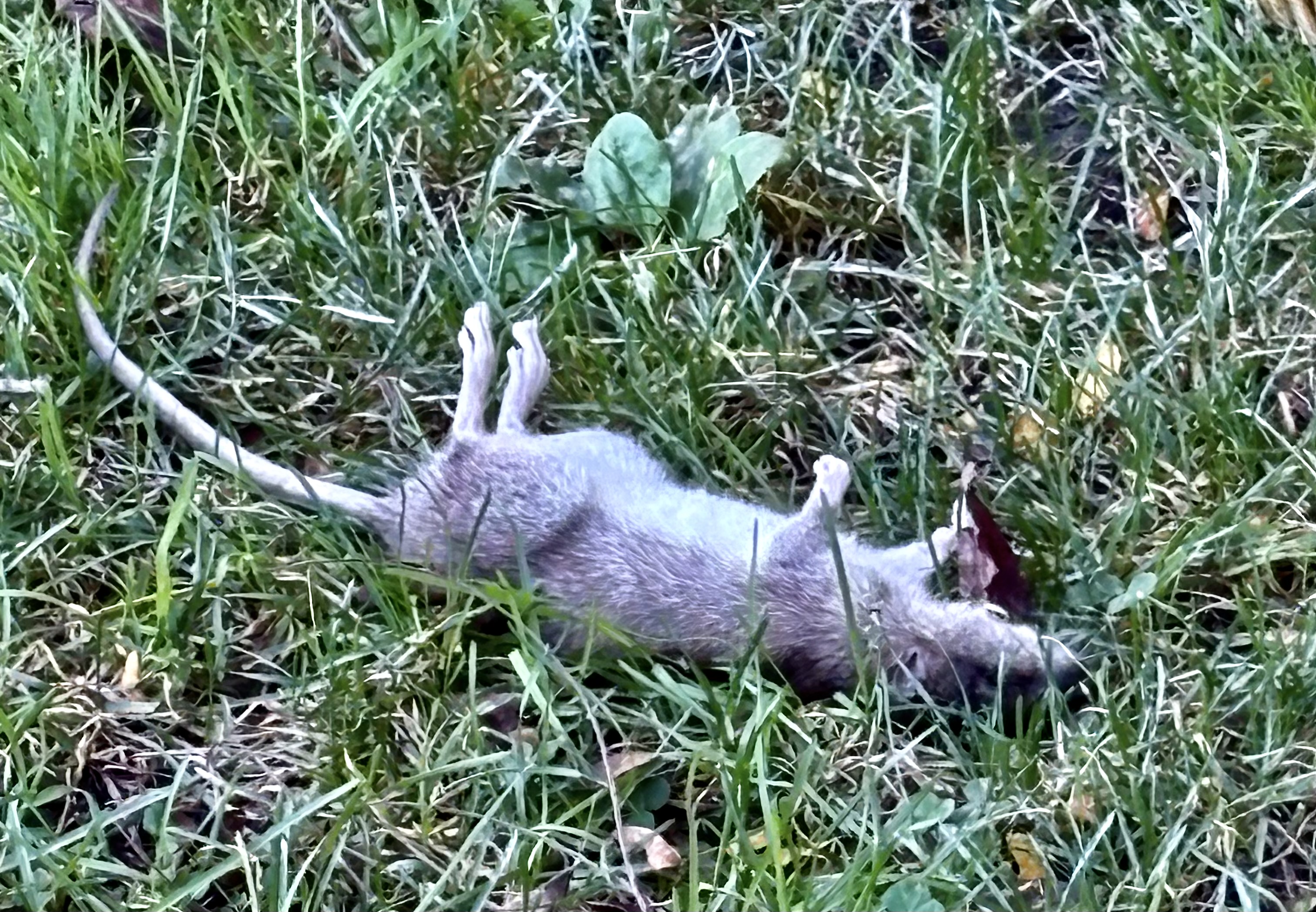
Later in the day, on our evening walk, I almost stepped on a DEAD RAT in the park, throwing terror into my dog-walking daydream.  

Dear god, what is going on?  A rat epidemic? Do rats still carry the plague? Rabies? Do we have vaccines for them? Trump would say don’t get those shots. Drink bleach. Take Intermectin. Isn’t that for parasites in pigs?
Oh, not again. Can’t I have just a few peaceful moments at the end of summer without that guy slamming into my thinking? 

Back in a voluntary meditative state to help ward off evil thoughts, I sat on a bench keeping vigil over the DEAD RAT to warn other dog owners. 

“Hey, yoo-hoo!” I shouted.

“Yes?”

“Watch out for the DEAD RAT over there by the hydrangeas!”

Ralph the dog was off his leash and just about ready to get a noseful of DEAD RAT. Ralph is a frisky German Shepherd with his senses still in tact. He smells a DEAD RAT a mile away. His grateful owner waved at me as he hurried over to pull Ralph away from the DEAD RAT.

Elsa, still unfazed, never uses her senses. She pretends her sniffer doesn’t work so she doesn’t have to chase squirrels. Her ears perk up when her name is mentioned but no other sound seems to register. And her eyes? Who knows what comes through those cloudy old pupils. Since she’ll eat anything, it’s dubious whether or not she still has a sense of taste. She had no sense of the nearby DEAD RAT.

But spatial awareness? Elsa has that in spades. She always knows where her little white body is in relationship to me. She is by my side, unleashed, whether we’re walking along a garden path or in wide open spaces.

In other words, she’s the perfect dog. 

As long as she doesn’t cozy up to a DEAD RAT.
Fear of Kudzu City

Fear of Kudzu City


The gardeners in the small neighborhood park I call my own, butchered the beauty out of the spring flowers and attendant bird migration. In their zeal to prune away the dead and diseased tree branches, they yanked out all non-native “invasive” species. This disrupted the seasonal pattern of our expectations. As I wandered through the other day, a neighbor with her spaniel in tow stopped me.

“What happened to our flowers?” She yelled across the boxwood.
“The gardeners mulched it all into last years’ compost.” I said. I don’t know her, but here we were joined by a sudden mutual experience.
“They went too far! Can’t you do something about it?” 

Me? I must have spoken with authority about the Chicago Park District’s program to remove invasive species and introduce native plants. As usual, I imparted knowledge based on next to nothing. Last summer as my allergies exploded, I read an article in the Chicago Tribune about the Park District planting more allergen-producing native plants, like goldenrod.  A passing employee of the Chicago Park District once educated me on the park’s introduction of native plants, especially those glorious hibiscus. And a neighbor who is a volunteer gardener at the Lincoln Park Zoo spends her summer eliminating “invasives”. That’s the extent of my knowledge on the subject.

“You can go to the Park District Board meetings and ask about it,” was my know-it-all answer.

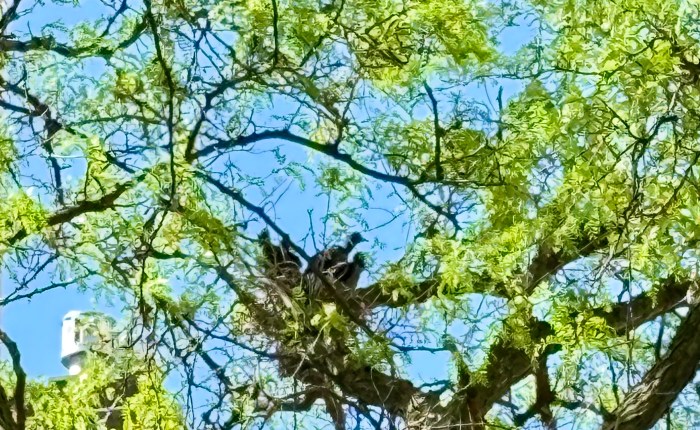
But Nature has once again reigned supreme in my city neighborhood. On my street, there is no human control over the crow’s nest and its four chicks that are flapping around in the branches. I watch them strengthen their young wings to fly out from their birthplace and fend for themselves. Wildlife never needs permission to be. But it does need protection.


The New York Times reported this week on one of Chicago’s best nature stories. The Lakeside Center at McCormick Place applied a treatment on its glass building to deter migrating birds from banging into it. Last year up to 1,000 birds died in one night at McCormick Place. This year, the deaths, due to the widow treatment, were down by 95%. Chicago’s unpopular mayor should take credit. For some of us this fact alone is enough to vote for his reelection.

Unfortunately there’s no treatment we can apply to protect ourselves from bumping up against the current man-made enemy that is called the United States of America. What can protect us from dirty air and water unleashed by industrial, vehicle and power plant toxins?

I envision a doomsday scenario, a post-apocalyptic environment like “the Last of Us.” Will my city’s native species die off and be replaced by invasive, toxic-loving kudzu? The White Christian Nationalists setting ecological policy have abandoned the Bible as their guide. Genesis 2:15, in all versions, clearly states we must tend to God’s creation.

NIV: The Lord God took the man and put him in the Garden of Eden to work it and take care of it.

KJV: And the LORD God took the man, and put him into the garden of Eden to dress it and to keep it.

NLT: The LORD God placed the man in the Garden of Eden to tend and watch over it.

CSB: The LORD God took the man and placed him in the garden of Eden to work it and watch over it.


NYT: An Illinois Building Was a Bird Killer. A Simple Change Made a World of Difference.


Election Distraction: Lincoln Park Hibiscus

Election Distraction:  Lincoln Park Hibiscus

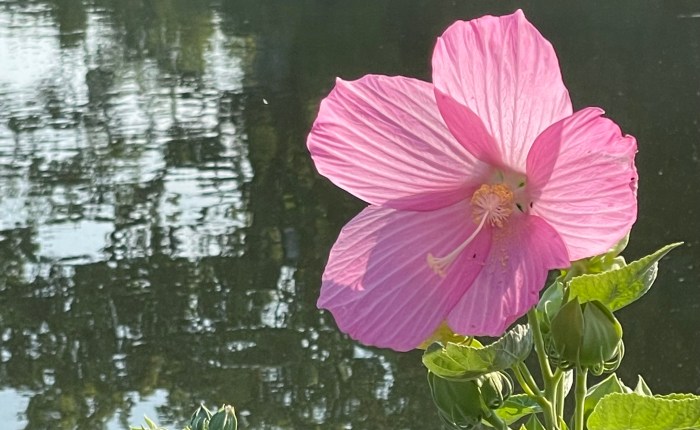
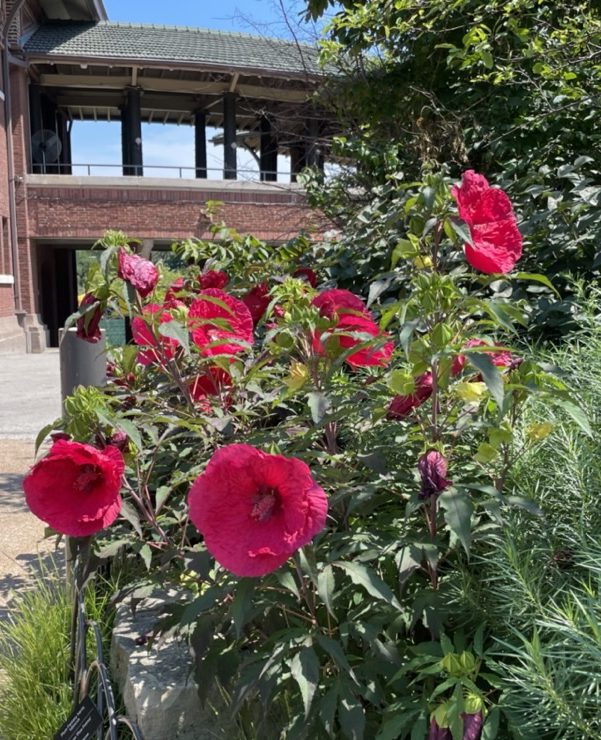
Rounding the corner by Cafe Brauer, the 115-year old red brick refectory on Lincoln Park Zoo’s South Pond, I stopped dead in my tracks at the sight of blooming Chinese-red hibiscus. Hundreds of blossoms the size and shape of CDs preened in the bright sun. They were onion-skin thin. I could practically see through them. I inched along the path flower by flower scanning each one for an answer. What. Were. They. Doing. There?

I’d rounded that corner hundreds of times in my life and had never seen those flowers. A woman in a dark green shirt marked with the telltale Lincoln Park Zoo logos wandered by.

“Do you know anything about these flowers?” I shouted.

“Yes, they’re Lord Baltimore hardy hibiscus.” 

“Were they here last year?”

“Nope. We cultivated them.”

She introduced herself as the head horticulturist at the Zoo and gave me a hibiscus primer. There are four species of hibiscus native to Illinois around the Zoo and the South Pond.

“Everyone thinks they’re tropical. We have a unique collection — the only accredited perennial herbaceous native hibiscus collection in the country.” 

On the way home, I spotted a couple I’ve known for years taking their afternoon walk. They informed me they’re thinking of buying a summer house in Michigan.

“What? How could you leave here in the summer? Did you know we have four native hibiscus around the South Pond and the Zoo?”

At the time, I thought this fresh information established the best reason to summer in Chicago. I doubled down on what I’d just learned. Without taking a breath I told them the hibiscus feed bees, hummingbirds and butterflies. Each flower on a hibiscus stalk lives only for a day or two, like a daylily. But, the plants keep opening new blooms from July to September. Garden Clubs from all over the Midwest send busloads of flower lovers to gaze at our hibiscus.

“You must walk by the pond and see them!”

That was the summer of 2019. I see them walking from time to time now, a little slower, a little quieter. A few weeks ago, I’d been in the zoo luxuriating in what I’ve come to think of now, five years later, as my hibiscus. I ran into my friends on the way home and fed them new information.

“Did you see the news?” 

“What news?”

There’s so much real news or breaking news these days they looked anxious.

“My friend Karen who volunteers at the zoo told me it’s in the paper today. Lincoln Park Zoo has just been named a National Botanic Garden!”

“Oh.”

“Yep. It’s a big deal. There are only two zoos in the country that are botanic gardens.”

“Oh yeah? What’s the other one?”

“Dunno. Maybe San Diego.”

I had no idea what I was talking about. The media and Time Out have touted San Diego plenty. So, I used this acclaim to put the best spin on our zoo.

“And the international Botanic Garden show will be in Chicago in summer 2027. First time its been in the U.S, in 27 years.” I said.

“Wow, that’s great.  Is that like the Chelsea Garden Show?”

“Yes! Only better.” 

“Well, we’ll see you around. We need to keep walking.”

“Ok. Great to see you. Glad you didn’t buy that summer house in New Buffalo.” 

“Oh, we did buy it. Stayed for a few weekends before the pandemic hit. Tried it that summer for a few weeks. Mistake. Too lonely. You’re right. Theres’s nothing like Chicago in the summer.”

“Ah. It’s the flowers, right?”

“Maay-bee”.

Ozzy the Arhat by Regan Burke


Do the dead always visit us in the morning? I wake up listening for the click-clacking tap-dancing, rat-a-tat across my hardened floors. Ozzy had well-padded soles, wide feet and solid toenails meant to root out rats and badgers from their earthen dens. No Scottie-level potted plants ever made it past the first day, neither inside nor on my third-floor balcony. His diggers instinctively, fanatically worked their way into the soil to get to something, anything that proved his worth, duty done. Satisfied with nothing more than a dirty nose and paws, he gave me a message: don’t worry, I’ll protect you from any danger, man or beast.

At the Takashi Murakami exhibit in Chicago’s Museum of Contemporary Art, I wondered aloud to my 20-year-old grandson, CJ Kelly, why the artist painted so many colorful frogs at the feet of the arhats. CJ mindfully revealed those are the arhats’ toenails, not frogs. Ah, toenails. Murakami’s arhats are Buddhist spirits who hesitate between two worlds, the physical and the not, to comfort suffering earthly beings. His bulbous toenails are a tribute to the noble path of those enlightened ones whose feet are moving them through their death and decay. The parade of toenails is Murakami’s day-glo gratitude for arhats who stop along the way to ease our sorrows.

Murakami called his Chicago exhibit, The Octopus Eats His Own Leg, based on an ancient Japanese adage that an octopus eats its own decrepit limb to save itself from death rot. A new leg grows back, the octopus is healed and lives a long and healthy life.

In the exhibit, the 33-foot-long painting, 100 Arhats, has 1,000 intricately painted toenails. I misinterpreted the toe protectors, thought they were frogs. After all, how could toenails mean so much to anyone but me? I harbor an unspoken repulsion of human toenails. Summer sandals expose these keratin plates sitting atop ugly toes that hardly ever match each other—some curled under, some straight, some turned outward, some inward—all on the same foot.  Toenails are often fungus-rotted discolored thick globs that women hide with colorful paint instead of covering with cool shoes. God clearly missed the boat in his design of the human toe apparatus.

But Ozzy’s coal-black, perfectly formed, hardy toenails witchy-curled out of his all-business paws, ever-ready for the hunt, the prowl. At rest, his legs stretched out before him showing off his toenails as if he’d just had a pedicure.

His body turned in on him overnight. Like the octopus, his system ate up his dying kidneys and liver but left a beleaguered heart that had to be put to rest. I now have my own arhat who will walk me through the sound of silent, unseen toenails until the hard margins at the edges of grief fade into the path.

murakami_portrait
Takashi Murakami in front of his epic work “The 500 Arhats.” (Courtesy MCA Chicago)


Change Your Life with Lima Beans

Change Your Life with Lima Beans

     When I put the light green kidney shape in my mouth, my tongue moved it to my baby molars, gingerly munching up and down, side to side, until I felt a mushy bean pop out of the slimy skin onto my tongue. I gasped, and my reflexive inhale involuntarily pulled the glob to the back of my throat. I gagged on the paper-like skin, exhaling the sodden lump back through the front of my teeth and out onto my plate. My little five-year old body sat at that table until “you eat those lima beans.” After everyone went to bed, I dumped the loathsome things in the garbage. That night I vowed to forever hate lima beans and thus seeded a recipe for an unyielding, uncompromising, black and white life.

     Whatever possessed my mother to force me to sit at the table of uneaten lima beans for hours? Was it a doctor who told her that her children needed to eat vegetables? Or perhaps she was trying to introduce exotic foods into our menu so she could show off her three little girls and their sophisticated palates.

     My sisters and I all hated vegetables. The older, Mara, would feign putting a forkful of beans in her mouth with an air of superiority, a competitive streak born in her and never pruned. Erin, the youngest, figured out how to put her vegetables in a neat pocket formed by her napkin and dump it in the trash while no one was looking. Hiding unpleasant situations is perennially rooted in her life.

     When the self-actualization movement bloomed in the 1960s and ’70s with books such as The Prophet, I’m Ok You’re Ok and Be Here Now, I cultivated my deeper self by rooting out my hatred for lima beans. I tilled the soil for a backyard garden in Toms River, New Jersey, and planted the formerly-detested vegetables. When they sprouted, I thought the light green shape hanging from the stem was a single bean. After a few weeks, bumps appeared under the thick skin of the seed pod. I diligently hosed away aphids, leafhoppers, and mites, but I was sure my crop was deformed. Consulting Rodale’s Basic Organic Gardening book, I learned the bumps were actually beans – four lima beans per pod. After a few months, I pulled the bean pods from the vines, broke them open and started eating the sun-drenched crop right there on my knees in the garden. My neighbor flew out of her back door and yelled Stop! You can’t eat raw lima beans! They’re poison!

     Uh-oh.

     This was a new reason not to eat them, cooked or uncooked, but I was determined to use lima beans to crack open the hardened space between “what is” and “what could be.” I brought an apronful of beans inside, cooked, salted and buttered them and ate the day’s harvest for breakfast. They were good.

     Abiding in the distasteful takes practice. The once indigestible lima bean aerated my closed mind and paved the way toward a paradise of tasty, fresh vegetables.