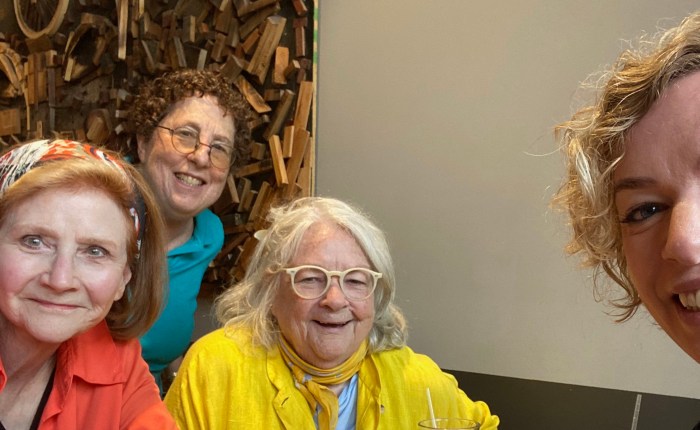
Julie Hamos announced her upcoming “genealogy” trip to Hungary as she was driving me home recently. She travels to unusual places (like Iran) but this seemed more weighty than a curiosity tour.
Indeed I have known Julie as a Hungarian refugee but she’s been so much a part of the political fabric in Illinois for so long, I forgot she has a pre-American history that never comes up in conversation.
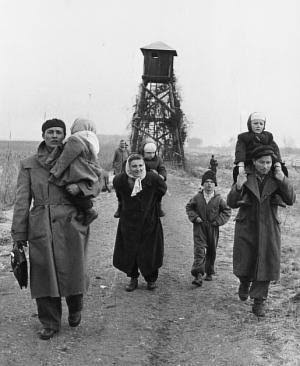
“My parents, and I walked five miles in the middle of the night from Hungary to the Austrian border. My three-year old brother, Jim, was carried. It was rainy and muddy. I was seven.”
“Oh, Julie, I never heard this story.”
In 1956, Holocaust survivors Agnes and Gary Hamos left their ancestral home in Budapest to escape the Soviet communist government. Hungarians were not allowed to leave the country. There were no exit visas. They snuck across the border into an Austrian refugee enclave in the dead of night with their children, Julie and Jim.
After the Hungarian Revolution of 1956, 200,000 Jews fled the country. About 9,000 went to Israel while others settled in the United States, Canada, Australia, Western Europe, and Latin America. The Hamoses made their way to Cleveland.
“Jim and I and another refugee friend are taking a trip to Hungary to retrace the five miles our families walked when we fled.” Julie said.
With Julie’s permission, I’m adding a few text messages that Julie sent to friends while on her genealogy tour. I’ve never known someone with a story like this and reading over Julie’s words still brings me to tears.
Americans are faced with a new commitment to safeguard the unique freedoms the Hamos family and millions of others have risked their lives for.
Freedom is, has always been, worth every step.
Friday. This has been an incredible visit to Budapest – no happy tourist attractions on this trip. Today we went to the large Jewish cemetery where we found, unearthed, cleaned, and pieced together the grave of our friend John’s great-grandmother (his other relatives at that cemetery were buried under rubble.. but we engaged in a treasure hunt to find them.) When we leave here tomorrow and go to the countryside, we’re going to find my ancestors and do the same thing.
Then we went to the Holocaust Memorial Center which I never knew existed. It was established by the government in 1999 and of course became controversial because originally it whitewashed Hungary’s role in the Holocaust. That’s changed and it’s a true history lesson with real depth about growing antisemitism and then mass extermination. So moving — with lots of lessons for today.
Tonight we had dinner with our only living relative in Hungary who invited her husband, son and his girlfriend to meet us. Their other son and daughter left Hungary under Orban, but tonight we also talked about their excitement and hope for Magyar – and what the election had been like. Fascinating.
Tomorrow we go to the border to re-live the Hungarian revolution!
Saturday. Today we went to the border close to where we escaped. We don’t know from our parents that exact route we followed, through muddy cornfields, to Austria.
We do know a smuggler was paid by Grandma and he met our train and then took us to his house to rest before nightfall. Today we visited Moszonmagyarovar which was the end of the train line and his home town. We also went to the train station where we got off that train 70 years ago.
The bridge at Andau (a James Michener novel) was the bridge used by many of the 70,000 Hungarians who escaped there. We did not do a long walk to re-create our escape (since those long—ago fields are unknown, and likely private). As our own symbolic experience, we walked across the bridge at Andau from Hungary to Austria. The bridge has been rebuilt and has graphic depictions of families pointed toward Austria. It’s the site of a memorial to the Hungarians who dared to make the escape.
Halfway across the bridge, at the border of Hungary, I surprised Jim. One of our family lores has been about little 3-year- old Jimmy’s white teddy bear. He was allowed to bring it (he was carried on the long walk) but we kept seeing searchlights and hearing gunshots through the night, so our parents threw it away – in the mud!- so we wouldn’t be discovered (along with Mom’s raincoat which was too shiny, they thought).
Halfway across the bridge, I surprised Jim with a small white teddy bear and a note that said “This time I made it all the way across the Hungarian border!” We both bawled – it’s a great video. Funny thing, he had talked about looking for a white teddy bear nonstop these last 24 hours, so it really was a big surprise.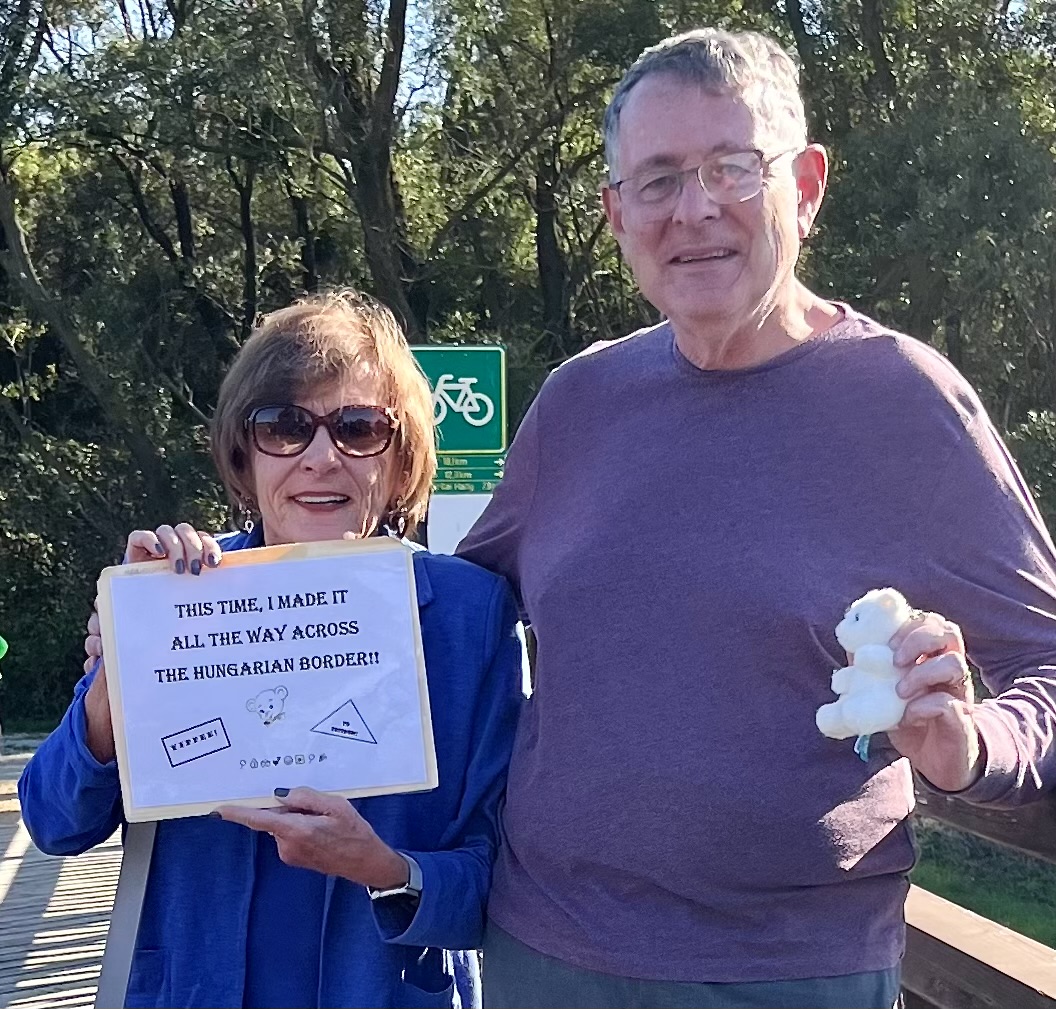
Staying at a “resort” with a spa and gourmet food at Andau. Great irony.
Tuesday. Hi all. The last two days in the countryside of Hungary have been meaningful and so, so emotional.
Yesterday we went to Paszto, Dad’s small home town. There the Holocaust exterminated almost everybody – except my dad and his brother who were in forced labor camps. Two grandparents died there and their names are on a memorial to Holocaust victims (the type found in every village in Hungary, it seems). We searched and found the graves of a great-grandmother, a great-grandfather, a great-great-grandmother and two great-great-grandfathers. Unbelievable! This was searching through and cleaning many ancient graves, and then placing our pebbles down on each grave in their honor.
Jim and I had an entourage of 9 people – our 2 traveling friends, 3 historians he had met online, the 2 remaining cousins we had met the other day in Budapest who took off a day to join us because they/we didn’t want to let go, and 2 friends from 77 years ago when I lived in Paszto. We got to really meet everyone over a group lunch.
I was born in a Budapest hospital, but Mom, Dad and Grandma were living in Paszto because Budapest was not habitable after the war. So I lived there to age 3. These two friends were my age as small children and we’ve connected over the years. It was fantastic to catch up with them. (BTW: my Hungarian is getting better by the day… ) At my request, we went to the house where we had lived and the lady who lives there now insisted on inviting me in to give me a tour.
So yesterday was quite a day. Lots of memories, and a real recognition that I wouldn’t be here without all of these life experiences and ancestors…
Today we drove to another part of Hungary with another historian (and distant cousin of our friend John). We went to two other cemeteries searching for Mom’s family. We found the graves of 2 great- grandfathers, while searching for more.
We also stopped at two train stations where Jews had been rounded up to be put in cattle cars to be transported to Auschwitz. We’ve seen the scenes in movies – so very sad. They have plaques in their honor, that’s it. I cried.
Tomorrow Jim and I go on to Romania – then part of the Austro-Hungarian Empire. Jim arranged tours with two different genealogists. My Grandma who lived with us all her life – a love of my life! – was born there. We’ll be looking for her large family.
It’s an amazing trip, everything we had planned (Jim mostly). It inspires lots and lots of thoughts and feelings about the tragedy of the Holocaust, the meaning of life, and about family. Whew
Love to all.
Friday. We’re in a beautiful little town called Oradea in Romania. Yesterday was bittersweet. Our guide for the walking tour took us to the Jewish sites and we learned about the impact of the Holocaust here.
There were about 30,000 Jews here in the 1930s-1940s. During the WWII period, antisemitic laws were passed, but the Jewish community was successful and pretty assimilated here. And then….in May 1944, a decree came down that every Jew had to walk away from their homes and possessions, and move into a cramped ghetto. Everyone!! They then interrogated some people and beat them to have them divulge where they hid their wealth. By the end of May and early June, they boarded everyone in cattle cars to ship them off to Auschwitz. In one month! Their Romanian/ Hungarian neighbors and friends stood on the sidelines and jeered. Only about 2,500 victims survived.That broke my heart yesterday… even as we enjoyed much of this lovely town.
Today was our last day. Jim had hired a guide to take us to 3 small villages where our Grandma’s family from at least 1850 had lived. One village had the Jewish cemetery and we searched mightily for our family’s graves (Jim will continue this cause we are convinced a few are there, and we now see the numbering system; he is determined to track down the cemetery register with the Jewish community.)
A sweet experience was going to Grandma’s tiny village, then called Papfalva and now Popesti, which has fewer than 2,000 residents. Hers was the Schwartz family with 12 children. Our guide wondered whether a senior would remember any descendent of this family who remained there, even for a while. We drove around until we saw an old guy in a wheelchair. His wife came out and offered to take us to the nursing home where the two oldest residents lived. This is hysterical, right? Sure enough, the nursing home agreed to bring them out. The man is 93 years old, his wife a little younger.
They searched their memories for a Jewish family named Schwartz, but no luck. It was adorable.They took a photo with us. For Jim and me, there was something spiritually very exciting to walk in the footsteps of our Grandma in this tiny village. She lived with us all our lives and was very important to us. So, we’ve experienced both heartbreak and joy in Romania.
Tomorrow we will drive toward Budapest for our flight home on Sunday. We will spend the afternoon in a town near Budapest that is a UNESCO-listed artist village.
Talk to you at home. Love
Julie Hamos has had a long career as policy advocate, public interest attorney, state legislator and state agency director. She was a young lawyer on the Subcommittee on Oversight of the U.S. House Ways and Means Committee in 1975, served as Illinois State Representative from 1998 for over 11 years, was a fellow at the Harvard Kennedy School of Government, appointed Director of the Illinois Department of Healthcare and Family Services. Julie has a J.D. degree from George Washington University. She continues to serve the public on boards and commissions too numerous to list.