State of the Union? You’re Kidding, Right?

FeaturedState of the Union? You’re Kidding, Right?

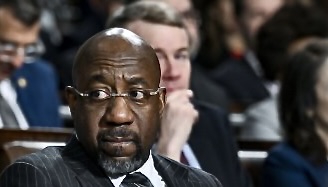
Why did so many people ask me about watching the State of the Union speech? And not just me. Local news reporters asked people on the street.  I’ve Had It Podcaster Jennifer Welch asked Resister Senator Chris Murphy of Connecticut if he was going.

“Well, hell no, I’m not going. He’s made a mockery of the State of the Union. And we don’t need to be a backdrop to his histrionics.”

Honestly, it’s not like the speech was the U.S. Women’s Hockey finals at the Olympics. It was Donald Trump’s State of the Union. The news about the number of Democratic Members of Congress and Senators not heading over to the House Chamber in the Capitol was interesting. However, it was expected. We didn’t need to see breaking news headlines about each boycotter pop out of our phones all day.

Resister Senator Raphael Warnock of Georgia preached at Trinity Church in Chicago Sunday. His sermon was titled I’ve had enough. Using the Hebrew Bible’s Isaiah, he reminded us of wicked kings. These kings and wannabe kings erase anything that looks like diversity, equity, and inclusion. 
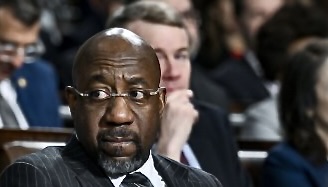
“Don’t act like this is politics as usual. This is not just politics, it’s spiritual wickedness in high places. Haven’t we had enough?”

Senator Warnock said God hates solemn assemblies that normalize this political spiritual wickedness. God hates?

“Wickedness in our lifetime is being facilitated and approved and applauded by people who are sitting in somebody’s church this morning,” preached Warnock. I’d hate that too if I were God.

Last summer, Speaker of the House Mike Johnson gathered some of his boys in prayer. They met in the basement of the Capitol. They emerged from their subterranean huddle to vote on the bill that kicked 15 million people off health care. Warnock questioned who those boys prayed to. Who did they talk to?

Senator Warnock did attend the State of the Union speech. Good for him. His ministry of solemn presence condemns the MAGA religion of those boys in the basement.

Trinity Church’s pastor, Rev. Dr. Otis Moss III and Rev. Dr. Raphael Warnock are alum of The Auburn Senior Fellows. They are two of twenty-five top leaders who bring justice-centered faith into the public square. An unprecedented cohort of changemakers, they were brought together by Auburn Seminary in New York City. You’ll see them in places like Minneapolis and Alligator Alley, No Kings rallies and detention center protests. No matter your religion or no-religion, if you ever get a chance to see one of them, go. Just go. They are listed here

The titles of Jennifer Welch’s podcast I’ve Had It and Warnock’s preaching I’ve Had Enough are misleading. Yes, they’ve had it, had enough. But they keep going, keep speaking out, keep organizing, keep preaching. 

Because they haven’t had so much that they quit. 
 

The Peace of Non Closure

The Peace of Non Closure

A new concept popped up at the outset of a recent anti-racist training session. Among the familiar “courageous-conversation” ground rules, the leader added, “We commit to non-closure. (pause) Right?”

Whoa, really? My fellow attendees all yes’d the speaker as if they knew this already. I thought I must have ignored an inboxed message, or, in my long season of retirement, missed another new corporate buzz word. Non-closure.

On the brink of Juneteenth, the half-day session promised to address the backlash to Diversity, Equity and Inclusion programs and policies. That morning all of nature said yes! to Chicago. I wanted to say yes! too, and take a long walk in the park with my dog. Instead, I reluctantly ambled over to the dingy conference room in a church basement near my home. Anti-racism churned inside me and I had no organized outlet. I was curious to see if there was anything new.  Answers.

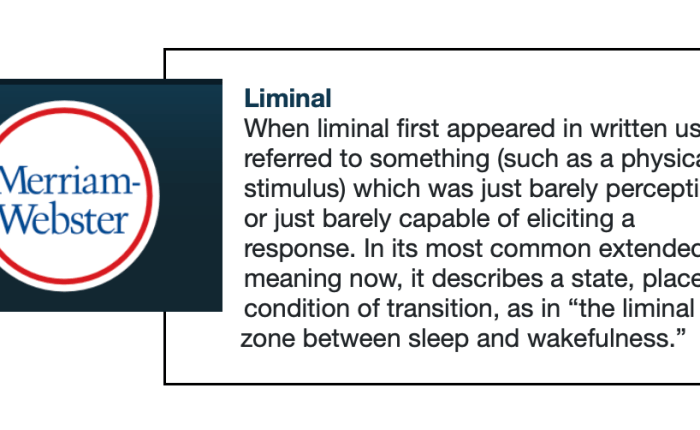
But here I was, swallowing a commitment to non-closure. No answers, no conclusions, no plans, no fantasies of what might be. Of the numerous anti-racism trainings I’ve attended since the murder of George Floyd this may be the first time I recognized that it’s safe to be in that liminal space of unknowing, of ambiguity. There would be no meaning-making, no sense-making, no closure.

Facilitators from Crossroads, an antiracism training organization, gathered us together, not to tell us what they know, but to find out what we know. They see, feel, but even more, they sense, not just a political backlash in anti-racism work but, an active softening in community and personal commitment. 

The air is leaking out of the tires.

This week Donald Trump and I had birthdays. We’re the same age. Several friends asked me how I planned to celebrate.

“I don’t really celebrate my birthday.”

“Why not?” Asked my favorite poet.

I had no answer. 

He asked about my writing.

“I’ve been thinking lately I may not write anymore.”

“Why?” He asked.

Another why question. And no good answer. Is that a failing? No answer? Does it mean I’m not sufficiently self-reflective?

Liminal, from the Latin, “threshold” puts time and space betwixt and between. On liminal days, birthdays dangle off the edge of time. The past no longer haunts me, the future no longer calls me. I neither wait nor wonder. Indeed, birthdays are liminal days.

Anthropologists say that memory disorder, pandemic uncertainty, authoritarianism, virtual reality, border disputes, old-age anxiety, environmental issues, and gender trouble put society in a self-protective liminal state. Whew! Thank you God. This beloved gift  allows me to live on the threshold where social norms, like answering the question “why” or reading every damn email are temporarily suspended. 

In the ninth grade, when I was consumed with past and future popularity by any means, I was inconveniently tormented with one living and one dead poet: T.S. Eliot and Alfred Lord Tennyson. A lot has been written about the spiritual liminality, the non-closure of their work. It’s only now (or is it?) that I see why these vexing lines captured me:

Tennyson’s Ulysses:
Yet all experience is an arch wherethro' 
Gleams that untravell'd world whose margin fades 
For ever and forever when I move.
TS Eliot’s Four Quartets:
Time past and time future
What might have been and what has been
Point to one end, which is always present
.