God! How I love WebMD! This online ingenious, comprehensive, and reliable health and medical source has saved me from many time-gnawing trips to the Emergency Room.
Last week I found myself at the bus stop on State Street near the Hilton Hotel with a “Netroots Nation” Convention credential swinging from my neck. I have no memory of the previous four hours. Zilch. I’d planned to attend the Netroots Nation Convention at the Hilton; the swinging credential assured me I’d at least registered.
Are you thinking I may have experienced an alcoholic blackout? Nope. Those days are long gone. I haven’t had a drink in forty-five years. Arriving home around 9:30 pm, I dove right into my laptop and searched for “lost memories”, which returned a description of something I’d hoped hadn’t happened to me:
“Losing time, or having large blocks of time for which one has no memory is a symptom of Dissociative Identity Disorder. Sometimes a person will lose so much time that they “wake up” in an unfamiliar town or place. This is called Dissociative Fugue.
Uh-oh. That sounds like the multiple personalities portrayed by Sally Field in the horror movie, “Sybil”. I’d hoped I didn’t murder anyone, or go to some stranger’s hotel room whilst in a fugue state. I searched further—typed “sudden memory loss”:
“Transient global amnesia, TGA, is a sudden loss of memory. It’s an alarming but harmless condition. Symptoms usually last for hours and then memory returns. It has no lasting consequences. Doctors aren’t sure what causes it. It’s more common in people over 50 and with a history of migraines.
Whoa! That’s me! Thank you WebMD and for the good news:
“TGA …is not caused by a neurological condition like epilepsy or stroke. With TGA, you remember who you are and recognize the people you know well.
Netroots Nation’s mission is “to bring together online citizens across America, inject progressive voices into the national conversation, and advance the values of justice, equality, and community in our nation’s politics.” Their annual convention in my hometown came at the right time for my aging activism. Chicago had just elected a progressive, smart, kind-hearted new mayor, Brandon Johnson. I believe with my whole heart that within a few years, Chicago will be a role model of common solutions for all American cities. At the convention, I’d hoped to replenish my quiver’s rah-rah-cis-boom-bah that had fizzled since Mayor Johnson’s inauguration.
In the late afternoon of the TGA incident, I planned to attend an event in the Waldorf Room, “Solidarity Across Differences: Organizing When We Disagree.” There’s no evidence I was there. But I was somewhere. My little black-and-white pocket notebook has three new quotes in my handwriting:
“There’s a collective out there that wants to shrink the hope of the possible.” Emma Tai, Director United Working Families—the grassroots organization that helped elect Brandon Johnson
“Chicago is a town that’s gonna show the world what the future looks like.” Randi Weingarten, President American Federation of Teachers
“Safety is not blue lights.” Brandon Johnson, Chicago Mayor
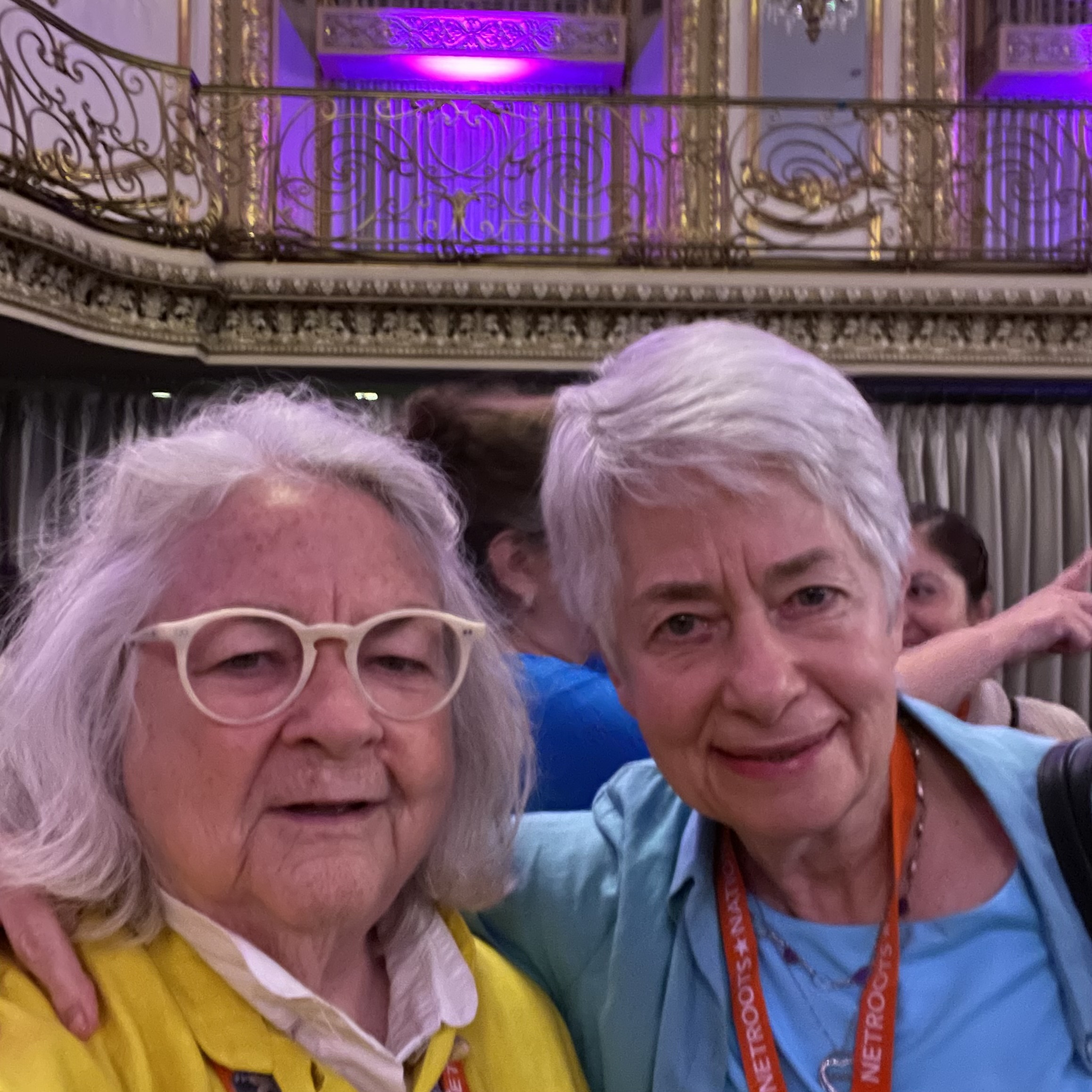 My iPhone displays several close-up photos of Mayor Johnson giving a speech, two selfies at the food table, and one selfie with Heather Booth a long-time political activist from Washington, DC. With the exception of the food table, these are exactly what I would have photographed, had I been in my right mind, proving once again how competent my online doctor, WebMD, is.
“…in TGA the patient cannot acquire new memories but otherwise can function normally; personal identity is retained…”
Whew! What a relief; between the notebook inscriptions and my photos, I have proof I acted my best self, and confirmation I had all the symptoms of an episode of TGA, Transient Global Amnesia.
Do I feel safe? Absolutely. Dr. WebMD tells me there’s rarely more than one occurrence. And no one has come forward to tell me I acted like Sybil.
At least not yet.

 Regan Burke