Is That a Rat?

FeaturedIs That a Rat?

Summer 2025 came to its 80 degree sunny end on September 22 at 1:19 pm. The autumnal equinox. About that time, the gardener at a building near Whole Foods was exchanging old for new in sidewalk planters. The red summer geraniums and green ferns were dug up, tossed out and replaced with lavender chrysanthemums and those curious purple cabbages. A potted plant gardener myself, I was glued to the gardener’s performance as I walked slowly by with Elsa. Two robust rats promptly jumped out of a planter onto the sidewalk so close I think they grazed my shoes (ew!) before scurrying off. Elsa’s rat-catcher terrier pedigree neglected to alert us. She was unfazed, didn’t flinch. Me? I screamed bloody murder. The gardener laughed. I suppose gardeners meet rats in the city all the time.

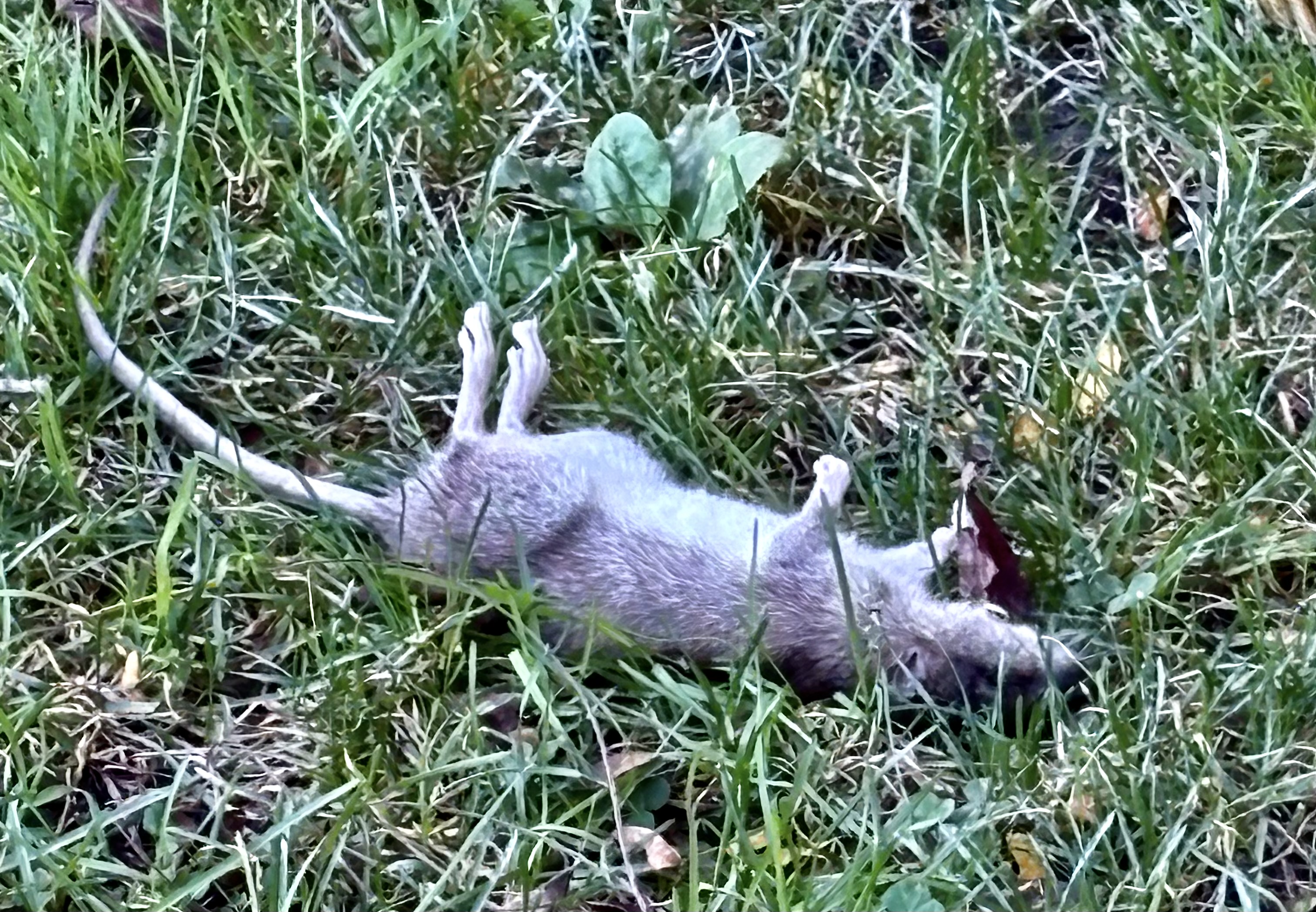
Later in the day, on our evening walk, I almost stepped on a DEAD RAT in the park, throwing terror into my dog-walking daydream.  

Dear god, what is going on?  A rat epidemic? Do rats still carry the plague? Rabies? Do we have vaccines for them? Trump would say don’t get those shots. Drink bleach. Take Intermectin. Isn’t that for parasites in pigs?

Oh, not again. Can’t I have just a few peaceful moments at the end of summer without that guy slamming into my thinking? 

Back in a voluntary meditative state to help ward off evil thoughts, I sat on a bench keeping vigil over the DEAD RAT to warn other dog owners. 

“Hey, yoo-hoo!” I shouted.

“Yes?”

“Watch out for the DEAD RAT over there by the hydrangeas!”

Ralph the dog was off his leash and just about ready to get a noseful of DEAD RAT. Ralph is a frisky German Shepherd with his senses still in tact. He smells a DEAD RAT a mile away. His grateful owner waved at me as he hurried over to pull Ralph away from the DEAD RAT.

Elsa, still unfazed, never uses her senses. She pretends her sniffer doesn’t work so she doesn’t have to chase squirrels. Her ears perk up when her name is mentioned but no other sound seems to register. And her eyes? Who knows what comes through those cloudy old pupils. Since she’ll eat anything, it’s dubious whether or not she still has a sense of taste. She had no sense of the nearby DEAD RAT.

But spatial awareness? Elsa has that in spades. She always knows where her little white body is in relationship to me. She is by my side, unleashed, whether we’re walking along a garden path or in wide open spaces.

In other words, she’s the perfect dog. 

As long as she doesn’t cozy up to a DEAD RAT.

Chicago’s Urban Wildlife: Embracing Pluralism and Nature

Chicago’s Urban Wildlife: Embracing Pluralism and Nature

All over early-morning Chicago, garbage trucks back in and out of alleys using rapid beep-beep-beep signals announcing their hulking presence. Elsa the dog and I are indifferent to this annoyance as we take our morning walk. But in mid-April, we both jumped to attention. We heard what seemed like a hundred garbage trucks backing up. The wildly unfamiliar bellowed from a block down the street.

“What’s going on Elsa?” I shouted down to my agitated Westie on the sidewalk. All of a sudden two honking Sandhill Cranes flew through the center of the street below the treetops. Their wingspan swooped past us from sidewalk to sidewalk as they glided and bellowed toward Lake Michigan. 

Elsa flew into a barking rage. I lost my breath. My knees buckled. The Sandhill Crane is an ancient animal whose sole purpose is entertainment.

I love these four-foot high red-headed trumpeting birds. I once traveled to the Platte River on the edge of Nebraska’s Sandhills for their spring migration. My friends and I joined serious birders on the 5:00 am riverbank to view 600,000 roosting Sandhill Cranes. Their summer and winter homes are the northern and southern edges of the Great Plains. They are North Americans, Midwesterners.

Where did this duo come from and where were they going? They were likely in a flock following the Great Lakes Flyway, the migration route to their summer home in the boundary waters between the U.S. and Canada. Perhaps they were lured away by a mischief of rats feasting on the overflowing garbage bins in the alleys of nearby restaurants. Did a garage truck disturb their hunt? Whatever the story, I am deeply grateful they strayed from the flock and flew into my morning fugue.

Fugue? Yes, lately every morning I awake in a seemingly altered state. Oh, I tend a regular household routine, brain-fogged by radio news from the psycho-battleground that is my home country. Any diversion is welcome, particularly wildlife making its way through my city street.

But diversions, like bird spotting, are fleeting. The pluralistic society we’ve known as democracy is under siege. Pluralism, a word as ancient as the Sandhills themselves, one we learned in middle school, has been displaced of late by DEI or Diversity, Equity and Inclusion. DEI was corporate America’s answer to the communal guilt stemming from the sight of George Floyd’s on-air murder. The lofty goal of transforming Human Resource departments into offices of Diversity, Equity and Inclusion crashed and burned on the heels of Donald Trump’s name-calling presidential candidate Kamala Harris a “DEI” hire. Little did we know then, the summer of 2024. The weaponizing of DEI was not a diversion. Instead, it was a tactic in a larger strategy to destroy pluralism and make America White and Christian.

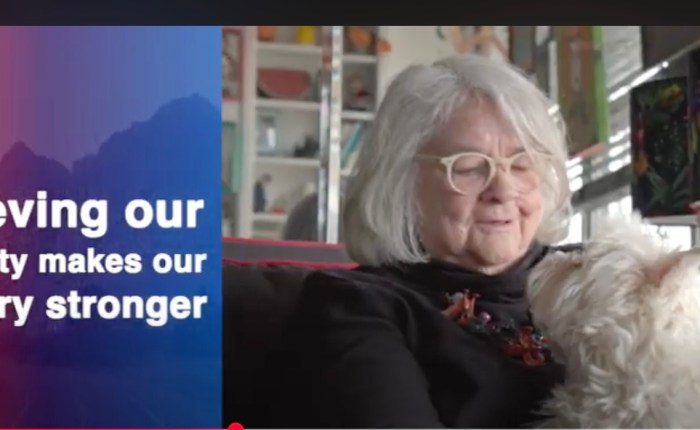
Interfaith America, the nation’s premier interfaith organization, has come to the battlefield now — taking the case for pluralism to the streets. A giant digital billboard in one of the most diverse locations in the country, Times Square, New York City, shows Interfaith America’s devotion to American pluralism. The message: diversity makes our country stronger. I’m in here, proud to represent my cohort, old white ladies with their dogs. Take a look.

Black Hole Jesus

Black Hole Jesus

First Holy Communion is a right-of-passage ceremony in the Roman Catholic Church where a seven-year-old is initiated into eating the body of Jesus Christ. I learned the elements of the Catholic service, the Mass, with my classmates in the second grade. The priest transforms the bread into Jesus’ body and the wine into Jesus’ blood. The wine, the blood of Jesus, is reserved for the priest. We the people eat paper-thin white tasteless wafers, the body of Jesus. Catholic children all learn that after we make First Communion, it’s expected we’ll eat the body of Christ every week for the rest of our lives.

“Let it dissolve in your mouth,” the nuns instructed, “It’s a sin to chew the body of Christ. And don’t touch it!”

The pomp and ceremony of my First Holy Communion overshadowed any eww!-ness related to eating Jesus’ flesh. Prim little girls wore white crinolined lace dresses, white shoes and socks, white cotton gloves and angelic white veils. Like brides. Squirmy spit-polished boys wore ill-fitting white suits and ties. Children sang a Gregorian chant, Tantum Ergo, in Latin. The ceremony shined as if the light of heaven broke through the ceiling and blessed us with all good things forevermore.

In the early grades, if anyone questioned how Jesus’ body and blood changed from bread and wine, there was only one answer.

“It’s a mystery,” they said. 

I fell hook line and sinker into this ethereal mystical world of Jesus-eating. He was inside me, outside me, all around me, all the time. Jesus, my imaginary friend, was under the bed with me when my parents’ raging drunkenness woke me in the night. And when long-fingered nightmares reached their talons in through the screens, Jesus saved me.

At Jesus’ Last Supper (and his First Communion) before he was tortured and murdered, he broke bread, sipped wine and said, “The is my body. This is my blood. Do this in remembrance of me.” Surely Jesus and his father knew what a theological shit storm this would cause for all time. There is no earthly world where anyone could possibly digest all that’s been interpreted by those simple words. 

In the upper grades, Catholic clergy gave fuller answers for Holy Communion, the Eucharist, they called it. Explanations always ended with, “It surpasses understanding.” When I joined a non-Catholic Christian church in my twenties, I learned that Protestant Communion is a public display of piety, not a mystery at all, a non-binding sacramental tradition.

Jesus, like the simple chassis of a computer, hides his infinitely more complex workings from the young in faith. It’s good he came as a baby. People love babies. I would have settled for a dog since I love dogs. This human Jesus soothed me as a child. In the second half of life I’m soothed by and troubled by the man or the myth at the same time. Jesus, a synonym for love, is comforting. His hidden complexities are troubling. Questions arise, starting, but never ending with, “Are you real?”

In Christopher Nolan’s movie Interstellar, a concrete love story moves in and out of a celestial black hole. A black hole forms when a star collapses in on itself, eventually creating a singular point of irresistible gravity. All matter, light, space and time are sucked into it and all instances of time become the present moment. 

These days, at my Presbyterian church, I sit motionless at traditional Communion, the Eucharist. When I hear the minister say Jesus’ words ‘do this in remembrance of me’, if I’m aware, I contemplate the past as present, as if in a black hole. The story of the Last Supper reminds me to honor the original Twelve, and others, who were in the room where it happened. They come through a black hole to my pew, in the hope that I see that the whole of the story is swallowed up and Jesus is the present moment. 

The veneer of the Communion tradition, like the computer chassis, hides the paradox of a simple complexity. Non-traditional Jesus, that black hole of pure love, that present moment, issues the most complex inhuman commandment, ‘love your enemies.’

Winter Rabbits in the City

FeaturedWinter Rabbits in the City

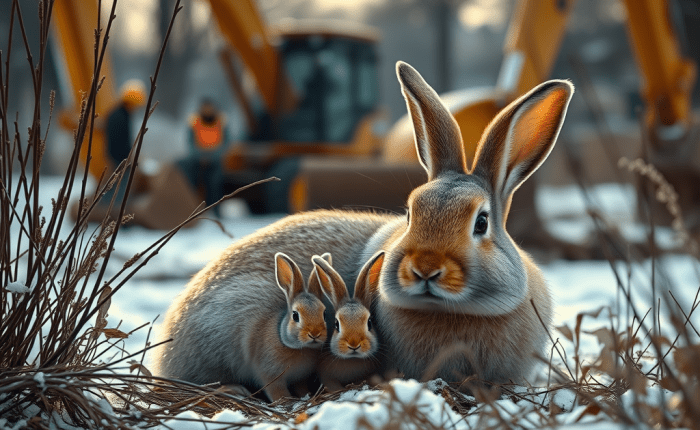
Rabbits are born and live out their stories in the same patch their entire lives. The lineage of the fat rabbit I see in the spring may have begun sixty-seven generations back, when the park was first established. After a month or so of observing her in April, she allows me the honor of seeing her two small cottontails, the next generation. They’re never in sight for long before they scurry away to the low brush.

My dog Elsa has old eyes. They may catch the bunnies on the run. Yet, her little legs tire as soon as the furries stop moving. Neither can her thinning olfactory glands sniff out their burrows. I’m pretty sure the rabbits are on to her as they don’t go far. All to say, the wildlife in the little city park seems safe.

Except it isn’t.

On a chilly November morning, I approached the far side of the park with Elsa. I wondered if the rabbits had burrowed in for the winter. I glanced over to the street side of the park to see gardeners unloading a backhoe from their truck. They wasted no time starting that thing up and ramming through the waist-high boxwood hedge to the middle of the garden, ripping out vegetation where the rabbits live.

“Hey! Stop!”

With Elsa at my heels, I  barged through the boxwood on my side of the park, flailing my arms. I was about to jump in front of the moving machinery. The driver stopped. His companion came to me.

“What about the bunnies?” I shouted.

“No English!” he shrugged.

“The rabbits! The rabbits! They live there!”

He laughed at me and signaled to the backhoe driver to keep going. They were having a ball.

That was it. I had no choice in the matter. The feral gardeners yanked all the underbrush, faded lilies and droopy irises. They removed the clumpy hostas that cover wild animals and the prairie asters that catch goldfinches and warblers. The backhoe dug holes for six newly planted baby trees. 

December is here now. Arborists removed honey locusts and hackberries that no one realized were distressed. The winter trellis of bare branches is spare. Above and below the wide open space leaves no comfort. No place to hide. The left-behind soft brown and grey prairie grass, goldenrod and hydrangea are fallow and forlorn.

But all will be lovely in the spring. And the ancestral rabbits will return. 

Whenever one of my dogs died I experienced profound grief that turned to sadness, for a time. A season of sadness. These days, sadness lasts longer. It’s not because my dog died but because so much is out of my control, like the displaced rabbits. I pray not for the sadness to leave me, but to manage to live with it. I have a sense many seasons of sadness are afoot. All may not be lovely this spring.

I wish I had saved those bunnies.

Arnold the Bulldog: Politics at the Doorstep

Arnold the Bulldog: Politics at the Doorstep

In Kenosha, at the door of a new white house in a new white neighborhood with curvy streets, low trees and developer-landscaped gardens, I knocked on the storm door, bang, ba-bang, bang. A huge white old English bulldog slid around  the corner from the kitchen to me, the stranger, barking as hard as his docile voice would allow. His owner appeared looking as if she could barely hold him back. 

I shouted through the door, “I love dogs! It’s ok. Can I pet him?”  We all smiled, dog included, and he came out to greet me with a gentle push of his massive short body against my legs.

“Hi, I’m with the Kenosha Democrats. Have you voted yet?”

“No, we’re voting tomorrow.”

“What’s his name?” 

“Arnold.”

“Arnold? Like Schwarzenegger?”

“Yes.” We both cracked up as Arnold dutifully looked one to the other, pleased to hear his name.

“You know, Schwarzenegger just endorsed Kamala Harris.”

Thus, I established my purpose in knocking on her door on a bright white Saturday afternoon.

“I know!” she said. Then she mouthed the words, “I’m voting for her.”

“Oh great,” I said, “”Thank you.”

Canvassers use a handy cell phone app, Minivan, to record voters’ responses. The drop down menu lists Strong Democrat, Lean Democrat, Undecided, Lean Republican and Strong Republican. Since my voter didn’t give it her all, I decided she was a Lean Democrat, punched it in and moved on to the house across the street.

As I came back to the sidewalk,  all of a sudden a white SUV sped out of Arnold’s driveway and stopped in front of me. She rolled down the window and shouted, “I’m for Kamala! Going to vote right now! Good luck!”

I thought back to her open door and realized someone else had been rattling around in the kitchen. A husband? She couldn’t let her husband know she was voting for Kamala Harris?

This gave me hope. I changed her in Minivan to Strong Democrat. Voting Harris.

Perhaps she represented a political ad where Julia Roberts voiced, “in the one place in America where women still have a right to choose, you can vote any way you want, and no one will ever know,” suggesting women can lie to their husbands about their vote. Apparently Fox News went berserk over this ad, as if spouses never lie to each other. 

Today, the day before election day, it hit me how different life will soon be. No matter who wins,  I’ll have no more reason to hope — for the vote, for my candidates, that the country will be at peace, or that democracy survives. It-is-what-it-is acceptance will necessarily move in to care for me.

Saturday afternoon trips from Chicago to Kenosha, stopping in the bustling Democratic headquarters then out to canvass voters will halt. My calves will never forget the two-step entrances to every house in Kenosha County. But memories of coffee and sandwiches at The Buzz Cafe on Sixth Avenue will fade.

The Buzz Cafe Kenosha Wisconsin


I do have something to hope for.

Incoming texts and emails will be reduced to a trickle. 

‘There’s a special providence in the fall of a sparrow’

‘There’s a special providence in the fall of a sparrow’
There’s a special providence in the fall of a sparrow.

If it be now, ’tis not to come.

If it be not to come, it will be now.

If it be not now, yet it will come – the readiness is all.

— Hamlet

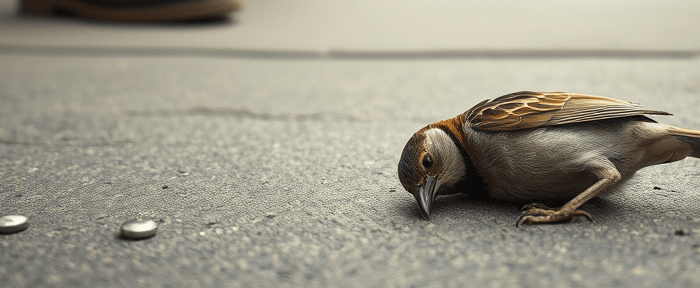
A sparrow fell from the sky and plopped down next to me on a sidewalk corner beside the church as neighbors, shoppers, and tourists bustled to their places.

“Damn! That’s disgusting!” Said a snap-back-hatted young man sidestepping around the splat. Looking the revenant himself as if returning from a dead weekend that probably started out fun on Friday night, he looked up. Was he searching for someone behind the clouds to blame?

“Look at it. So gross!” Looking down now, seemingly blaming the sparrow for its dead ugly existence.

Perhaps because I was headed to church, the sparrow’s lasting legacy in the bible came to mind. Scriptures tell us to look at how God cares for the lowly sparrow as a metaphor for how that same God cares even more for humans. But here I was, staring at a dead bird. Did that God in the bible throw the bird down beside me so I’d know who’s in charge around here? Is it an omen of a bad year ahead? A symbol of immortality? A sign to repent?

There’s a peregrine falcon nest directly east on Lake Michigan in the intake crib of Chicago’s water system. Those tricky raptors attack other birds in mid-air and sometimes miss their prey as they swoop down to catch them. On my dog walks, I’m constantly on the lookout for bird carcasses (sometimes impaled in the bushes) because Elsa will sneak a forbidden lick if I’m not vigilant.  I assumed the unfortunate sparrow was one of these victims.

If God set this complicated natural aerodynamic food chain in motion, so be it. I’ll accept that God. However, no God is going to snap me to attention about the upcoming election or remind me of some regrettable remark I’ve made by throwing foreboding dead birds at me. The same force may have set all the emotions of fear and regret in my DNA, but a god that powerful better not have my same human characteristics. I’m conscious of an impersonal force, something outside of myself, an unexplained presence. I believe there’s a higher power, that I call God. Holding that power out as a relatable, reasoned person that acts as a mean-spirited human, to get my attention is not my idea of a god. At least not today, or, not at this moment.

The ubiquitous house sparrow is not native to the United States, I’ve been told by birders. They chirp most of the US awake in the morning and nest outside our homes’ nooks and crannies. At Chicago’s Navy Pier, if you try to eat McDonald’s fries outside, you’ll be sharing them with sparrows. If you look at your phone outside the Pancake House to catch up on text messages, sparrows will swoop in and pluck at the remnants of your Dutch Baby. This diminutive invasive species is so plentiful that I give it short shrift, ignore it, as if it’s not important.

Until one drops from the sky on my way to church.

____________________________


It’s not lucky to be almost assassinated

It’s not lucky to be almost assassinated

She came to me at nine years old with an incomplete backstory. No longer a viable breeder after age five or six, the owners kept her way past her financial contribution to the family. She’d delivered two litters a year, about 100 puppies. “We just liked her,” they told me. My inquiry, “I’m an old lady dog-lover, looking for an old-lady dog companion,” hit just the right tone. “You’re an answer to our prayers.” And so I got Elsa.

The day after the attempted assassination of the former president, I hungered for Sunday air. You know, the first day of the week kind of air, where everything starts over. Air that requires nothing. No lofty thoughts, no reflection, no opinions, judgments, or conclusions. Sunday air. I breathe Sunday air when singing a well-known hymn like “It is well with My Soul”.

When peace like a river, attendeth my way

When sorrows like sea billows roll

Whatever my lot

Thou hast taught me to say

It is well, it is well, with my soul

And when the preacher elevates my being with no effort on my part, I breathe in the Sunday air of love. 

Sunday air was unattainable at church last week, though. It was not well with my soul. Right off, the preacher prayed “for former President Trump, grateful he did not succumb to political violence. This world is in love with violence, a violence that threatens the best in us, so renew in us a commitment to the Christ, who calls us to turn the other cheek, to love our neighbor, to love our enemies.” On receiving this, I sucked in a big chunk of we’re-gonna-lose and couldn’t seem to exhale.

The sermon choked off any puff of relief— a parable about prayer that meant nothing to me. My diaphragm would have swelled during hymn-singing, but the tunes were unfamiliar yawns.

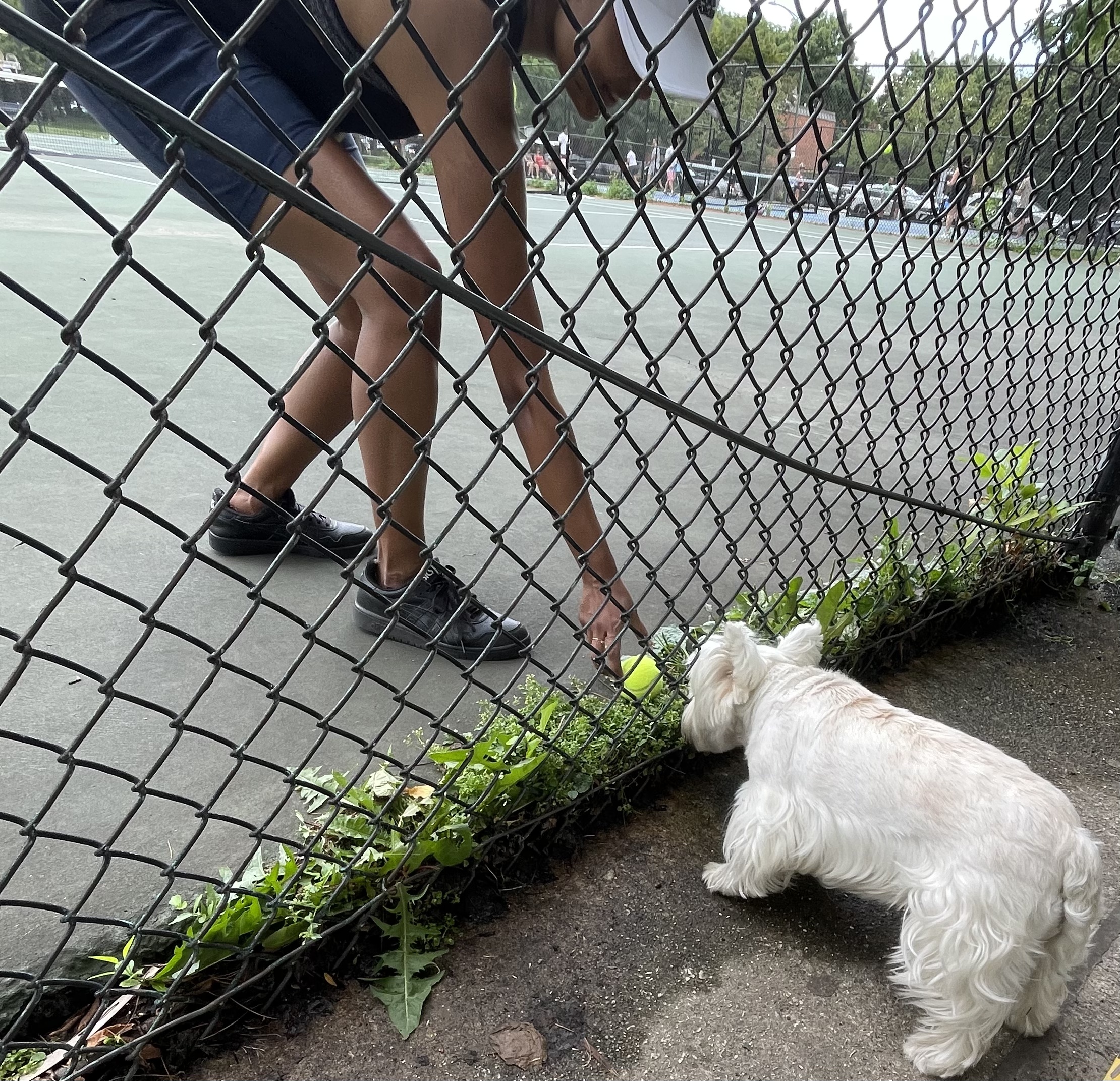
And so, airless, I vamoosed to the outdoors, home to fetch Elsa for a trip to the park to watch tennis players sweat it out. She was too hot to sniff around the edges and lazed in the shade instead. Until a tennis ball bounced toward her behind the chain link fence. She bolted for it and dug into the wire to try to slay that green fuzzy rodent stunt double. She would have broken her teeth to get to it. A tennis player picked up the ball, a good ball, and tossed it over the fence with big Sunday air to Elsa, who received it with the gusto of a kid catching bubbles. She flaunted her prize using all the primal dog moves that delight dog-loving humans. I never knew she was a ball dog. 

Echoing Bill Maher, Bulwark podcaster Tim Miller asked his spirit guide and Managing Editor, Sam Stein: 

“Can I say Trump is the luckiest dog on the planet?”

“No! You can’t say that.”

“I can’t?” Asked Miler.

“No! It’s not lucky to be almost assassinated.” Said Stein.

But Elsa. She’s a lucky dog.

Smelly Lilacs

Smelly Lilacs

The tulips were showing their last droopy colors. The iris’ were ready to pop for a week or two of runway-like exhibitionism. The trees in the small park were half-dressed, embarrassed by their young fresh leaves, waiting for their green siblings to fill in around them. 

And oh those smelly lilacs. 

Their short-lived incarnation makes me holler 

thank you Jesus. 

And then, the warblers.

Every spring is the same. Year after year. And yet, every single time, I’m shocked out of winter doldrums by the sheer variety of beauty and fragrance in the cultivated and in the wild city gardens. A text or an email or an article from birding organizations will remind me to listen for migrating warblers. They pass through as the tulips fade. I hear them. Never see them. 

Warblers visit Chicago on their way up north from Central and South America. They’re tiny. My old eyes are acclimated to spotting bigger birds—starlings, blackbirds, crows. Even sparrows are larger than warblers. I look, but mistake the warbler for a leaf or a twig, even a large bug.

But the other day, on an unusually seventy-five-degree May morning, I passed under a tree while Elsa sniffed around the ground cover for messages from new and old pals. I heard a symphony of birdsong overhead and looked straight up to see tiny bright-colored warblers flitting from branch to branch, hunting insects. 

I switched on my iPhone, pressed the Merlin bird app, and recorded a Tennessee Warbler, Yellow Warbler, Yellowthroat, and American Redstart all singing their wee hearts out within shouting distance. I suddenly realized I was in a bird “fallout,” a phenomenon that occurs when curious weather slams into migrating songbirds in the air and they descend into the trees below. 

The weather systems predict the number of songbirds that may be migrating over Chicago on spring nights. Attracted to their reflections in the windows of highrises, they accidentally kill themselves by flying into lit buildings.

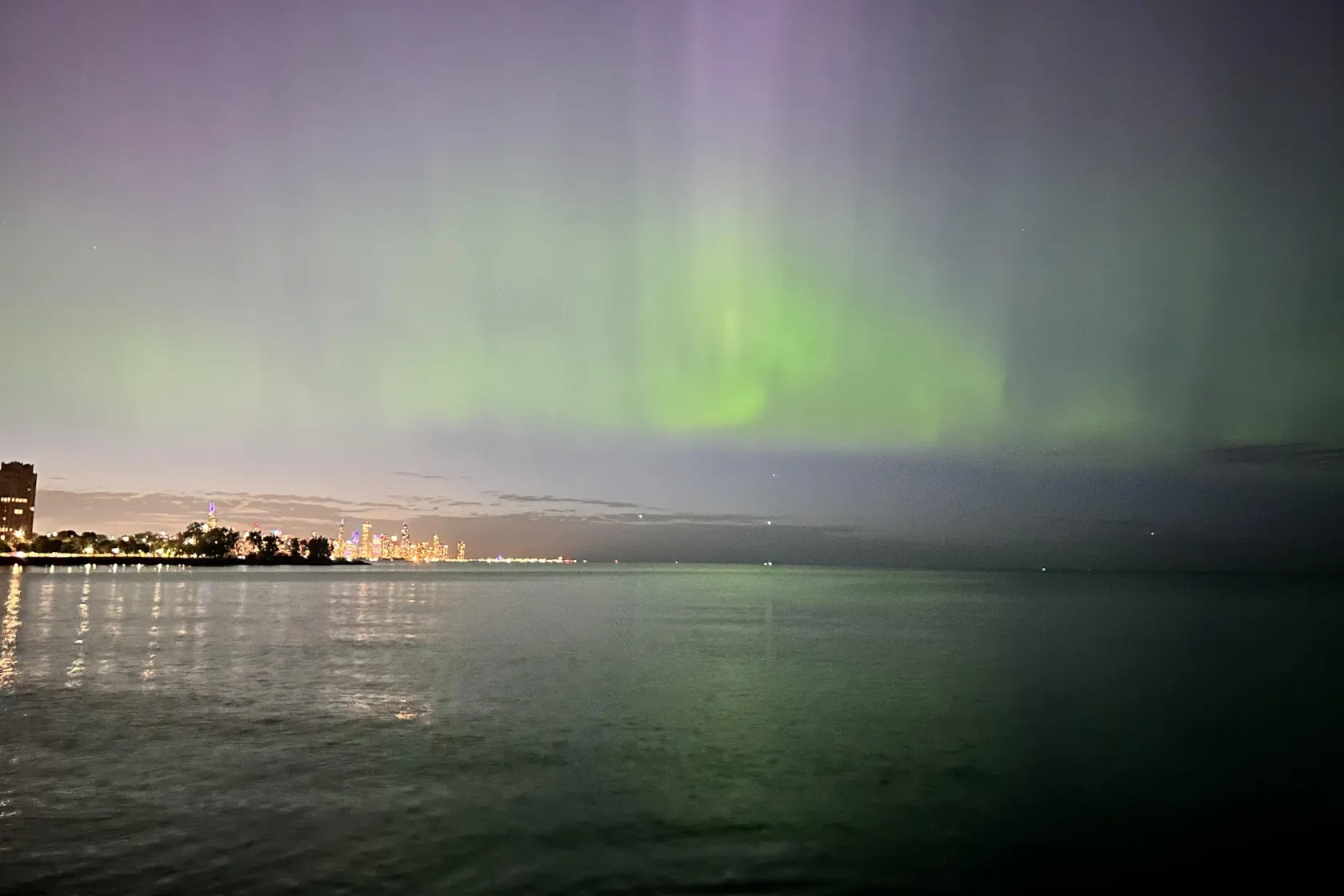
The uncommon migration fallout happened twelve hours after Chicago’s unusual sky-drenching from the northern lights—yes, the northern lights! The aurora borealis: blazing bits shooting out of the sun, hitting the diluting atmosphere with undulating ribbons that lit up the Chicago night. All this only a month after a solar eclipse. 

Hyde Park residents Meghan Hassett and her husband Max Smith captured the northern lights from Promontory Point Friday, May 10, 2024. Provided by Meghan Hassett

In the park, a dog-walking neighbor neared with Zeus, stopped, and looked up. 

“Whatcha lookin at?”

“Warblers.”

“Oh,” and he continued on. He lives in my building and told me a few days before that he’s planning a hiking trip to the Rockies because he “likes nature.”

Me too.

Sensemaking: The Eclipse

Sensemaking: The Eclipse

From my window, I can see Lake Shore Drive’s curve at Oak Street, an “S” curve fraught with danger. Some days, as many as five separate car crashes occur from unsuspecting or inexperienced drivers speeding toward the curve and sliding off the road. Heavy gauge ribbed steel barriers prevent errant vehicles from jumping the curb, flying off across a small park, and crashing into the Drake Hotel and vintage apartment buildings on East Lake Shore Drive.

On eclipse day, April 8, 2024, an East Lake Shore Drive building was an arrival point for President Joe Biden’s visit to Chicago. To augment the threat of car bombs speeding down Lake Shore Drive and intentionally barreling off into the building, city salt trucks lined up bumper to bumper on a half-mile stretch of the S curve that hugs the small park on one side and Lake Michigan on the other.

At 2:07 pm, the moon blocked the sun by 94% as I waited in the park with my dog Elsa. A few other dogs tethered to humans stood nearby. 

“Is the eclipse happening soon?” I called out to one.

“Yes, right now,” a neighbor announced.

“Here!” He rushed over and handed me his solar glasses so I could see the shadow of the moon crossing the sun. 

“Oh, there it is,” I whispered, “I thought the sky would be dark.”

At 94% sunshine, the sky doesn’t turn dark. Even a tiny sliver of the sun is so bright it can light up the sky. I hadn’t been paying much attention to the details of the solar cycle or lunar eclipses. I knew light from that 6% sunshine is so intense it can fry your eyeballs, but I didn’t know that 6% sunshine gives off an intense, vibrant light capable of eliminating shadows.

As I handed the solar glasses back to my neighbor, I looked down at Elsa, standing in the projection of overhead tree limbs. April brought out buds, but still no shady foliage. The images of the boughs, branches, and twigs on the ground were as clear as they were on the trees, like a photo. A perfect mirror image of the deep brown arbor architecture above. Nothing in my memory compared to this. I sensed, though, a deep knowing, as if ancient benevolent familiars had brought me the seeing of a thousand ancestors.


Elsa in the eclipse

“The sun is about a million times brighter than the full moon,” explains Angela Speck, an astronomer at the University of Texas at San Antonio, “So if 99.9% of the sun is obscured,” she says, “there will still be a thousand times more light than the full moon.

I read that in the days before the eclipse, but it held no meaning and slipped my memory. I still had a preconceived notion that the sky would turn black. Experiencing the solar light on the ground, mine and Elsa’s ground, in the valley between the salt trucks and the highrises, revved up my consciousness. 

Now it makes sense.

Cold Wars

Cold Wars

The 2019 Polar Vortex slid down from the North Pole, threatening to lock Chicago into subzero stillness. I prepared for the warring cold by teeing up the entire 18-hour series of The Marvelous Mrs. Mazel. Then I threw stale bread crumbs onto my balcony to nourish the house sparrows, finches, and chickadees before they huddled together in eaves and cracked soffits to wait it out. I shuttered in and Dapped all the little crevices around the balcony door that were spritzing air into my not-so-insulated living room. That was the extent of my preparation for the coldest two days ever recorded in Chicago.

Day one brought minus 23 degrees. I woke to a thick film of silver ice covering all the windows. The ice curtain obscured the humanity moving around behind the windows across the street and any fool pedestrian walking in the feels-like-minus 40.

My binge-watching was interrupted mid-morning by a thrashing whomp, whomp whomp on the concealed balcony. I inched toward a clearing in the frosty glass.

A murder of crows had come to forage.

The much-studied American Black Crow might be the most intelligent animal other than primates. They hide their food and come back for it. If a crow looks you in the eye, she will remember you, follow you down the street, and caw at you for attention like a wild pet. 

On day two, the temperature was 21 degrees below. The ice wall on my windows melted enough for a small lookout. I abandoned Mrs. Mazel and placed a chair well away from the clearing to observe the crows without startling them. They first landed in late morning. A mighty set of black wings fluttered a plumped-up body onto the balcony railing, and the rest followed—a family of five dipping to the balcony floor for leftovers. They flew off and came back. Again. And again. And again. I remained still throughout, trying to lock eyes with the birds. In the afternoon, the weather broke and allowed the dog and me to walk outside—under the watchful eyes of noisy new friends.

The first cold days of 2023 were predicted for the weekend after Thanksgiving. Though nowhere near the 2019 plunge, 30-degree temperatures heightened awareness of asylum-seeking families living on cardboard slabs outside police stations. I sought diversion through another favorite TV series, Julia.

The TV automatically tuned in CNN, though, where there was live coverage of the hostages being released from Gaza. A mysterious and curious need for every scrap of information gripped me. Who are they? What are their stories? Where are they going? I saw six women over the age of 70. One 85-year-old was helped onto a bus. I winced, feeling my own arthritic pain. Four children appeared—ages 2, 4, 5, and 9. I squinted to see if they were clutching teddy bears.

After watching for two tearful days, unrelenting shivers overcame me. And when I took the dog for a walk, that murder of crows cawed to us from the barren trees.