The Peace of Non Closure

The Peace of Non Closure

A new concept popped up at the outset of a recent anti-racist training session. Among the familiar “courageous-conversation” ground rules, the leader added, “We commit to non-closure. (pause) Right?”

Whoa, really? My fellow attendees all yes’d the speaker as if they knew this already. I thought I must have ignored an inboxed message, or, in my long season of retirement, missed another new corporate buzz word. Non-closure.

On the brink of Juneteenth, the half-day session promised to address the backlash to Diversity, Equity and Inclusion programs and policies. That morning all of nature said yes! to Chicago. I wanted to say yes! too, and take a long walk in the park with my dog. Instead, I reluctantly ambled over to the dingy conference room in a church basement near my home. Anti-racism churned inside me and I had no organized outlet. I was curious to see if there was anything new.  Answers.

But here I was, swallowing a commitment to non-closure. No answers, no conclusions, no plans, no fantasies of what might be. Of the numerous anti-racism trainings I’ve attended since the murder of George Floyd this may be the first time I recognized that it’s safe to be in that liminal space of unknowing, of ambiguity. There would be no meaning-making, no sense-making, no closure.

Facilitators from Crossroads, an antiracism training organization, gathered us together, not to tell us what they know, but to find out what we know. They see, feel, but even more, they sense, not just a political backlash in anti-racism work but, an active softening in community and personal commitment. 

The air is leaking out of the tires.

This week Donald Trump and I had birthdays. We’re the same age. Several friends asked me how I planned to celebrate.

“I don’t really celebrate my birthday.”

“Why not?” Asked my favorite poet.

I had no answer. 

He asked about my writing.

“I’ve been thinking lately I may not write anymore.”

“Why?” He asked.

Another why question. And no good answer. Is that a failing? No answer? Does it mean I’m not sufficiently self-reflective?

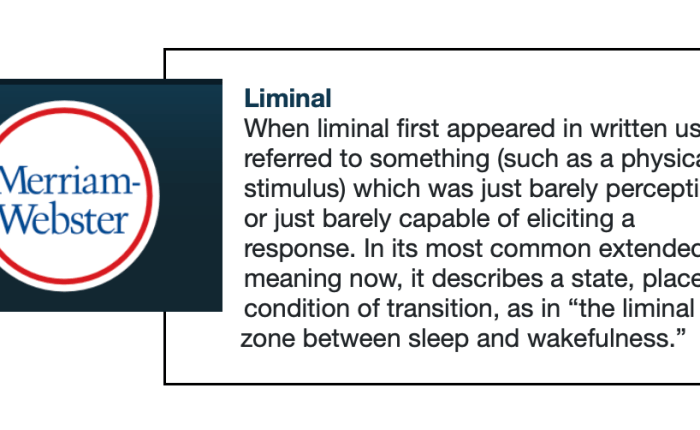
Liminal, from the Latin, “threshold” puts time and space betwixt and between. On liminal days, birthdays dangle off the edge of time. The past no longer haunts me, the future no longer calls me. I neither wait nor wonder. Indeed, birthdays are liminal days.

Anthropologists say that memory disorder, pandemic uncertainty, authoritarianism, virtual reality, border disputes, old-age anxiety, environmental issues, and gender trouble put society in a self-protective liminal state. Whew! Thank you God. This beloved gift  allows me to live on the threshold where social norms, like answering the question “why” or reading every damn email are temporarily suspended. 

In the ninth grade, when I was consumed with past and future popularity by any means, I was inconveniently tormented with one living and one dead poet: T.S. Eliot and Alfred Lord Tennyson. A lot has been written about the spiritual liminality, the non-closure of their work. It’s only now (or is it?) that I see why these vexing lines captured me:

Tennyson’s Ulysses:
Yet all experience is an arch wherethro' 
Gleams that untravell'd world whose margin fades 
For ever and forever when I move.
TS Eliot’s Four Quartets:
Time past and time future
What might have been and what has been
Point to one end, which is always present
.

Oh no! Parables

A few months ago, I wrote about a preaching at church on the parable of the ten virgins, or bridesmaids as they say in modern versions of the New Testament. In the story, told by Jesus in the gospel of Matthew, the ten women are waiting for the arrival ceremony outside the gates of the wedding venue. Five of them, known as the wise bridesmaids, came prepared with full oil lamps, greeted the wedding party, and they all entered the gates to the feast. The other five, known as the foolish bridesmaids, were out buying lamp oil, took too much time in the shop, and got locked out of the party. The preacher says the oil is a metaphor for hope. Always have a little hope stored up because you never know when God will present herself with the next great opportunity.

I really hate parables. They’ve always made me feel bad about myself. Oil as a metaphor for hope seems a stretch, but it still makes me cringe. In this and all Bible stories, I relate to the foolish ones, the worst person in the story. I’m never ready, always late, and a failure at time management. 

The question arises: why would Jesus, my earliest-remembered friend, use the parables to traumatize me with such heavy doses of self-blame? No wonder people have stopped attending Christian churches.

At the church I attend, the Sunday bulletin at the end of May included this statement: 

This summer, we will take our messages from the stories that Jesus loved to tell: Parables. 

Oh Jeez. That gives me about thirteen Sundays’ worth of sermons to learn and absorb some wider spiritual truths that have eluded me thus far. I have hope that the preacher is up to the task. In his kick-off to the summer pulpit, he talked about the parable of the Sower. Do you know that one? The farmer throws seeds around willy-nilly throughout the land, giving no thought to where they settle. Some seeds settle on rocks, some on thorns. I’ve always considered myself the thorny soul who has choked off God’s seeds through my own self-will. Another parable evoking self-blame.

When I was younger, I used to buy cheap packets of wildflower seeds at Walgreens and toss them around Lincoln Park on my morning run in places that needed a bit of sprucing up. I never bothered cultivating them; I simply hoped a few would spring to life. It was a labor of rebellious love. 

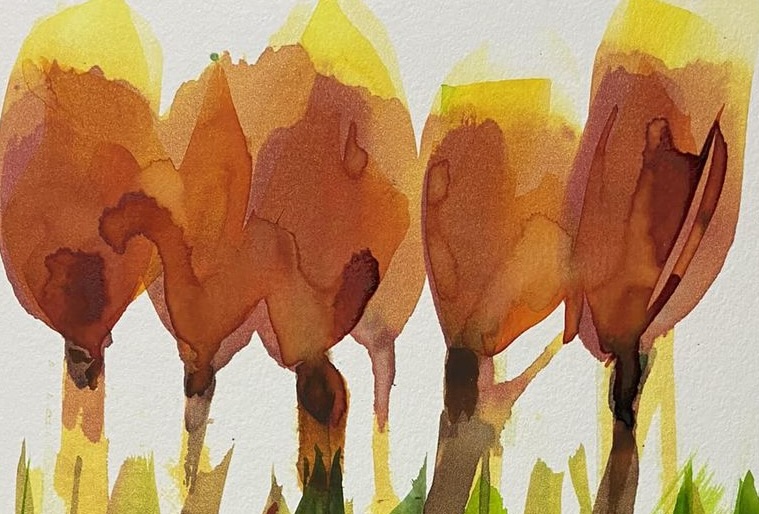
The preacher reminded me of those long-ago spring days. He interprets the seeds as love, God spreading love around. Sometimes, love takes. Sometimes, it doesn’t. But God keeps throwing it out there, just like I kept throwing out seeds of wildflowers. Love is power, says the preacher,  tender power, vulnerable but power nonetheless, capable of changing people. The sighting of Spring’s first tulips makes me happy, no matter how anti-happy I may be. That’s powerful love.

Perhaps a summer of parables will be ok. 

Smelly Lilacs

Smelly Lilacs

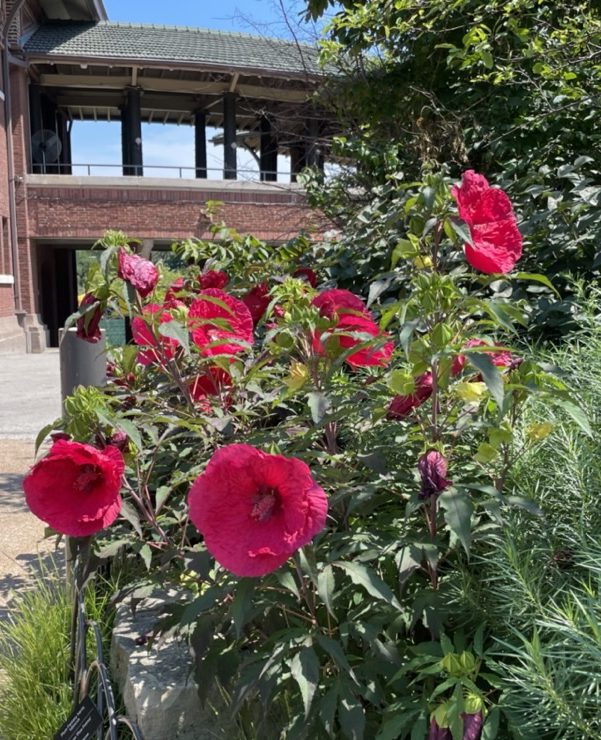
The tulips were showing their last droopy colors. The iris’ were ready to pop for a week or two of runway-like exhibitionism. The trees in the small park were half-dressed, embarrassed by their young fresh leaves, waiting for their green siblings to fill in around them. 

And oh those smelly lilacs. 

Their short-lived incarnation makes me holler 

thank you Jesus. 

And then, the warblers.

Every spring is the same. Year after year. And yet, every single time, I’m shocked out of winter doldrums by the sheer variety of beauty and fragrance in the cultivated and in the wild city gardens. A text or an email or an article from birding organizations will remind me to listen for migrating warblers. They pass through as the tulips fade. I hear them. Never see them. 

Warblers visit Chicago on their way up north from Central and South America. They’re tiny. My old eyes are acclimated to spotting bigger birds—starlings, blackbirds, crows. Even sparrows are larger than warblers. I look, but mistake the warbler for a leaf or a twig, even a large bug.

But the other day, on an unusually seventy-five-degree May morning, I passed under a tree while Elsa sniffed around the ground cover for messages from new and old pals. I heard a symphony of birdsong overhead and looked straight up to see tiny bright-colored warblers flitting from branch to branch, hunting insects. 

I switched on my iPhone, pressed the Merlin bird app, and recorded a Tennessee Warbler, Yellow Warbler, Yellowthroat, and American Redstart all singing their wee hearts out within shouting distance. I suddenly realized I was in a bird “fallout,” a phenomenon that occurs when curious weather slams into migrating songbirds in the air and they descend into the trees below. 

The weather systems predict the number of songbirds that may be migrating over Chicago on spring nights. Attracted to their reflections in the windows of highrises, they accidentally kill themselves by flying into lit buildings.

The uncommon migration fallout happened twelve hours after Chicago’s unusual sky-drenching from the northern lights—yes, the northern lights! The aurora borealis: blazing bits shooting out of the sun, hitting the diluting atmosphere with undulating ribbons that lit up the Chicago night. All this only a month after a solar eclipse. 

Hyde Park residents Meghan Hassett and her husband Max Smith captured the northern lights from Promontory Point Friday, May 10, 2024. Provided by Meghan Hassett

In the park, a dog-walking neighbor neared with Zeus, stopped, and looked up. 

“Whatcha lookin at?”

“Warblers.”

“Oh,” and he continued on. He lives in my building and told me a few days before that he’s planning a hiking trip to the Rockies because he “likes nature.”

Me too.

Happy Birthday Hellraiser

Happy Birthday Hellraiser

The long call of a spring robin woke me from a dream about Mother Jones. She was organizing my group to protest the nightmarish abolition of women’s rights, as in Margaret Atwood’s The Handmaid’s Tale

“I don’t march anymore. I can’t run!” I muttered in half-sleep.

I tugged to escape her visitation as I was tugging the covers to get up and contemplate the robin’s daybreak anthem. The common backyard robin is unusual along the Lake Michigan shoreline where I live. Its song is one of the few teachings I remember from my own mother. 

I’d been to a Mother Jones birthday party at the Irish American Heritage Center in Chicago. Mary Harris Jones, born in County Cork in 1837, immigrated when she was ten years old. Her husband and four children all died of yellow fever in 1867. Four years later her dress-making shop was destroyed in the Great Chicago Fire. Undaunted, this fierce, five-foot-tall Irish American became an organizer for workers’ rights, particularly the United Mine Workers.

On May 1, 1886, there was a general strike for the eight-hour workday which led to the Haymarket Riot in Chicago. Mary Harris Jones declared her birth date as May 1, to honor the Haymarket Martyrs. Her exact birthday is unknown. Most records of peasants born in western and southern Ireland were lost or destroyed during the Irish Potato Famine (1845 to 1852). This is true of my own ancestry. 

Mother Jones helped coordinate major strikes in the coal mines and on the railroads where my great-grandfather and great-uncles worked. Her protest marches included children who wore banners saying, “We Want to Go to School and Not to the Mines.” They could easily have been my relatives.

Women activists belittled her lack of commitment to women’s suffrage.  She said “you don’t need the vote to raise hell!”  Jones believed it was more important to advocate for the working class—black, white, men, women and children—than to support women’s causes alone.

Like Mother Jones’ family, my father’s forebearers were discriminated against due to their immigrant status, their Catholic faith, and their Irish heritage. The shame of the Irish hung heavy in their Kentucky and Indiana homes. But still, my father, fresh out of law school in the late 1930s, working for the United Mine Workers, wrote the first union pension legislation in the United States.  And, family lore supposes his father, my grandfather, was a union organizer on the railroad.

When Mary Harris Jones turned 60, she began calling herself “Mother” Jones. She dressed in matronly black, wore old-fashioned hats and referred to the laborers she helped as “her boys.”

When I was 60, I took up offense for workers in my office. Wage inequality, discordant work assignments, and unfair discipline reeked of cruelty. In the end, I got canned, but their jobs were secured. 

Like the robin wake-up call at dawn, Mother Jones calls from the graveyard and wakes me to the oppressed and wronged.

I bow to her. In gratitude.

Happy Birthday Mother Jones.

Jews

Jews

Jesus, my lifelong friend, accompanied me through chicken pox, mumps, and measles when quarantine isolated me from my sisters, parents, and friends. No, I didn’t have Mother Theresa-like visions. He was more of an imaginary friend for my waxing brain, like an animated Pooh Bear.  Clergy at St. Mary’s school in Terre Haute, Indiana, taught that Jesus was born in Bethlehem and died in Jerusalem. Due to those back-to-back pre-vaccine childhood illnesses, I heard these Jesus facts my second time around in the first grade. The teaching doubled down in my malleable brain, which had grown to ninety-five percent of its total capacity, normal for a six-year-old.

There was never any question that Jesus was born of Jewish parents. Israel, presented as a holy place, not a political state, was sacred ground because that’s where Jesus lived. There was always the implication that we, as Catholics, were in Jesus’s family, that somehow we had Jewish roots. If Jews believed in Jesus, they got to go to heaven, like us Catholics. But no other religion. Such was my Roman Catholic schooling.

Our single black-and-white family television transmitted few programs into our living room in the 1950s. Roy Rogers and I Love Lucy were allowed, but my parents insisted we watch the nightly news. My sisters and I didn’t dare whine for fear of verbal reprisals like, “Shut up and listen—maybe you’ll learn something.” 

They’d let us watch “This is Your Life,” a forerunner to PBS’ “Finding Your Roots’. In 1953, This is Your Life broadcasted the story of 32-year-old Hanna Bloch-Kohner, a Holocaust survivor. I wasn’t much interested in the not-so-famous Hanna, but I did wonder about the Holocaust.

When I was ten years old, as my brain power peaked, local TV stations advertised the opening of Old Orchard Shopping Center in Skokie, Illinois. We lived in Wilmette, on the border of Skokie.

“Where’s Skokie?” I asked my mother.

“That’s where all the Jews live.” She answered.

All my thoughts screeched to a halt. I’d never seen a Jew. I assumed that whatever Jews were leftover from the time of Jesus surely had died in that mysterious “Holocaust,” a word adults uttered in a hush. Of course, I couldn’t ask my mother what Jews were doing in Skokie. She expected me to know what she knew, no matter the subject. She would have ridiculed me with a sarcastic, “You’re kidding me. Don’t you watch the news?”

From that moment on, I looked for Jews in supermarkets, at the beach, in the record store, and even at school. It’s possible I looked for men who resembled Jesus. In high school, I met a Jewish brother and sister. I stared them into my spiritual family. I wondered how they got to New Jersey from Bethlehem or Jerusalem or Israel, those holy places whose ancient remnants had settled in my bones, with Jesus. 

My brain, now waning, has reformed itself through evidence, facts, and logic into knowing and loving the Jewish story. There may be evidence, and there may be facts, but there’s no logic to knowing Jesus. 

That’s still a belief. 

Sensemaking: The Eclipse

Sensemaking: The Eclipse

From my window, I can see Lake Shore Drive’s curve at Oak Street, an “S” curve fraught with danger. Some days, as many as five separate car crashes occur from unsuspecting or inexperienced drivers speeding toward the curve and sliding off the road. Heavy gauge ribbed steel barriers prevent errant vehicles from jumping the curb, flying off across a small park, and crashing into the Drake Hotel and vintage apartment buildings on East Lake Shore Drive.

On eclipse day, April 8, 2024, an East Lake Shore Drive building was an arrival point for President Joe Biden’s visit to Chicago. To augment the threat of car bombs speeding down Lake Shore Drive and intentionally barreling off into the building, city salt trucks lined up bumper to bumper on a half-mile stretch of the S curve that hugs the small park on one side and Lake Michigan on the other.

At 2:07 pm, the moon blocked the sun by 94% as I waited in the park with my dog Elsa. A few other dogs tethered to humans stood nearby. 

“Is the eclipse happening soon?” I called out to one.

“Yes, right now,” a neighbor announced.

“Here!” He rushed over and handed me his solar glasses so I could see the shadow of the moon crossing the sun. 

“Oh, there it is,” I whispered, “I thought the sky would be dark.”

At 94% sunshine, the sky doesn’t turn dark. Even a tiny sliver of the sun is so bright it can light up the sky. I hadn’t been paying much attention to the details of the solar cycle or lunar eclipses. I knew light from that 6% sunshine is so intense it can fry your eyeballs, but I didn’t know that 6% sunshine gives off an intense, vibrant light capable of eliminating shadows.

As I handed the solar glasses back to my neighbor, I looked down at Elsa, standing in the projection of overhead tree limbs. April brought out buds, but still no shady foliage. The images of the boughs, branches, and twigs on the ground were as clear as they were on the trees, like a photo. A perfect mirror image of the deep brown arbor architecture above. Nothing in my memory compared to this. I sensed, though, a deep knowing, as if ancient benevolent familiars had brought me the seeing of a thousand ancestors.


Elsa in the eclipse

“The sun is about a million times brighter than the full moon,” explains Angela Speck, an astronomer at the University of Texas at San Antonio, “So if 99.9% of the sun is obscured,” she says, “there will still be a thousand times more light than the full moon.

I read that in the days before the eclipse, but it held no meaning and slipped my memory. I still had a preconceived notion that the sky would turn black. Experiencing the solar light on the ground, mine and Elsa’s ground, in the valley between the salt trucks and the highrises, revved up my consciousness. 

Now it makes sense.

Stop Making Sense

Stop Making Sense

WBEZ Chicago is celebrating 40 years of one of the greatest concert films of all time, Stop Making Sense, at the Studebaker Theater in downtown Chicago’s Fine Arts Building.

I love this movie. Every Sunday when my son was a toddler, he’d nap as his father studied, and I’d go to the movies. When he was old enough, we went to the movies together, especially on Christmas Day after the divorces, and it was just the two of us. At seventeen, he convinced me to see the Talking Heads’ 1984 concert film Stop Making Sense at the same Studebaker Theater.

“I don’t like punk rock,” I said.

“It’s not punk. It’s different. You’ll like it,” he convinced me.

He had his own band at the time and knew his music, so I trusted him. He was right. I blasted the Stop Making Sense cassette on my car radio until the tape wore out.

The film documents the legendary rock band Talking Heads performing at Hollywood’s Pantages Theater in December 1983. David Byrne, Tina Weymouth, Chris Frantz, and Jerry Harrison perform alongside an ecstatic ensemble of supporting musicians.

When my movie buddy Marca Bristo was alive, we went to the movies nearly every Saturday. We’d mull the pros and cons of what we had just seen in the quiet theater afterward before going off to a coffee shop to talk about politics.  Marca died in September 2019. The releases that year included Little Women, 1917, and It’s a Beautiful Day in the Neighborhood. Part of mourning Marca meant slacking off on movie-going. I saw only one movie for the rest of the year,  Just Mercy, which tells the true story of defense attorney Bryan Stevenson and his client, a black man falsely accused of murder. It was my quiet tribute to Marca, a powerful advocate for disability rights.

These days, I’m wary of catching Covid and all manner of infectious diseases so I’ve been in only one movie theater since March 2020 to see Caste.

But I may have to venture into the old Studebaker theater with its high ceiling and wide aisles to see this old film with old friends who love the old Talking Heads. There’s just nothing like being in a room full of people who love what you love.

________________________

Stop Making Sense Tickets

Not Dead Yet

Not Dead Yet

(written for Skyline Village Chicago March-April 2024 newsletter)

Robert Kramer, 74, talking to students at the University of Southern California: “You have far more at stake in changing how we approach aging than I do. You are far more likely, statistically, to live past 100 than I am. If you don’t change society’s attitudes about aging, you will be condemned to lead the last third of your life in social, economic, and cultural irrelevance.”  

A KFF News article,  Do We Simply Not Care About Old People? lays out the blatant disregard for our citizen elders, citing covid-19 statistics.

Around 900,000 older adults have died of covid-19 to date, accounting for 3 of every 4 Americans who have perished in the pandemic. In the last week of 2023 and the first two weeks of 2024 alone, 4,810 people 65 and older lost their lives to covid — a group that would fill more than 10 large airliners.

Yet, where is the outrage? Experts in the field of aging from around the country all agree ageism has always existed, but the pandemic elevated an intense, hostile prejudice against us.

“The implied message to older adults is: ‘Your time has passed, give up your seat at the table, stop consuming resources, fall in line,’” said Anne Montgomery, 65, of the National Committee to Preserve Social Security and Medicare. She says that baby boomers can “rewrite and flip that script if we want to, and if we work to change systems that embody the values of a deeply ageist society.”

In the years I’ve tried to advocate against ageism, I’ve heard everything from “I’m 80 years old, and I’ve never experienced ageism” to “Ageism? What’s that — not admitting how old you are?”

Gay rights leader Harvey Milk famously said in the 1970s, “Come out to your parents.” He knew, and he was right, that if people got to know gay people (can I say “queer” now?), their bias toward them would diminish.

Anti-ageism advocates say, “integrate, don’t separate.” The best way to overcome the ageist stigma is for the people who are stigmatizing you to get to know you. Don’t put “old” in the closet. Go out. Speak out. Be old.

Chicago has separated the old from the rest of the population — in housing, in social groups, in churches, and in health care. “They” don’t see us. ‘They” look through us. We defend ourselves by saying: I wrote a book! I walked the Camino! I volunteer! I have wisdom! I babysit! Walk dogs! Ride my bike!

Reminding people that we are still here, part of the human experience, walking through life like everyone else at any other age, is the best way to flip that script, not by bragging about our credentials but by our visible presence. And when we can’t hear or when our brain energy gets depleted at 3:00 in the afternoon, we ask people to speak up, and we excuse ourselves to take a nap. 

We’re old. Say it. Be it. It’s OK.

What’s Love Got To Do With It?

What’s Love Got To Do With It?

On February 15, 1976, I drove my red Toyota ten miles west from my Toms River, New Jersey, home to a small church meeting in Whiting.  I’d not had a drink for twenty-four hours. My head was pounding. I shook and shivered and sweated. I sat down but had one foot out the door.

Toms River shoulders the Atlantic Ocean. Most of life there happens near the ocean, its inlets, and brackish rivers. Whiting, known for the now-closed Nature’s Rest Nudist Colony, sits on unceded Leni Lenape land at the northern edge of New Jersey’s Pine Barrens. It’s a defunct railroad town surrounded by scrub pines, that dreary little tree that never grows more than eighteen feet because of the sandy soil. No one goes there.

I drove to Whiting to a meeting of Alcoholics Anonymous because I wanted to be anonymous and not run into anyone I knew. I had an overwhelming urge to announce out loud to strangers that I was going to kill myself with vodka.

An active adult community, Crestwood Village, had risen up near Whiting. The eight men and women at the AA meeting were over fifty years old, which was a turn-off for me at twenty-nine. But I was banging on the bottom and had nothing to lose. I thought I’d spill the beans there and bug out for the liquor store on my way home.

The group of eight centered the AA meeting around me and how I could stay sober. They figured out a schedule of who could follow me home that night and stay with me for the next few days. Each day, a different soul appeared on my doorstep to feed me, talk to me, answer the dreaded phone, and connect me to an AA group in my neighborhood. Their messages were the same: you’re sick, we were sick, too. Drink water. Eat chocolate. Go to AA. They trusted me with shocking truths about their lives before sobriety. 

They traveled well beyond their small community in the Pine Barrens and re-arranged their comfortable lives to help a suffering alcoholic. The obsession to relieve my misery with booze lifted after about seven days. Each of them called every day for a month.

I never drank again. After a few months, I sold my house, gave away the dog, left an estranged husband, packed up my son and houseplants, and drove to Chicago.

I was a dead soul before I met that group of kind and loving saints in New Jersey’s outback. Every minute of every day, I thought only of drinking and not drinking.

In the forty-eight years since, I’ve met many people who have asked for help. I share the same love that was offered to me that first week. In very few cases, people have stayed sober themselves. Most have disappeared, died, or gotten pissed off and moved on. 

Love saved me. That’s all I can wish for others.

Happy Valentine’s Day.

.

Sharks and Snakes At the Movies

Sharks and Snakes At the Movies

One summer in the early 1960s, my mother walked the beach near our Sea Girt, New Jersey home. A shark came into the calm shallow of the Atlantic and chomped off the leg of a man wading right in front of her. 

Another that week. And another. Grisly accounts and sightings of man-eating “great whites” all along the central Jersey coast appeared daily in the Asbury Park Press. Lifeguards stood high on their stands and whistled us out of the surf repeatedly at any sign of a dorsal fin. The summer was terrifying. 

When Peter Benchley’s 1974 novel, Jaws, appeared on the paperback rack, my mother snatched it up, read it, and passed it on. She and everyone else at the Jersey Shore convinced themselves that Benchley, who lived in New Jersey, based the book on our summer shark attacks. 

What a book. After eyeing that famous book cover, my seven-year-old son, Joe, became interested in and eventually obsessed with sharks. Having read in Dr. Spock that I shouldn’t tell my child frightening stories, like the crucifixion of Jesus, I kept the Jaws story from him. 

The movie Jaws was released the following year. I refused to watch it, much less expose it to my eight-year-old. His sleep was already interrupted by nightmares after getting hit with a pitched baseball at Little League. 

At age nine,Joe announced that Jaws was at the neighborhood theater on Dollar Day and begged me to take him. The near-empty theater was spooky. I held both hands over my eyes for most of the show .

“You can open your eyes now,” Joe said.

I did, just as the shark was ripping apart a girl on her raft.

“Oh my god! I’m going to puke! I thought you said it was ok!”

We laughed so hard we could hardly hear the movie. Thus began those funny years when boys learn there’s a big payoff in pranking their parents.

When Raiders of the Lost Ark came out in 1981, we lived in Chicago. 

“Is it about Noah’s Ark?” I asked Joe.

“No. The Ark of the Covenant. You know, where the Ten Commandments are.”

Dragging him to Sunday school all those years had paid off.

We ran to the 1,400-seat Esquire Theater on Oak Street. The only tickets left were upfront. Right there, on the front row, the entire wall before me slithered and hissed as Harrison Ford was lowered into a hypnotic pit of 10,000 snakes. 

I shut my eyes. 

“OK to look now,” Joe whispered.

And again, I got fooled into watching the creepiest part of the movie, where Indiana Jones is staring down a hooded cobra.

Raiders is set in 1936 and follows Indiana Jones vying with Nazi Germans to recover the invaluable long-lost Ark of the Covenant. Some have interpreted it as Steven Spielberg’s creation to slam the Nazis for the Holocaust. But to me, it’s a hilarious, breathless adventure, made memorably funnier by the prank of my fourteen-year-old movie companion.

And a memorable relief from how I view Nazis today.