Is Scott Galloway out of Touch?

FeaturedIs Scott Galloway out of Touch?

For the first time in my life, I attended a Sunday service at a Unitarian Universalist Church, to see Chicago’s mayor, Brandon Johnson, in dialog with the pastor. I was curious to hear what this progressive Black mayor had to say to a progressive Northside (White) church.

The pastor began the service with an announcement.

“The Unitarian Universalist Church was established by and for people who do not believe in hell.”

“Whaat?” I was so startled I hardly heard the rest of the preamble. I don’t believe in hell. No one I know believes in hell. But I’ve never heard nor would I ever expect to hear such good news from any church pulpit. 

But wait, there’s more good news! The “UU’s” reject original sin, believe in a God who loves and redeems all human beings, and trains congregants in social justice work. These are my beliefs too.

The bias I’ve had against the Unitarian Universalist Church stems from old thinking that Unitarianism is a heretical religion because they don’t display a cross. Where did I get that crap? Since I’ve been attending a Presbyterian Church for over 45 years, it must have slipped into my head when I was half asleep some Sunday morning. 

Speaking of old ideas, on Friday, December 5, podcaster Scott Galloway responded to a young man who asked:

“How do I get more involved in politics?”

Galloway said “… because young people don’t vote, old people keep voting themselves more money, right? $40 billion child tax credit gets ripped out of the infrastructure bill, but the $120 billion cost of living adjustment for Social Security flies right through.

…our old people have figured out a way to vote themselves more money, and the fact that people under the age of 18 don’t vote, the budget reflects values, and our values are that we don’t really love our children.”*

This is a typical Scott Galloway motivator: money. He will happily reveal how much he’s worth and how he manipulated the modern system to get there. But his statement pitting the young against the old using the antiquated idea that we old citizens are sapping federal dollars from the young shows a decided lack of sophistication and reality. 

First of all, we want young people to succeed. We were young Pete Buttigieg’s biggest voting bloc, long before he announced his Gray New Deal in Iowa 2020. We vote for SNAP and child tax credits. We volunteer at food kitchens, tutor at public schools, babysit our grandchildren and are worried about ours, yours and future generations.

Secondly, we pay. We will pay the government $202.90 a month in 2026 for Medicare Part B, which covers doctor’s visits. That’s a 9.7 percent increase from 2025. We count on the Social Security Cost of Living Adjustment (COLA) to offset that Medicare increase. But in 2026, the Social Security COLA is only a 2.8 percent increase, posing a hardship for Social Security recipients who live check to check in this era of (non) affordability.

Third, don’t we all know that the way young people get involved in politics is to volunteer? What? Is that just a Chicago thing?

After 40 years, curiosity brought me, 79 years old, to an unexpected new idea about the Unitarian Universalist Church. 

Let’s hope Scott Galloway, 61years old, becomes curious enough to come to a new idea about how the real world works.

______________

You can find Scott Galloway’s email address here:

*The Prof G Pod with Scott Galloway: How to Get Involved in Politics, How Scott Galloway Writes, and How He Follows the News, Dec 5, 2025https://podcasts.apple.com/us/podcast/how-to-get-involved-in-politics-how-scott-galloway/id1498802610?i=1000739823645&r=196.38 This material may be protected by copyright.

Chicagoans: People of the Water

FeaturedChicagoans: People of the Water

Chicago is a water town. Lake Michigan and the sky above are our watermarks, the invisible identifier embedded in the soul of anyone who lives here for more than a year, or so. We are built around the lakeshore, the river banks, the canals, the bridges. Oh those bridges! For the next two to three years, three downtown bridges over the Chicago River are closed for repair. I know the river. I know those bridges. Whenever I’m a passenger in a car headed toward the Chicago River, I, a non-driver, turn into a navigational virtuoso.

“Turn left on La Salle Street! Now! Go to Jackson and make a right. Yes, Jackson.”

I’m insufferable. And always right.

Once you’ve lived anywhere in Chicago with even the thinnest view of the lake or the river, you can never go back, never not have water in your sights. Magical is an inadequate adjective. It’s cellular. What must it have been like for those who settled this land we call Chicago? Did a wild black and blue sky moving over Lake Michigan shout danger to our native ancestors? On windy days, did the lake and river together kick up such a fuss that the confluence was unnavigable? Were their beliefs tied to a cellular connection between the water, the land, the ancestors? Dare we imagine that those first peoples inseminated future generations, yes us, with a cellular connection to the water? 

My favorite visitors are those whose excitement about the Chicago Harbor Lock exceeds mine. The Lock is at the confluence of the Chicago River and Lake Michigan. It is part of multiple locks and dams that allow water from Lake Michigan to flow inland, toward the mighty Mississippi. Chicago devised reversing the flow of the river in the 1900s to send our sewage downstream, away from our beloved lake. Lucky for us. Unlucky for St. Louis. 

Boats and cargo ships moving from the river to the lake first enter the lock and tie up. Like a water elevator, the water raises or lowers to meet the level of the lake. I’ve been on tourist boats waiting in line on either side for tankers and cargo boats to get through the Lock. Thousands of Chicagoans live in high-rises with floor to ceiling windows where they can pull up their work desk and chair and watch the Lock all day long as they work from home. What a great city. This water town.

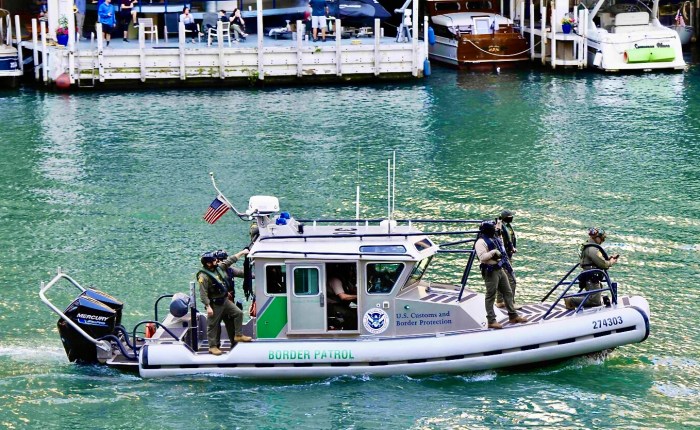
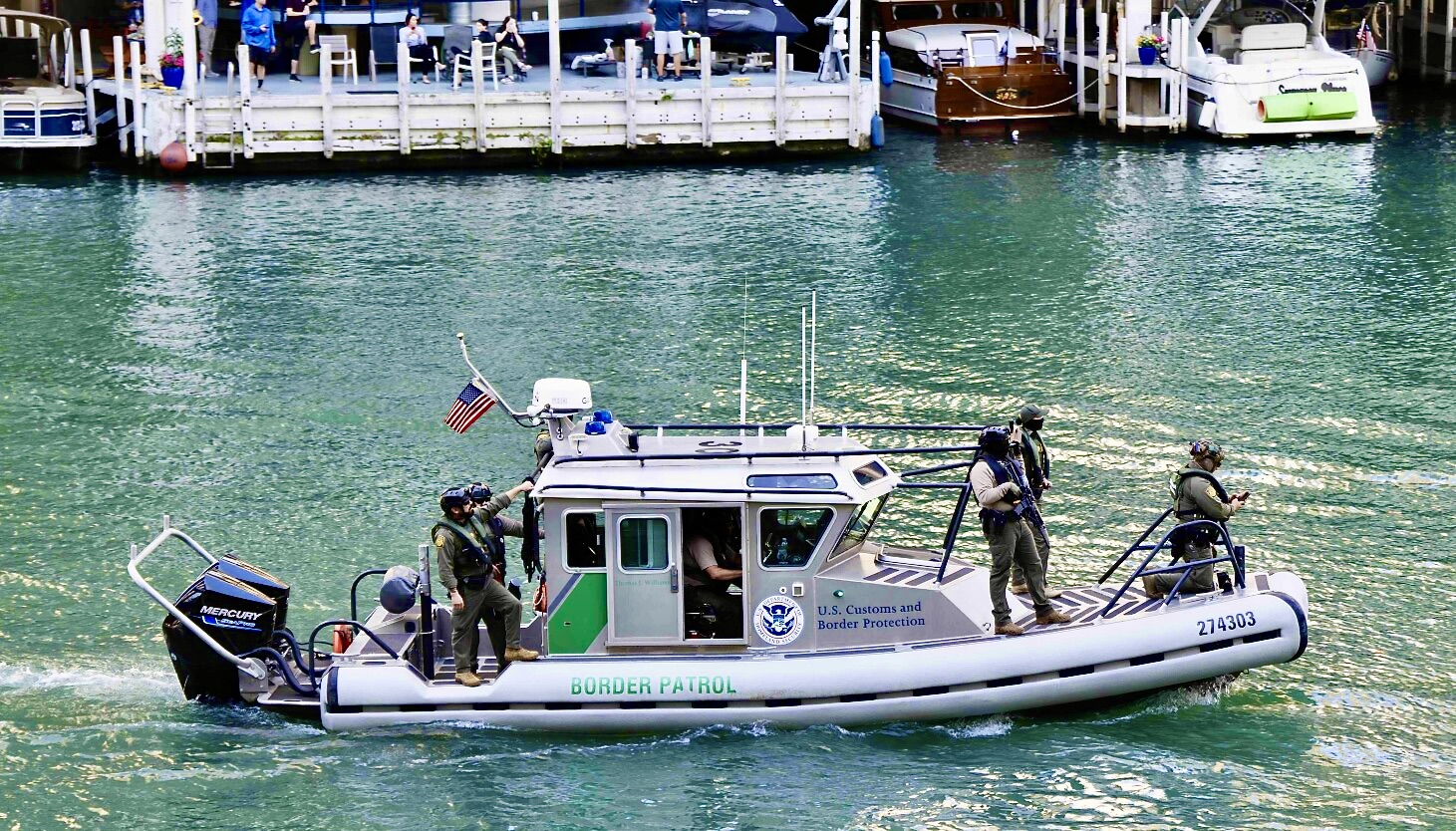
In mid-September, Customs and Border Patrol (CBP) agents were dispatched to Chicago as part of the Trump Administration’s ICE operation to arrest illegal immigrants with criminal records. They announced themselves by cruising up and down our cherished Chicago River, in and out of tour boats and kayaks. Some were masked. All were uniformed. All were armed with semi-automatic long guns. How did such an invasion get through the Lock?

Since that absurd melodramatic entrance into our city, the CBP has cruised into neighborhoods in military vehicles, springing into action to terrorize Chicagoans, citizens and non-citizens. 

Chicago responded with multiple layers of volunteer rapid response teams covering every scenario of civic and private life. New and old activists carry whistles to alert neighbors of CPD/ICE presence on our streets. Neighborhood school patrols walk children to school.

The Customs and Border Patrol floated into Chicago with 250 agents. There’s reason to believe that number is reduced to 100 for the winter. One of their most horrific tools, tear gas, doesn’t work in cold weather. They’ve gone off to warmer climes for training — to figure out how to deal with the likes of Chicagoans. Reportedly they will be back a thousand fold in the spring.

Oh these blue-minded Chicagoans.

These people of the water.

Will be ready.
______________

“Yet once you’ve come to be part of this particular patch, you’ll never love another. Like loving a woman with a broken nose, you may well find lovelier lovelies. But never a lovely so real.”― Nelson Algren

Broadview: Silent Resistance

FeaturedBroadview: Silent Resistance

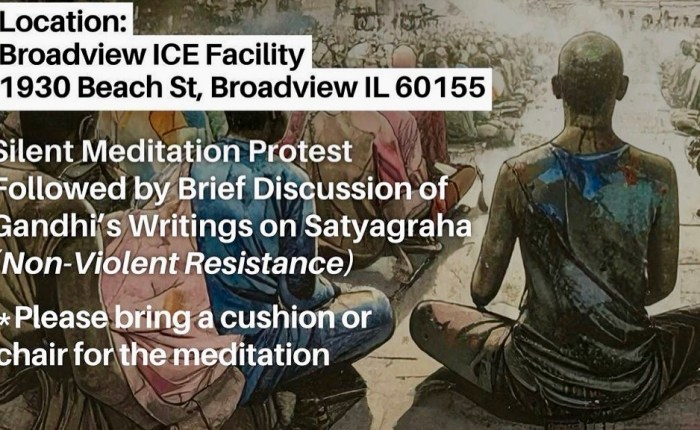
The announcement of a “Peace is our Protest” silent meditation hit my incoming a few weeks ago. I asked my Zoom meditation group to join me at The Broadview ICE Detention Center outside Chicago.

“I thought you were joking!” Rita said afterwards. 

And why wouldn’t she think it was a joke? Since the start of the Trump Administration’s Operation Midway Blitz in late 2025, Broadview has been newsworthy. Masked men in military costumes with automatic weapons shoot protesters in the head with pepper balls that explode into disabling chemicals. Demonstrators have been wrestled to the ground, zip-tied and arrested. Who in our group of graying meditators with varying degrees of mobility and vitality would be going someplace like that?

Well, Abigail and I did go. It was an easy drive. We arrived early. There were a few people already settled on their meditation mats, facing west. We set our lawn chairs down behind them. All was quiet. Two noisy protesters yelled out from time to time but experienced meditators treat ambient noise as neutral thoughts, not sound. We followed their piety and remained unstirred. Silent. Eyes closed. Forty-five minutes passed. A gong sounded. We stretched. 

“Look behind us,” Abigail whispered.

Over my shoulder I caught sight of about two hundred people. Sitting. Quietly. These valorous contemplatives came in behind us and squatted so softly we had no idea they were even there.

“I tried silent protesting and it never works!” A noisy bystander on a bike screamed at us. 

No one responded. No one felt compelled to yell back, argue, persuade. We remained silent. 

An unnamed man read a passage from Gandhi on non-violent resistance. We then folded our chairs and walked softheartedly to the car. As I passed by an Illinois State Trooper, he locked eyes with mine and said, “Thank you for coming.”

Broadview, an immigration processing center constructed in the 1970s, is a spit from the interstate highway leading to downtown Chicago. For thirteen years, a vigil at Broadview has been organized by the Interfaith Community for Detained Immigrants. Every Friday morning, Sisters of Mercy Pat Murphy and JoAnn Persch have led peacekeepers in prayer for detainees, some of whom are in transit to other facilities or are awaiting deportation.

“We are brothers and sisters, and it doesn’t make any difference the color of our skin or our religion or the country we come from,” Sister Murphy says, “we believe in one human being to another, a theology of presence.”

At the silent meditation protest we neither asked for nor received answers. No conclusions. No changes. No one needed to be there. We came to be present. A living theology of presence. I call this God. Others call it something else — the universe, spiritual essence, nature, mindfulness, other God names.

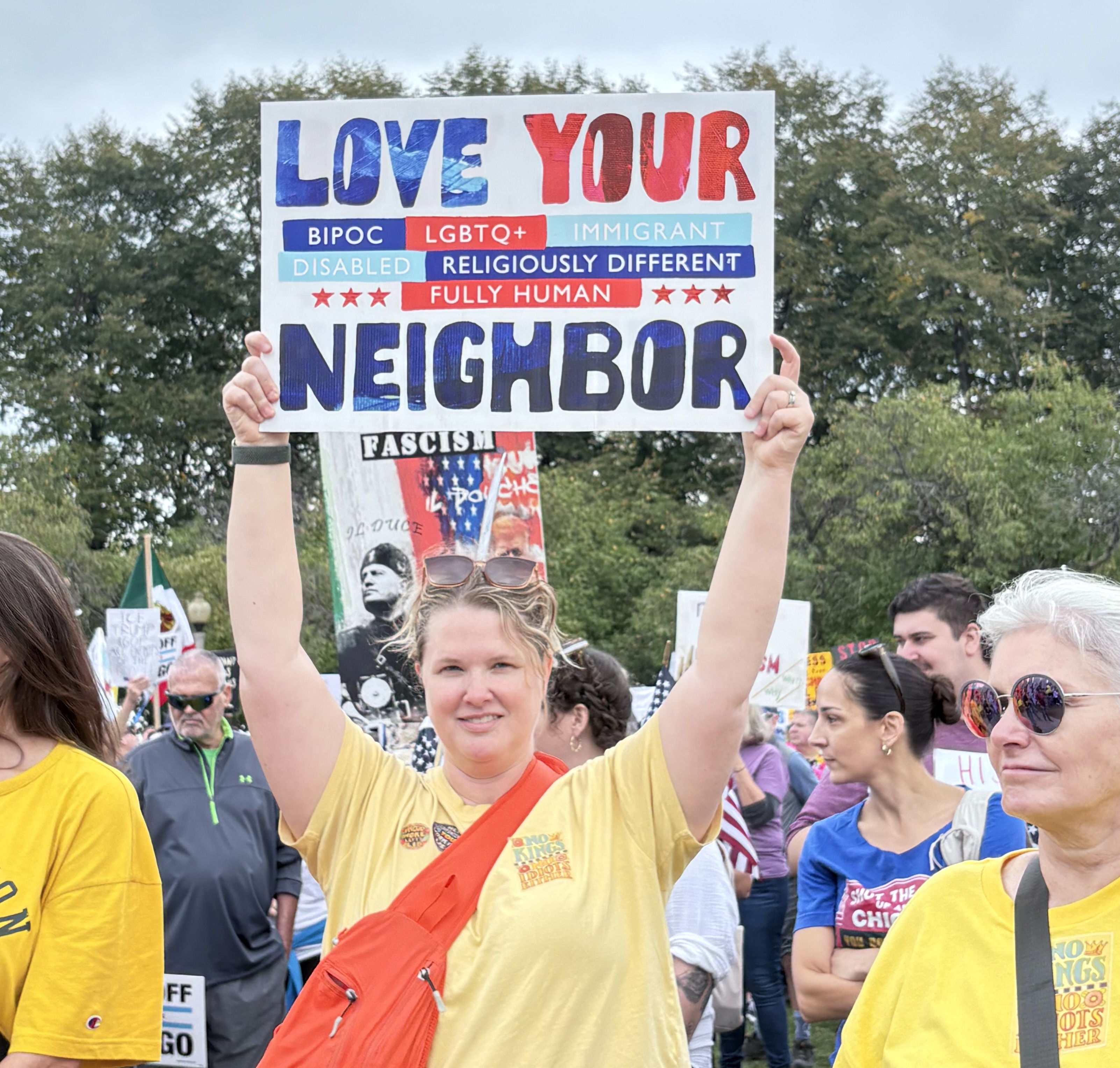
A week later the whole world watched millions peacefully protest at No Kings’ rallies. In Chicago, I walked all around the Butler Field rally in Grant Park and saw very few hateful slogans on signs. I’ve never seen such a noble protest. We marched up Michigan Avenue converging with streams of others walking from the south and west carrying woke messages.

Love not hate.

Faith Over Fear. 

Love Your Neighbor.

The Woodstock Nation. Long may it last.

___________________________________________________

Satyāgraha, from Sanskrit: “holding firmly to truth”, is a particular form of nonviolent resistance or civil resistance. The term was coined and developed by Mahatma Gandhi (1869–1948). Gandhi proposed a series of rules to follow in a resistance campaign:

  1. Harbor no anger.
  2. Suffer the anger of the opponent.
  3. Never retaliate to assaults or punishment, but do not submit, out of fear of punishment or assault, to an order given in anger.
  4. Voluntarily submit to arrest or confiscation of your own property.
  5. If you are a trustee of property, defend that property (non-violently) from confiscation with your life.
  6. Do not curse or swear.
  7. Do not insult the opponent.
  8. Neither salute nor insult the flag of your opponent or your opponent’s leaders.
  9. If anyone attempts to insult or assault your opponent, defend your opponent (non-violently) with your life.
  10. As a prisoner, behave courteously and obey prison regulations (except any that are contrary to self-respect).
  11. As a prisoner, do not ask for special favorable treatment.
  12. As a prisoner, do not fast in an attempt to gain conveniences whose deprivation does not involve any injury to your self-respect.
  13. Joyfully obey the orders of the leaders of the civil disobedience action. 

MLK: “…only when it is dark enough can you see the stars.”

MLK: “…only when it is dark enough can you see the stars.”

On a podcast about grief, artist Laurie Anderson revealed to Anderson Cooper that she felt sad without being sad when her husband, rocker Lou Reed died in 2013. She came to this awareness at a class on the Tibetan Book of the Dead. The teacher, Bob Thurman, said there is no dead. Dead doesn’t exist. He was referring, in part, to post mortem existence.

Different concepts of the afterlife exist in most religions and philosophies. For atheists who believe nothing happens after death, Thurman, a Tibetan Buddhist, teaches there is no nothing. Dead is not nothing.

I’m about as sure of what happens when the body breathes its last as I am of next week’s weather. Oh, I tacitly agree with those who suggest I’ll see my dead dogs again, the same way I concur it’s going to snow tomorrow. Maybe. Maybe not. Surely, dead is not nothing?

On November 22,1963, my mother called from New Jersey to the Catholic boarding school where I was sent to “shape up” in Williamsburg, Virginia. I picked up the black handle dangling from its stretched out cord in the one allowable phone booth for us wayward boarders.

“Kennedy’s been shot.” She said.

I replied, “I know. He’s dead. It’s on the radio.”

There’s a reason my mother called me. She knew, even at seventeen years old that I’d be upset, more like hysterical. Politics had grabbed me as a pre-teenager watching the Vietnam war on TV. By the time Martin Luther King Jr. was assassinated, I, a twenty-two year old hippie, had been to two marches on Washington and written hundreds of letters to Congress and President Johnson. I was in support of the Civil Rights bill, the Voting Rights bill, banning the bomb and against the Vietnam war. Anytime the morning news stirred an injustice I had to fix, I reached for my stash of pre-stamped postcards to fire off messages to Congress. I harangued my friends—at work, in bars, on the beach, at parties—to think and talk like me. They didn’t. I kept going.

MLK’s admonition, “Our lives begin to end the day we become silent about things that matter,” initially whipped me into a frenzy of activism—more letters, more phone calls, more marches, more recruiting. Then in his “Drum Major Instinct,” speech in 1968 he preached to act as a servant, not a savior. It is noble to help just one person, change one person’s viewpoint, get one person to vote. Gradually, I adhered to King’s spirit and put into practice a daily mindfulness mantra:  the worries of the world don’t own me, I don’t own the worries of the world. 

DNA has proven dead is not dead. DNA, our physical manifestation of life itself, apparently lives forever. Anyone who has had a DNA test questions their reported trace variants of first peoples like Neanderthal listed in their results, as if our DNA was there at the beginning, or, before? Some religions teach physical immortality, that our dead bodies will rise (or have risen) to live in Paradise. It begs the question: wherever our raised bodies take up residence, will they have our same DNA?

Martin Luther King’s DNA lives in the generative marrow of his words. I always feel sad, without being sad on this day, his birthday, like Laurie Anderson grieving over Lou Reed. His death forever transitions into the endorphins between my dreams and awareness. He lives in that zero-gravity mirage of my inner life that says:  serve, get out there, be brave, do it, say it.

Yep. Dead is not nothing.


Listen: Laurie Anderson & Anderson Cooper

(updated from 2023 MLK day)

The DOGE and Aging

The DOGE and Aging

Adlai Stevenson III (1930 – 2021) entered the 1982 race for Illinois governor just as I had become unemployed. My only memory of that forsaken job, like all the others, is my shameful obsequiousness to the forgettable male boss. 
 
A journalist friend, Paul Galloway (1934-2009) interceded on my behalf to the Stevenson campaign for a volunteer position. Yes, that was necessary. And still. The sublime expression, “We don’t want nobody nobody sent,” originated in a Chicago ward campaign office. Campaigns still scrutinize volunteers with more than an eye roll. Because of my juice through the local newspaper, people were cautious about what was said around me.

I floundered around the office of Adlai Stevenson’s wife, Nancy, who was usually out campaigning. One day, I had the great fortune to be tagged to drive her to Oak Park for an event. That fluke set off a campaign-long assignment as Nancy’s driver.

Nancy and I regularly stepped into community rooms where older adults were having lunch through the federal Meals on Wheels program. Older women would clasp Nancy’s wrist, pull her ear close to their lips and whisper messages for her to take back to her husband. The Meals on Wheels crowd assumed Adlai III was his father, Adlai II, the governor when most of them were young. Nancy, who had a gentle and keen understanding of aging, let most of them hold this holy untruth. She displayed genuine kindness in her friendly interactions with old people who were in obvious cognitive decline. This helped me admit my own subconscious bias toward the aging. My ageism has changed overtime, especially now that I’m old and experience age discrimination against myself and my friends.

Meals on Wheels is funded through the Older Americans Act Nutrition Program which was permanently authorized by Congress in 1972. The purpose is three-fold: 1) reduce hunger, food insecurity, and malnutrition; 2) promote socialization; 3) promote health and well-being by preventing health-related diseases. The Program is available to adults age 60 years and older. Priority is given to low-income individuals, racial or ethnic minorities, rural communities, those with limited English proficiency, and/or those at risk of institutionalization.

One of our campaign stops was a community space in the neighborhood of Hegewich. It is located on the far south side of Chicago, known as the perfect workingman’s neighborhood. When Chicago’s steel mills shut down in the 1980s, the Polish immigrants who’d settled in Hegewich lost their jobs. They also lost their pensions. People survived on government subsistence and odd jobs.

As Nancy began her round of shaking hands, bobbing up and down to lean over to hear the messages of the elderly, she announced, “You know, my husband, Ad, voted for Meals-on-Wheels when he was a senator in Washington.”

Before she could get out another word, a large woman in the corner who looked like a George Booth cartoon yelled: 

“Yeah? Well, he oughta be here now for the corned beef! ‘Cause it stinks!”

“Well, I’ll be sure to tell Adlai!” Nancy shouted back.

Funding runs out on December 31, 2024 for the Older Americans Act and the Meals on Wheels Program. If Congress doesn’t vote to reauthorize the Act, the Nutrition Program will be at the mercy of Elon Musk and Vivek Ramaswamy’s Department of Government Efficiency (DOGE). And they have vowed to eliminate all programs that have not been reauthorized by Congress.

My guess is neither of them have come to terms with ageism.

Election Distraction: Lincoln Park Hibiscus

Election Distraction:  Lincoln Park Hibiscus

Rounding the corner by Cafe Brauer, the 115-year old red brick refectory on Lincoln Park Zoo’s South Pond, I stopped dead in my tracks at the sight of blooming Chinese-red hibiscus. Hundreds of blossoms the size and shape of CDs preened in the bright sun. They were onion-skin thin. I could practically see through them. I inched along the path flower by flower scanning each one for an answer. What. Were. They. Doing. There?

I’d rounded that corner hundreds of times in my life and had never seen those flowers. A woman in a dark green shirt marked with the telltale Lincoln Park Zoo logos wandered by.

“Do you know anything about these flowers?” I shouted.

“Yes, they’re Lord Baltimore hardy hibiscus.” 

“Were they here last year?”

“Nope. We cultivated them.”

She introduced herself as the head horticulturist at the Zoo and gave me a hibiscus primer. There are four species of hibiscus native to Illinois around the Zoo and the South Pond.

“Everyone thinks they’re tropical. We have a unique collection — the only accredited perennial herbaceous native hibiscus collection in the country.” 

On the way home, I spotted a couple I’ve known for years taking their afternoon walk. They informed me they’re thinking of buying a summer house in Michigan.

“What? How could you leave here in the summer? Did you know we have four native hibiscus around the South Pond and the Zoo?”

At the time, I thought this fresh information established the best reason to summer in Chicago. I doubled down on what I’d just learned. Without taking a breath I told them the hibiscus feed bees, hummingbirds and butterflies. Each flower on a hibiscus stalk lives only for a day or two, like a daylily. But, the plants keep opening new blooms from July to September. Garden Clubs from all over the Midwest send busloads of flower lovers to gaze at our hibiscus.

“You must walk by the pond and see them!”

That was the summer of 2019. I see them walking from time to time now, a little slower, a little quieter. A few weeks ago, I’d been in the zoo luxuriating in what I’ve come to think of now, five years later, as my hibiscus. I ran into my friends on the way home and fed them new information.

“Did you see the news?” 

“What news?”

There’s so much real news or breaking news these days they looked anxious.

“My friend Karen who volunteers at the zoo told me it’s in the paper today. Lincoln Park Zoo has just been named a National Botanic Garden!”

“Oh.”

“Yep. It’s a big deal. There are only two zoos in the country that are botanic gardens.”

“Oh yeah? What’s the other one?”

“Dunno. Maybe San Diego.”

I had no idea what I was talking about. The media and Time Out have touted San Diego plenty. So, I used this acclaim to put the best spin on our zoo.

“And the international Botanic Garden show will be in Chicago in summer 2027. First time its been in the U.S, in 27 years.” I said.

“Wow, that’s great.  Is that like the Chelsea Garden Show?”

“Yes! Only better.” 

“Well, we’ll see you around. We need to keep walking.”

“Ok. Great to see you. Glad you didn’t buy that summer house in New Buffalo.” 

“Oh, we did buy it. Stayed for a few weekends before the pandemic hit. Tried it that summer for a few weeks. Mistake. Too lonely. You’re right. Theres’s nothing like Chicago in the summer.”

“Ah. It’s the flowers, right?”

“Maay-bee”.

‘There’s a special providence in the fall of a sparrow’

‘There’s a special providence in the fall of a sparrow’
There’s a special providence in the fall of a sparrow.

If it be now, ’tis not to come.

If it be not to come, it will be now.

If it be not now, yet it will come – the readiness is all.

— Hamlet

A sparrow fell from the sky and plopped down next to me on a sidewalk corner beside the church as neighbors, shoppers, and tourists bustled to their places.

“Damn! That’s disgusting!” Said a snap-back-hatted young man sidestepping around the splat. Looking the revenant himself as if returning from a dead weekend that probably started out fun on Friday night, he looked up. Was he searching for someone behind the clouds to blame?

“Look at it. So gross!” Looking down now, seemingly blaming the sparrow for its dead ugly existence.

Perhaps because I was headed to church, the sparrow’s lasting legacy in the bible came to mind. Scriptures tell us to look at how God cares for the lowly sparrow as a metaphor for how that same God cares even more for humans. But here I was, staring at a dead bird. Did that God in the bible throw the bird down beside me so I’d know who’s in charge around here? Is it an omen of a bad year ahead? A symbol of immortality? A sign to repent?

There’s a peregrine falcon nest directly east on Lake Michigan in the intake crib of Chicago’s water system. Those tricky raptors attack other birds in mid-air and sometimes miss their prey as they swoop down to catch them. On my dog walks, I’m constantly on the lookout for bird carcasses (sometimes impaled in the bushes) because Elsa will sneak a forbidden lick if I’m not vigilant.  I assumed the unfortunate sparrow was one of these victims.

If God set this complicated natural aerodynamic food chain in motion, so be it. I’ll accept that God. However, no God is going to snap me to attention about the upcoming election or remind me of some regrettable remark I’ve made by throwing foreboding dead birds at me. The same force may have set all the emotions of fear and regret in my DNA, but a god that powerful better not have my same human characteristics. I’m conscious of an impersonal force, something outside of myself, an unexplained presence. I believe there’s a higher power, that I call God. Holding that power out as a relatable, reasoned person that acts as a mean-spirited human, to get my attention is not my idea of a god. At least not today, or, not at this moment.

The ubiquitous house sparrow is not native to the United States, I’ve been told by birders. They chirp most of the US awake in the morning and nest outside our homes’ nooks and crannies. At Chicago’s Navy Pier, if you try to eat McDonald’s fries outside, you’ll be sharing them with sparrows. If you look at your phone outside the Pancake House to catch up on text messages, sparrows will swoop in and pluck at the remnants of your Dutch Baby. This diminutive invasive species is so plentiful that I give it short shrift, ignore it, as if it’s not important.

Until one drops from the sky on my way to church.

____________________________


Me & Pete Buttigieg

Me & Pete Buttigieg

Never have I felt so valued at church as I did last Sunday. Presbyterians I hardly knew tugged at my sleeve or grabbed my elbow or those less buttoned-up screeched in my face — all congratulating me on getting to meet Pete Buttigieg. I’d posted a photo of Pete and me on FaceBook that week. A well-heeled Democratic couple in Chicago’s Lakeview neighborhood scrambled a party together that raised $700,000 for the Presidential campaign of candidate Kamala Harris six days after she chose Governor Tim Walz as her Vice Presidential running mate. A friend bought two tickets he couldn’t use and asked if I’d like to have them.

Gulp. Yes. Yes. Yes. I said. Pete Buttigieg is the most poplar Democrat in the United States. He’s the youngest person ever to serve as US Secretary of Transportation, was the mayor of South Bend, ran for president in 2020, is married with two children and oh, he’s gay. When he kicked off his campaign for President in 2019, I traveled to South Bend with Amy, Peter and Mark in the pouring rain to be at his announcement in the leaky old Studebaker factory. Pete was on Kamala’s short list for Veep, but, well, he’s gay. The US electorate can stretch its collective imagination to accept only one major cultural shift at a time. I guess. Democrats like me are giddy over the historic candidacy of Vice President Kamala Harris, a black woman, running at the top of the ticket. We would have been rapturous if she’d chosen Pete, but honestly, we’re not far from that in her choice of Tim Walz, a funny smart former high school football coach who loves state fairs, teaching, sitting on Congressional committees, governing Minnesota, serving in the National Guard and traveling to China.

I just love campaigns. I love candidates, campaign organizers, campaign volunteers, campaign consultants, campaign buttons, campaign events and campaign offices. My high school held a student-led Democrat-Republican combined mock convention in 1964. I was assigned to be Republican candidate Nelson Rockefeller’s campaign manager. I wrote to Rockefeller’s campaign office in New York requesting his platform in order to write my nominating speech for the mock convention. The campaign responded by sending me free stuff: crates full of campaign buttons, posters, leaflets, scarves, ties, cufflinks, bracelets, position papers, and even a suggested stump speech. I plastered the school with Rockefeller posters and made sure every student had some sort of paraphernalia with “Nelson” on it. The students chanted “Nelson! Nelson!”, I delivered my nominating speech and Rockefeller won the student endorsement by a wide margin. 

I had already been steeped in soda-shop debates rebutting a freshman classmate’s anti-government racist diatribes. I read the boy’s constant companion, the 1958 publication The Blue Book of the John Birch Society ( a precursor to Trumpism and Project 2025) in order to prove him wrong point by point.

In the eighth grade my class was bussed to the airport and given hand-held American flags to wave and cheer as President Dwight Eisenhower deplaned from Air Force One. 

Sixty-five years later, I’m still at it.

It’s not lucky to be almost assassinated

It’s not lucky to be almost assassinated

She came to me at nine years old with an incomplete backstory. No longer a viable breeder after age five or six, the owners kept her way past her financial contribution to the family. She’d delivered two litters a year, about 100 puppies. “We just liked her,” they told me. My inquiry, “I’m an old lady dog-lover, looking for an old-lady dog companion,” hit just the right tone. “You’re an answer to our prayers.” And so I got Elsa.

The day after the attempted assassination of the former president, I hungered for Sunday air. You know, the first day of the week kind of air, where everything starts over. Air that requires nothing. No lofty thoughts, no reflection, no opinions, judgments, or conclusions. Sunday air. I breathe Sunday air when singing a well-known hymn like “It is well with My Soul”.

When peace like a river, attendeth my way

When sorrows like sea billows roll

Whatever my lot

Thou hast taught me to say

It is well, it is well, with my soul

And when the preacher elevates my being with no effort on my part, I breathe in the Sunday air of love. 

Sunday air was unattainable at church last week, though. It was not well with my soul. Right off, the preacher prayed “for former President Trump, grateful he did not succumb to political violence. This world is in love with violence, a violence that threatens the best in us, so renew in us a commitment to the Christ, who calls us to turn the other cheek, to love our neighbor, to love our enemies.” On receiving this, I sucked in a big chunk of we’re-gonna-lose and couldn’t seem to exhale.

The sermon choked off any puff of relief— a parable about prayer that meant nothing to me. My diaphragm would have swelled during hymn-singing, but the tunes were unfamiliar yawns.

And so, airless, I vamoosed to the outdoors, home to fetch Elsa for a trip to the park to watch tennis players sweat it out. She was too hot to sniff around the edges and lazed in the shade instead. Until a tennis ball bounced toward her behind the chain link fence. She bolted for it and dug into the wire to try to slay that green fuzzy rodent stunt double. She would have broken her teeth to get to it. A tennis player picked up the ball, a good ball, and tossed it over the fence with big Sunday air to Elsa, who received it with the gusto of a kid catching bubbles. She flaunted her prize using all the primal dog moves that delight dog-loving humans. I never knew she was a ball dog. 

Echoing Bill Maher, Bulwark podcaster Tim Miller asked his spirit guide and Managing Editor, Sam Stein: 

“Can I say Trump is the luckiest dog on the planet?”

“No! You can’t say that.”

“I can’t?” Asked Miler.

“No! It’s not lucky to be almost assassinated.” Said Stein.

But Elsa. She’s a lucky dog.

The Big Freak Out

The Big Freak Out

Metaphors have frittered away from me. To be fair, they hadn’t much choice. In conveying messages to contemporaries over the past few years, whether speaking, emailing, texting or DM’ing, I’ve developed a necessary plain spokenness, lest the meaning be misconstrued, misunderstood or confusing. Fallout from this mind-bending prosaic language is living at a level of plain thinking, another aspect of old age (I’m 78) that I wish I’d been warned about.

While watching Joe Biden perform at the now-famous CNN debate in June, I came unstrung in the grip of knowing that Biden’s plain-thinking, plain-speaking style was killing any chance of beating Trump in the November election. 

“Oh. my. god. He’s like my neighbor Ray,” I thought. Ray, who used to converse like a college professor and remember your name like you were his student, but now he talks only sports and weather. Ray, who cannot grasp metaphors unless they’re baseball sayings he’s used all his life, like “on the ball” or “step up to the plate” when he motions for you to exit the elevator before him.

On an unsually quiet afternoon, that is to say, no sirens, no gas-powered lawn mowers, no garbage trucks beep, beep, beeping as they backed out of the alley, I was studying David Montero’s new book, The Stolen Wealth of Slavery: A Case for Reparations. My book group decided to read two chapters at a time in order to absorb a history none of us had ever known. The premise that the intellect is stimulated through awe and wonder has proven true in this group, with this book. Montero’s research thoroughly tracks how the free labor of Black people in the South became the basis of the entire US economy and her dominance over world markets. His writing is loaded with similes and metaphors.

“The energies of three million enslaved people were organized into an industry, industrial enterprises were increasingly fertilized by slavery, and the output of the system was shipped across the world.”

(All of a sudden, a swift “click-clum” in the room interrupted my reading. I turned and saw a ragged chunk of dried-up old paint on the floor, fallen from the ceiling. Surely there’s a metaphor here. Chip off the old block? Chip on your shoulder? Paint the town red? Naw. Nothing. I got nothing.)

In the chapter, “The Union Must Perish,” Montero included a white abolitionist’s account of his travels to the slave market of Virginia. Published in the New York Daily Tribune in 1850, part of it reads:

“…this was the most heart-sickening sight I ever saw. I involuntarily exclaimed, “Is it possible that this is permited in my own native country—the country I have loved so well, and whose institutions I have exultingly pointed to as an example for the world. If this is Christianity, don’t call me a Christian.”

The emotons expressed are precisely what I feel now that the Trump-appointed United States Supreme Court ruled that the President is unbound from the rule of law and can freely engage in criminal activity. Our Christian Nationalist Supreme Court looks forward to the next president closing the borders to anyone but White Christian Europeans, slashing gay rights, civil rights, and women’s rights, and requiring biblical education in public schools. Echoing the 1850 abolitionist, if this is Christianity, don’t call me a Christian.

There ain’t no metaphor for that.