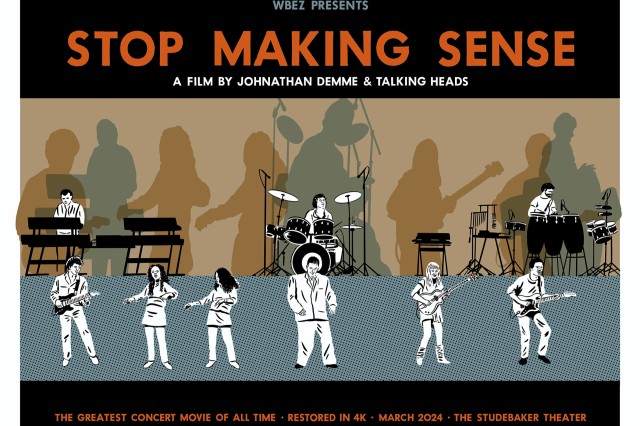
WBEZ Chicago is celebrating 40 years of one of the greatest concert films of all time, Stop Making Sense, at the Studebaker Theater in downtown Chicago’s Fine Arts Building.
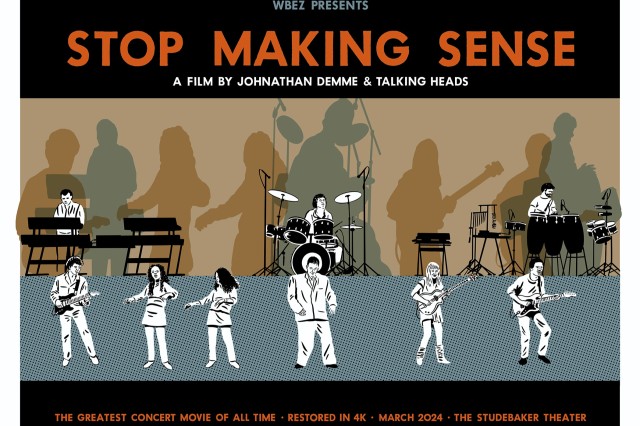 I love this movie. Every Sunday when my son was a toddler, he’d nap as his father studied, and I’d go to the movies. When he was old enough, we went to the movies together, especially on Christmas Day after the divorces, and it was just the two of us. At seventeen, he convinced me to see the Talking Heads’ 1984 concert film Stop Making Sense at the same Studebaker Theater.
“I don’t like punk rock,” I said.
“It’s not punk. It’s different. You’ll like it,” he convinced me.
He had his own band at the time and knew his music, so I trusted him. He was right. I blasted the Stop Making Sense cassette on my car radio until the tape wore out.
The film documents the legendary rock band Talking Heads performing at Hollywood’s Pantages Theater in December 1983. David Byrne, Tina Weymouth, Chris Frantz, and Jerry Harrison perform alongside an ecstatic ensemble of supporting musicians.
When my movie buddy Marca Bristo was alive, we went to the movies nearly every Saturday. We’d mull the pros and cons of what we had just seen in the quiet theater afterward before going off to a coffee shop to talk about politics. Marca died in September 2019. The releases that year included Little Women, 1917, and It’s a Beautiful Day in the Neighborhood. Part of mourning Marca meant slacking off on movie-going. I saw only one movie for the rest of the year, Just Mercy, which tells the true story of defense attorney Bryan Stevenson and his client, a black man falsely accused of murder. It was my quiet tribute to Marca, a powerful advocate for disability rights.
These days, I’m wary of catching Covid and all manner of infectious diseases so I’ve been in only one movie theater since March 2020 to see Caste.
But I may have to venture into the old Studebaker theater with its high ceiling and wide aisles  to see this old film with old friends who love the old Talking Heads. There’s just nothing like being in a room full of people who love what you love.
________________________


 Regan Burke