Body, Mind & Soul Music

Body, Mind & Soul Music

Candles, Israel-Gaza, and a World We Don’t Have Yet

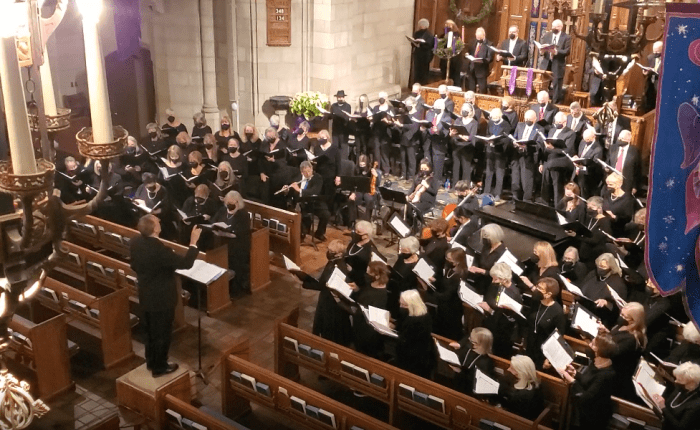
Jonathan and Sandy Miller founded “Sounds Good” choirs for older Chicago adults in 2016. Two years later, they added “Good Memories” choirs for those with dementia and early-stage Alzheimer’s. Having no background in singing and an inability to carry a tune or read music, I hesitated to volunteer to help people with following their sheet music. But Sandy and Jonathan said a fuller group would give people a better choir experience. So I joined.

I’d been worried that I had slid into a period of ever-increasing cognitive decline myself. In researching what was happening to me, I’d read that singing, particularly choir singing, could help stitch together busted nerve endings in the brain. It has. Learning to match the notes to the words, concentrating on reading the music, and trying to vocalize it seems to replenish bits of lost grey matter. Choir singing enlarges my world by healing the brain.
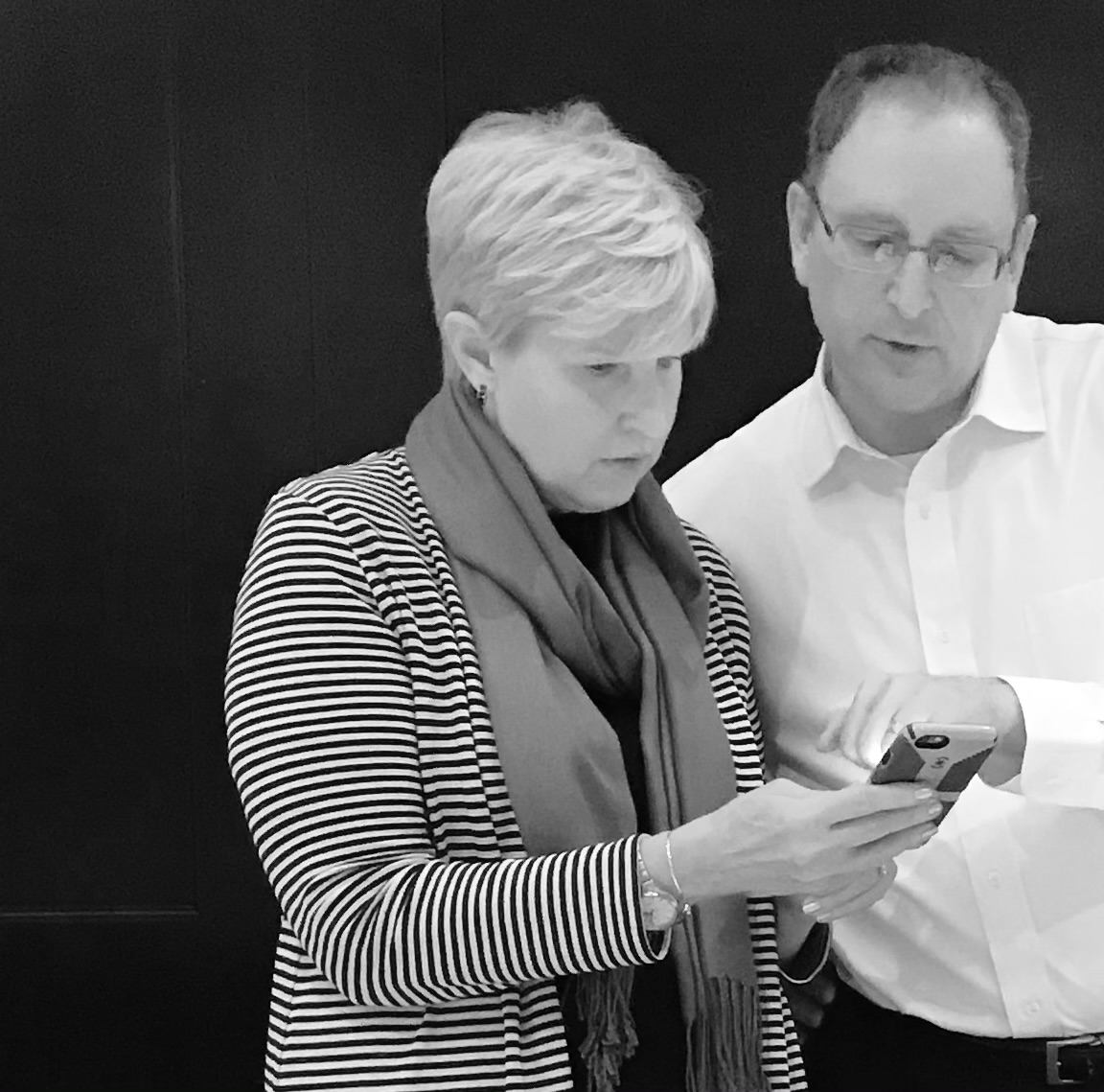
Sandy & Jonathan Miller, Founders of Sounds Good/Good Memories Choirs

Little did I know that the world of Jonathan and Sandy Miller is a body, mind, and soul experience. The following essay was posted on the Sounds Good website. Jonathan Miller doesn’t “preach’” as our choirmaster. But he and Sandy exemplify every good quality expressed here.


Come hear the fruits of these labors at our concert in Chicago on Dec. 21, 2:00 pm, 4th Presbyterian Church, 880 N. Michigan Ave.


Candles, Israel-Gaza, and a World We Don’t Have Yet

by Jonathan Miller

We have been rehearsing “Light One Candle” in all of the Sounds Good Choirs for many weeks. When Linda Powell and I picked the song for this fall’s concerts, we had no idea how timely it would seem now—almost prophetic. It suddenly feels deeply relevant, especially when seen in the context of events unfolding in Israel and Gaza. What is happening there horrifies me as a Jew and breaks my heart as a human being. My heart cries out at the suffering that has taken place and is bracing for yet more suffering to come. 

Look anywhere in your news feed for thirty seconds, and you’ll see it: we have not learned how to live together. A song, therefore, that acknowledges pain and suffering is a good thing right now. A song about “the terrible sacrifice justice and freedom demand” is a wise and timely song.

Light one candle for the Maccabee children
With thanks that their light didn’t die
Light one candle for the pain they endured
When their right to exist was denied

Peter Yarrow wrote “Light One Candle” in 1982 when war broke out between Lebanon and Israel; he said that he hoped the song would take hold in people’s hearts like “Blowin’ in the Wind” had captured American hearts during the Vietnam War. The song holds up the example of the “Maccabee children”—those Jews who stood up for themselves when the Romans took over the Temple in Jerusalem around 165 BCE—as a source of inspiration, resistance, and courage.
History gives us many such role models of courage. Sandy and I recently went to a fundraiser for the nonprofit “Facing History and Ourselves.” Facing History equips middle- and high-school teachers and administrators to embrace a thoughtful, rigorous approach to history to promote civic engagement, a sense of empowerment, and the investigative rigor to understand how injustice happens—so we don’t have to repeat past mistakes. Their training and curriculum resources encourage deep inquiry. They show students how to ask the tough questions. They foster in an entire school (not just a social studies classroom, which is super cool) an orientation toward challenging entrenched attitudes about race, bullying, homophobia, and other volatile topics. A young woman spoke at the fundraiser; she had studied with Facing History in high school and had just graduated from college. Her words were an inspiring lesson in honesty and bravery. She said her college “worked hard to get Latinx students there, but they didn’t make us feel welcome when we arrived.” She spoke of fighting to raise awareness of the issue, to help create safe spaces for Latinx students at her college, and of her vision to shape a career that combines her passion for reproductive rights with her concern for immigrant women.  

Light one candle for the strength that we need
To never become our own foe
And light one candle for those who are suffering
Pain we learned so long ago

The event concluded with a conversation between Jonathan Eig, whose recent biography of Dr. Martin Luther King, Jr. has met with critical acclaim, and Adam Green of the University of Chicago, whose scholarly work includes post-emancipation African-American history, cultural studies, and urban studies. The conversation was about Dr. King’s legacy for us in our time; it was fascinating, and I felt stretched in a wonderful way afterward. The conversation took a deep dive into, among other things, our tendency to put leaders on pedestals; the seminal influences on King’s life and thinking, including Coretta Scott King and Rosa Parks; and King’s own way of stretching himself to take on bigger and bigger problems, even when it was very difficult, and of continuing to find and engage with people whose views differed widely from his own, including Stokely Carmichael and the toughest Vice Lords gang leaders in Chicago.

Light one candle for the terrible sacrifice
Justice and freedom demand

Toward the end of the conversation, Adam Green reminded the audience about Howard Thurman’s 1948 book, “Jesus and the Disinherited,” one of my favorite books. A mentor to Dr. King, Howard Thurman was dean of the chapel at Boston University and one of the most influential theologians of the 20th century. In this book, Thurman speaks to the downtrodden of the time: Americans of African descent, against whom Jim Crow relentlessly hurled insult upon humiliation upon pain upon injustice. However, rather than encouraging African Americans to succumb to rage, violence, hate, or disconnection, Thurman exhorted just the opposite: moral courage, a conviction that their own basic goodness, in concert with others, could turn the tide, and a sense, using Christian language, of “committing myself to the redemption of everyone.”

Echoing Gandhi, who said, “Nonviolence requires more courage than violence,” Dr. King said, “We will meet suffering with soul force.” When we do not follow the crowd by succumbing to fear or fearmongering, we can look our situation squarely in the eye and begin to tell the truth of the situation. Following this example, we must insist on goodness and truth-telling from ourselves first, holding ourselves to a higher standard rooted in compassion, what Abraham Joshua Heschel calls “moral grandeur and spiritual audacity.” This, in turn, creates a virtuous cycle of people committed to making the entire situation work for all concerned. I especially like how Buddhist nun Pema Chödrön describes King’s mindset: “For me to be healed, everyone has to be healed.” If my life gets better, but you are left in the dust, does that really work in the long run?

Light one candle for all we believe in
That anger not tear us apart
And light one candle to find us together
With peace as the song in our hearts

A worldview where we all mattered… what would our planet look like if that’s what we all strove for? How would we have to enlarge our sense of who “we” are if we wanted that sort of society? Can we challenge ourselves, individually and collectively, to do that? I’d like to find out. I’m not sure we can survive as a species if we don’t.

What all these wise people are pointing to is not conventional thinking, and I don’t claim to be good at it. If it were easy to create a bigger box that could hold us all, what King called “a revolution of values,” we would have done it by now. But I want that world: an America, for example, where I don’t have to choose between health insurance and food or between living in my car and paying rent and where I don’t have to endure ridicule for wanting that. I want a world where my character and skills matter more than my skin color. I want a world where caring for my children or parents doesn’t mean I have to quit my job. I want to be able to love whom I choose, make choices about my own body, and live with dignity in a place that I can afford. And of course, I want a world where the gifts and experiences of older adults are celebrated. It may take us still more centuries to “light one candle to find us together with peace as the song in our hearts,” but it’s the right direction. Let’s go there.

Don’t let the light go out!
It’s lasted for so many years!
Don’t let the light go out!
Let it shine through our hope and our tears.

“Light One Candle,” written by Peter Yarrow. Lyrics ©Warner Chappell Music, Inc.

©Jonathan Miller


Is This Funny?

Is This Funny?

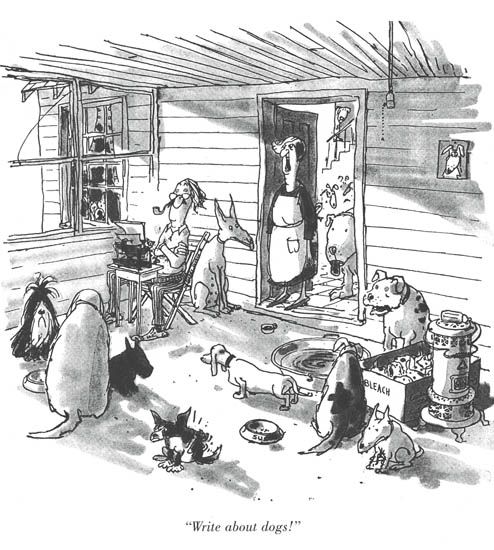
George Booth, the New Yorker cartoonist who died in November 2022, once created the funniest cartoon in memory. First of all, Booth’s silly line drawings were and remain funny enough–they don’t need captions. But the one I so love is a man sitting at his typewriter on a dilapidated porch wistfully smoking a pipe. Nine or ten dogs of different sizes and shapes laze around. There’s a bulbless socket hanging from the ceiling. His wife stands in the doorway. Caption: “Write about dogs!”

Ok. Ok. It’s not the funniest cartoon to you. But for me, a dog owner and a writer, it’s hilarious.

Obviously, the cartoon man has shouted, ‘What should I write about?’  ‘Write about dogs’ is a funny way of saying ‘write what you know’, writing’s first principle. Even fiction holds truths. Funny conversations and tales of goofy adventures are all around, like the dogs in Booth’s cartoon. I hesitate to write them because I don’t want my blog-reading friends to know how amusing their lives are to me. And what if the writing isn’t funny?

This summer I attended a free Comedy Writing Workshop taught by a professional, very intuitive, improv comedian. We didn’t have to pretend to be a tree or a bologna sandwich, though that would’ve been a kick; we simply pretended we were at job interviews and went back & forth with questions and answers. We could have answered any old way, and indeed creativity was encouraged, but everyone in this group seemed to answer like their jobs were on the line for real. And they. were not. funny.

Me? I said I was fired from my last job because I attempted to kill my husband with a stapler when he came to the office for a surprise lunch. Funny? I thought so, but no one laughed. Perhaps I actually look or sound like a murderer.

The comedy teacher smartened up to this over-55 group right away. She tailored the two-hour class to the cognition level of the twelve students she had before her. And still, no one was funny.

A friend of mine who’d recently been examined for dementia gave permission to the memory doctor to ask me how my friend had changed. Without hesitation, I answered, “She’s really funny but it’s taking her longer to get the punch line.”

Is this part of it? Aging, I mean.

Most researchers I skimmed agree that age-related cognitive decline contributes to difficulty with “humor comprehension”. The list of symptoms includes:

  • An inability to understand satire
  • A childlike sense of humor or enjoyment of slapstick comedy
  • Laughing at things that are not particularly funny, such as a dog barking
  • Taking jokes literally
  • Making inappropriate comments about strangers in public

George Booth created his last New Yorker cartoon ten months before he died from complications of dementia at 96. The cartoon cover is a goofy white dog glancing at a clock. Is that funny? A dog checking the time? 

If not, George and I share the same demented symptom of chuckling at things that aren’t particularly funny

.

Collective Salvation

Collective Salvation

My friends and I laugh when we can’t remember the names of a TV series or old movie stars. We keep the conversation going anyway, knowing sooner or later someone will blurt out,”Paul Newman!” who starred in Cat on a Hot Tin Roof with um, what’s her name? Oh yeah, Elizabeth Taylor.

Memory isn’t the only part of the brain clogged up. It takes longer for us to get the punchline of a joke. And we worry about the one who stops getting the punchline altogether. Processing information requires sifting through a lifetime of brain clutter. It simply takes more time these days. 

When I first became aware of the rummage sale in my head, I consulted Dr. Google for tips on decluttering. Dr. Google assured me that indiscriminate shopping, getting lost, difficulty with numbers, language, dates, names and places are all part of the normal aging process called cognitive decline. Researchers say eat right, exercise, socialize and learn something new.

And consult a neurologist.

I called the Mesulum Center for Cognitive Neurology at Northwestern University. “Someone will call you back,” the receptionist said.

“Can’t I just make an appointment?”

“No. Someone needs to talk to you first.”

“I’ll wait.”

“No. Someone will call you.”

I missed the callback. Called again. Missed again. And again.

Processing TV news had become difficult. I couldn’t connect information from one sentence to the next. To understand morning radio, I had to stop getting dressed, sit down with a cup of coffee and listen. Reading was clunky. Some words on the page faded. Some didn’t. I went to the eye doctor three times within six months. She insisted my vision was fine.

A friend told me about a new choir for people with early-stage memory loss. The organizers sought volunteers to help people with the music and to round out the choir. No audition or experience required. I’d never read sheet music or sung in a choir but I love to sing. So I signed up.

The first day I hesitated to accept my songbook. Would I remember to bring it to rehearsals? Would I even remember the day and time of rehearsals? People asked me what “part” I sang. I had no idea.

“I have to sing the melody,” I said.

After a few warm-up exercises we started learning an Oklahoma medley. Alice, sitting next to me, noticed I was having trouble. The music was running ahead of me—I couldn’t catch the words. She pointed to the soprano lines and pulled out a yellow marker to highlight them.

“Sing the notes with the stems pointing up,” She whispered.

That was 2018. I mark my own music now, never forget a rehearsal and can find my place on the sheet. Months of practice pulls the music closer, though I never feel concert-ready.

In December 2022 our repertoire included songs in five languages. Each deja-vu rehearsal seemed like a new beginning. I rarely got my voice to attach the foreign words to the notes. But on concert day, my brain latched onto another dimension. I sang perfectly.

I’d say I really cleaned up.

Just in Time, I Found You Just in Time

Just in Time, I Found You Just in Time

I used to ignore articles that say cognitive decline slows if I eliminate sugar or play bridge. I found work-arounds instead. When I lost my numbers I set up automatic bill payments with the bank. I can never remember if choir practice is on the fourth or fifth floor; I simply follow my fellow singers. And I rely on my phone or friends to tell me the dates and times of my appointments, events and plans.

Memory loss has been gradual. I’m in good company though—my friends and I laugh Unknownwhen we can’t remember the name of the movie we just saw. But when I started hyperventilating with disabling anxiety in airports and receiving bizarre Chinese packages I’d ordered from ads on Face Book, I called Northwestern Hospital to see a

neurologist.

“Someone will call you back,” the receptionist said.

“Can’t I just make an appointment?”

“No. Someone needs to do an intake over the phone first.”

“I’ll wait.”

“No. Someone will call you.”

I missed the callback. Called again. Missed again. And again.

I felt like I was racing against the clock. Processing the TV news was becoming difficult. It moved too fast and I couldn’t retain information from one sentence to the next. To understand NPR’s Morning Edition, I had to stop getting dressed or making my bed, sit down with a cup of coffee and listen. Reading the news wasn’t impossible, just clunky. Some words on the page faded. Some didn’t. I went to the eye doctor three times within six months. She told me there was nothing wrong with my eyes or my vision.

I consulted Dr. Google. Indiscriminate shopping, getting lost, difficulty with numbers or language as well as forgetting dates, names and places are all a part of the normal aging process called cognitive decline. Researchers say eat right, exercise, socialize and learn something new to keep your brain from slipping past the point of no return. Some say singing actually heals the brain, so I joined the Good Memories Choir.

IMG_1112
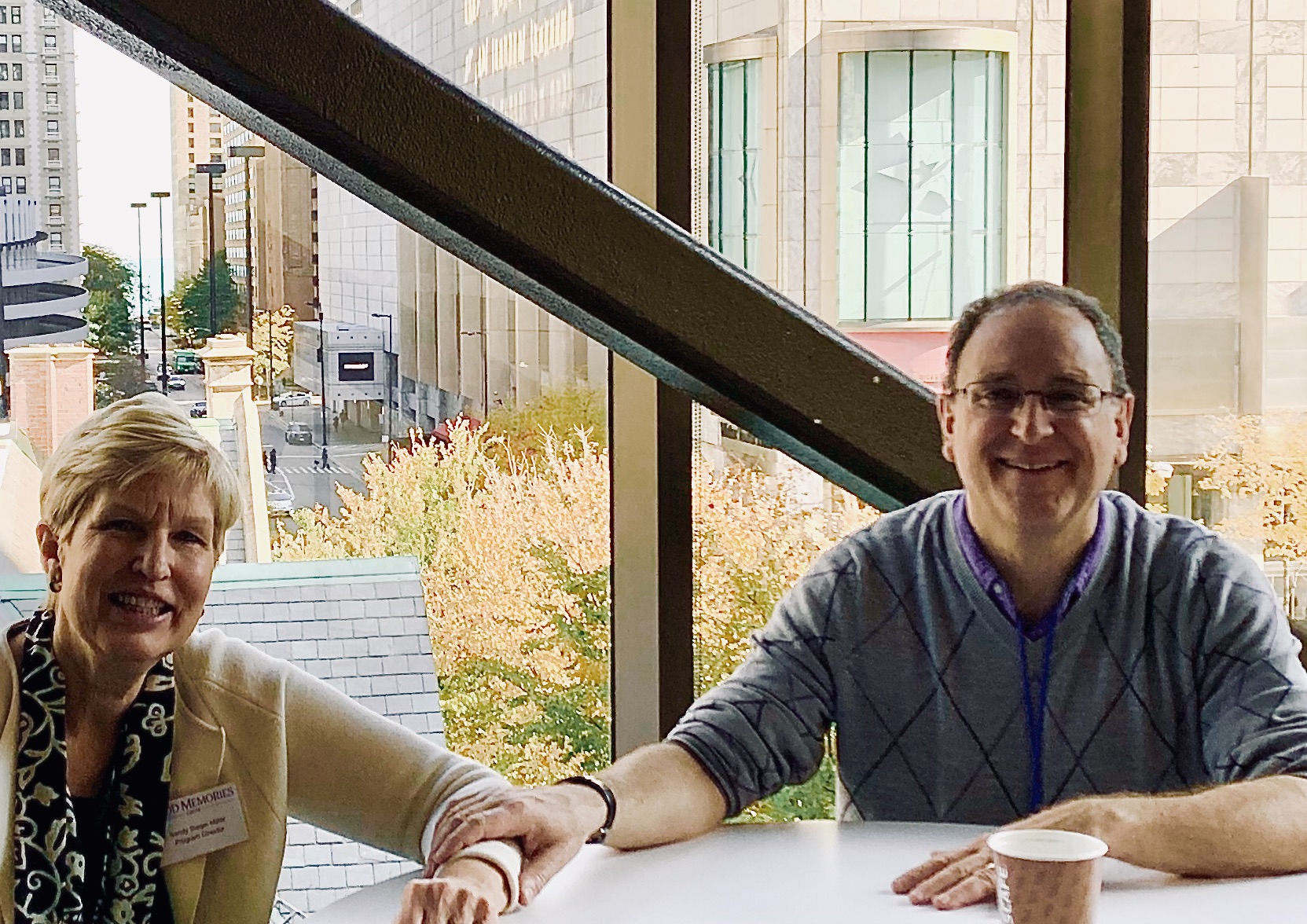
Jonathan and Sandy Miller • Founders of Good Memories Choir               Fourth Presbyterian Church • Chicago

On the first day I hesitated accepting my songbook. Would I remember to bring it to weekly rehearsals? Would I even remember the day and time of weekly rehearsals? People asked me what “part” I sang. I had no idea.

“I have to sing the melody,” I said.

Alice sat next to me in the last row of the soprano section. I love to sing along but I know nothing about music. The singing was running ahead of me—I couldn’t catch the words. After singing a few songs, Alice showed me the soprano lines and suggested I highlight the words. She told me to sing the notes with the stems pointing up. I focused. I was learning a new language.

Good Memories is a choir of people with early-stage memory loss, their care partners and volunteers. I met the Google criteria for cognitive decline but I didn’t have an official diagnosis. I joined as a volunteer, unsure where, or even if, I fit. After singing every week for over a year, I never forget my songbook, the lyrics are nailed to the page and I follow the notes.

One of the first songs we sang, The impossible Dream, seemed impossible for me. There were too many words too close together. At the concert I sang every word. And Alice whispered, “You made it.”

Yes, I did. Just in time.


Learn more: Five Symptoms of Cognitive Decline

Join a choir! Jonathan Miller, Artistic Director of Good Memories Choir will help find one in your area. Contact him.


Treat yourself. Watch Judy Garland sing Just In Time

Shallow, I’m Into The Sha-la-la-low Now

When the attendant told me I was at the wrong gate, I froze. I’d been at Midway Airport for two hours waiting to fly to Salt Lake City for my granddaughter’s 2018 graduate school graduation. My vision blurred, my legs shook and I gaped at him without speaking. I actually couldn’t hear him. Someone grabbed my arm and raced me over to the correct gate just before the jetway closed. Inside the plane, I was escorted to Row A
where they keep an eye on people. th-4

I traveled twice more that summer. Once I was in the wrong TSA line, so confused that a stranger brought me to where I needed to go, again. I’ve since developed a phobia, thanks to nightmarish remembrances of Tom Hanks in the movie Terminal—about a man who lives in the airport after he is denied entry into the US.

A friend who works for O’Hare tells me airport workers regularly experience confused old people wandering around lost and panicked. I’ve traveled a lot in my life but familiarity with airport commotion holds no weight now.

When I first retired, I was unsympathetic to people with cognitive disorders. I joined the morning exercise classes at church but not to make friends. I told myself I wasn’t like those old people. Well, those old people have subsequently shown me how to be old, have compassion for those who talk slower than I do, who will never remember my name nor I theirs, nor the title of the book we just read or the movie we all saw. Our get-th-7togethers are often hilarious games of 20 Questions where we all guess what someone is trying to remember.

There’s just not enough room for all the bits lodged in my aging brain. A mysterious natural phenomena controls the shedding and changing of my grey matter, like menstruation and menopause in my body. Trouble is, the shedding seems to be more active these days. Oh sure, curiosity fills my brain with new information but its cells refuse to let those memories form and what I learned yesterday is soon forgotten.

One technique I use to block braincell destroyers is to ignore anxiety-producing articles that say cognitive decline slows if I eliminate sugar or learn chess. Perhaps the content is correct, but I’m possessed of my own version of old age, not a researcher’s cookie-cutter version. Similarly, I cast off brain-shrinking agitations delivered by younger friends who tsk me for walking too slow or for asking them to speak up. 

However, I love music so I responded to an article about choir singing strengthening the memory and joined the Good Memories Choir. Singing won’t get me back in airports, but learning music keeps me attached to the real world. In Bradley Cooper’s remake of A Star Is Born, Lady Gaga sings about the love of the two main characters as “far from the shallow now,” as if the brain has no choice but to deepen the couple’s experience. In my case, like the reversed flow of the Chicago River, I have no choice but to spill out of the deep and into the shallow now.

___________________________________________________________

For those who don’t understand my title, I give you, with love, Shallow