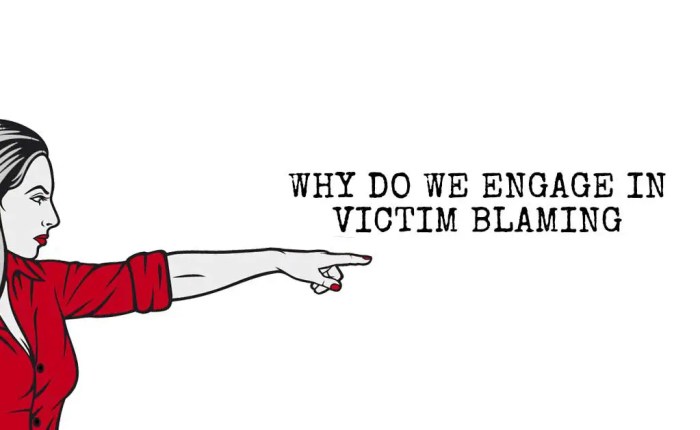
When my dog died of liver cancer, I thought it was my fault. Why, you ask? Because I didn’t keep him from eating sidewalk nasties. What the hell? Did I think I was that God I no longer believe in? You know, the God who causes pain and suffering?
Victim-blaming runs deep with me. I’m good at it. Whether I blame myself for dead dogs, misfortune, and health problems or I blame others for theirs, the first thought upon hearing bad news is, what did I do wrong? What did they do wrong? When a friend told me she was hospitalized for an irregular heartbeat, my reaction was, “How does that happen?” Implying she did something to cause it.
Before the pandemic, in my downtown Chicago neighborhood, thugs drove around casing out pedestrians, jumping out of cars, knocking vulnerable people to the ground, and stealing their belongings. My neighbor reported getting mugged in broad daylight while walking her dog. My reaction?
“Why weren’t you wearing that whistle I gave you?” As if she could have done anything to stop three teenage boys from shoving her up against a brick wall and ripping into her clothes to find her iPhone.
At community meetings, police officers gave primers on how to protect yourself. Among the suggestions was to attach a colorful whistle to your coat, not necessarily to use, but as a deterrent. I had a few bright red whistles from RAINN.org, the national anti-sexual assault advocacy group, so I called and asked for more.
“We don’t have those anymore. Our survivors thought they were a sign of victim-blaming.”
Whoa, I didn’t see that coming. I get it, though. Victims of sexual assault are hyper-aware of all the ways society, either by word or by thought, says, “That’s what you get for wearing those clothes or walking on that street at 3:00 a.m. or not wearing a whistle visible to your attacker.“
Over twenty-five years ago, I became a victim of fibromyalgia, a mysterious inflammation of the tissues connecting the muscles to the bones. That’s not the exact definition. I use that description because it’s easy for me to visualize. Contrary to all medical knowledge, I have a notion that if I can visualize it, I can heal it. I get relief with meditation, movement, and writing, but there’s no cure, no healing. I think I can fix it because I blame myself for causing it.
Deep down, or really just below the surface, I cannot accept the randomness of bad things happening to good people. I want reasons and meanings—some way to help me control the fear that I’m next. This psychology is my Screwtape, the Tempter leading me into madness. Dr. Google tells me it’s a natural phenomenon. I’m committed to seeking a way forward through virtuous self-care. But that, too, is Screwtape tempting me into believing I alone can fix it.

Living untethered to reasons and meanings is like George Clooney detaching himself in the movie “Gravity” to save Sandra Bullock. It requires courage received only through grace.
 room or home or even all the gory details about my parent’s drinking. It means to write that I wished my mother was more like I-Love-Lucy or that on most mornings I put my finger under her nose to test for life.
 Regan Burke