Why did so many people ask me about watching the State of the Union speech? And not just me. Local news reporters asked people on the street.I’ve Had It Podcaster Jennifer Welch asked Resister Senator Chris Murphy of Connecticut if he was going.
“Well, hell no, I’m not going. He’s made a mockery of the State of the Union. And we don’t need to be a backdrop to his histrionics.”
Honestly, it’s not like the speech was the U.S. Women’s Hockey finals at the Olympics. It was Donald Trump’s State of the Union. The news about the number of Democratic Members of Congress and Senators not heading over to the House Chamber in the Capitol was interesting. However, it was expected. We didn’t need to see breaking news headlines about each boycotter pop out of our phones all day.
Resister Senator Raphael Warnock of Georgia preached at Trinity Church in Chicago Sunday. His sermon was titled I’ve had enough. Using the Hebrew Bible’s Isaiah, he reminded us of wicked kings. These kings and wannabe kings erase anything that looks like diversity, equity, and inclusion.
“Don’t act like this is politics as usual. This is not just politics, it’s spiritual wickedness in high places. Haven’t we had enough?”
Senator Warnock said God hates solemn assemblies that normalize this political spiritual wickedness. God hates?
“Wickedness in our lifetime is being facilitated and approved and applauded by people who are sitting in somebody’s church this morning,” preached Warnock. I’d hate that too if I were God.
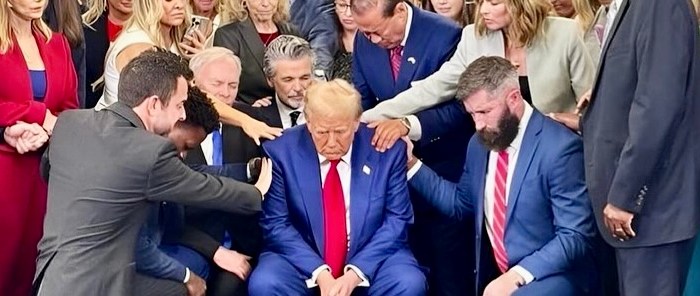
Last summer, Speaker of the House Mike Johnson gathered some of his boys in prayer. They met in the basement of the Capitol. They emerged from their subterranean huddle to vote on the bill that kicked 15 million people off health care. Warnock questioned who those boys prayed to. Who did they talk to?
Senator Warnock did attend the State of the Union speech. Good for him. His ministry of solemn presence condemns the MAGA religion of those boys in the basement.
Trinity Church’s pastor, Rev. Dr. Otis Moss III and Rev. Dr. Raphael Warnock are alum of The Auburn Senior Fellows. They are two of twenty-five top leaders who bring justice-centered faith into the public square. An unprecedented cohort of changemakers, they were brought together by Auburn Seminary in New York City. You’ll see them in places like Minneapolis and Alligator Alley, No Kings rallies and detention center protests. No matter your religion or no-religion, if you ever get a chance to see one of them, go. Just go. They are listed here.
The titles of Jennifer Welch’s podcast I’ve Had It and Warnock’s preaching I’ve Had Enough are misleading. Yes, they’ve had it, had enough. But they keep going, keep speaking out, keep organizing, keep preaching.
In the early 1970s the doomsday prophecies in Hal Lindsey’s The Late Great Planet Earth, stoked my Toms River, New Jersey, Christian fundamentalist cult. Little did I know that the prophesies of the cult religion of my youth would come true through a new religious movement, the National Apostolic Reformation (NAR). Fifty years later.
Based on his interpretations of the Book of Revelations, Hal Lindsey connected end-of-the-world Biblical prophecies to current events. In his view, Satan’s plans to form a one-world government and religion were triggered by the establishment of the state of Israel and the World Council of Churches—both in 1948.
Converts, like me, of the 1970s Jesus movement, still flash-backing to acid trips, saw signs of the end times around every corner. In our small church community, anti-globalism was our protest because Satan was using the banks to form a global economy. We boycotted the Bank of America. We refused to use credit cards. We wrote letters condemning the birth of the European Union. An increase in the divorce rate, recreational drugs, new technology, the gasoline shortage, religious ecumenism. All these signaled the diabolic end of the world, the coming of the Antichrist, or some kind of unearthly vision that terrified vulnerable young comfort-seekers.
I left the Christian cult after sobering up in Alcoholics Anonymous, divorcing an abusive husband, and moving 1,500 miles away from the scene.
Starting in the 1980’s, unbeknownst to me, Christian fundamentalism slowly morphed into the New Apostolic Reformation. The prime NAR chronicler, Matthew D. Taylor, describes the NAR’s leadership as a “spiritual oligarchy” of apostles and prophets. Apparently God has told NAR adherents that Donald Trump is their spiritual leader. You’ll have to figure that one out for yourself, but the results are obvious.
The NAR apostles and prophets tell Trump his job is to “advance God’s earthly kingdom so Christ can return.” Advancing the earthly kingdom is outlined in Project 2025. The elimination of abortion and women’s rights; same-sex marriage and gay rights; dismantling USAID as a stand against globalism—all the shockers in the first year of Trump 2.0 are advancing the earthly kingdom.
Venezuela is the biggest shocker so far, at least for me. Fifty years ago I learned that the Book of Revelations prophesied God would make the United States, Russia and China the world’s three spheres of influence. The United States would get the entire Western Hemisphere. Russia gets its region, and Europe. China gets all of Asia, India, Africa. This is the umbrella of national sovereignty, the opposite of international integration and the seeds of anti-globalization.
A radio broadcaster startled me on Saturday morning, January 3, with the news that the US invaded Venezuela. The long-forgotten voice of myself as a 25-year-old Jesus Freak bellowed, “Uh. Oh. Wake up. It’s happening.”
Donald Trump, in a 2017 speech to the Joint Congress, announced he was not the President of the world. Instead, he stated, he was the President of America. These words sent a signal to anti-globalists and end-times prophets around the world. It was a declaration that the US will once again dominate the Western Hemisphere. Vladimir Putin confidante Alexander Dugin, heard the call and issued a statement that traditionalism had won, globalism lost.
Anthropologists say pandemic uncertainty, virtual reality, environmental issues, old-age anxiety, border disputes, memory disorder, and gender trouble put society in a self-protective liminal state, a state betwixt and between. Perhaps these unsettling markers ushered in Donald Trump as the leader of the new world order. Now that we’ve fallen over the threshold, what do we do?
Something fluttered around me, as if I’d stepped into a web of butterflies. But I hadn’t. Butterflies were off in the distance. On the Nature Boardwalk surrounding the marshy South Pond in Lincoln Park I was soaking in the August-blooming bubblegum-colored big-flowered swamp mallows. And there on a daisy branch sat a goldfinch. And another, on a farther branch. Hidden in the yellow coneflowers were a few more, pecking at seeds. Goldfinches had entered my airspace as they headed for the wild prairie flowers at the swamp’s edge. Goodness nurturing goodness.
My held-breath whispered, “You know, Regan, God did not have to give us the goldfinch.” At that moment, as others before it, I believed in God. The previous morning, fearing all goodness had vanished from the earth, I assumed God, like the butterflies, had flittered off in the distance, out of sight, out of the picture.
I lost my faith in goodness for the umpteenth time the day President Trump told Texas Governor Greg Abbott to redistrict Texas in order to gain five more gerrymandered Republican Congressional seats. Americans, who vote with their pockets, are realizing everything they buy to survive in this world since Trump became President has skyrocketed. Because of that, commentators suggest Trump is afraid we’ll all vote against his MAGA party in the 2026 mid-term elections yielding more Democrats in Congress. Cynics say Trump needs more Republicans in Congress in case he declares an “election emergency” and tells Congress to appoint him for another term.
No one need explain redistricting to me. In the 1980s I worked in the Illinois legislature where computerized gerrymandering was invented in the basement. Drawing legislative lines to benefit Democratic incumbents was de riguer, not just acceptable, but expected. No one uttered the word gerrymander then. Today, Illinoisans are surprised to hear Republicans scoffing that their state takes the cake on gerrymandering. The secret is out.
Republican Governor Abbott yielded to Trump’s demand. He introduced a newly drawn map with the five added Republican Congressional seats to the Texas legislature. The Democratic Texas lawmakers promptly left the state. The Texas legislature needs those Democrats in the Austin capital to make up the necessary quorum to vote on that map.
And those Texas Freedom Fighters, as they’re described at Jesse Jackson’s Rainbow PUSH Coalition, are housed in a high-security hotel outside of Chicago. They’ve had bomb scares and death threats. They cannot move around without security. I can’t think of a lower hell than being far from home stowed away in an exurb hotel with no end in sight.
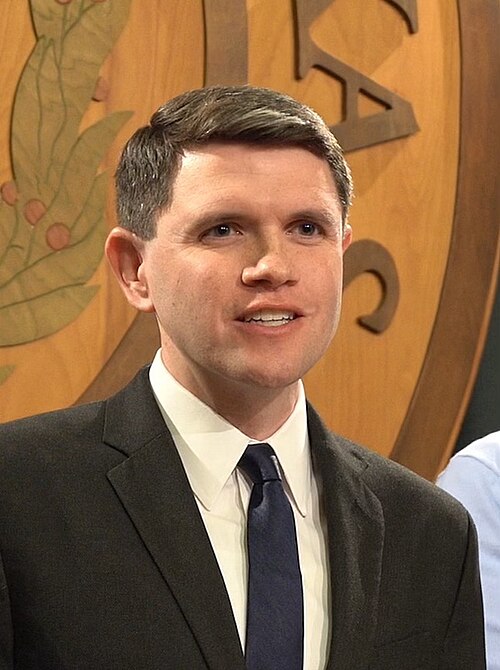
One of the exiled Texans, James Talarico from Austin, attends a Christian seminary to ground himself in the fight against White Christian Nationalism that’s roiling the Texas legislature. A nurturing goodness, he speaks of hope and love and responsibility to the United States.
These Texans, these democracy heroes, are saving us from the worst of gut-wrenching trumpism. When the day comes to proclaim their victory, let’s stroll around the Nature Boardwalk among the goldfinches, daisies and butterflies, nurturing goodness.
At Saturday morning coffee in downtown Chicago, a friend and naturalized citizen joined our small group. They work (or by now, worked) at a federal agency where half the workforce had just been fired.
“Are you next?” I asked.
“I wrote a list of things I can do to make money. Nothing to do with my profession but at least I have options,” they said, “I have EU passport and know some languages. My European colleagues are already strengthening connections between their countries. There’ll be jobs.”
Watching TV on February 28, I was like a six-year old sitting cross-legged in front of a life-size screen expecting it to throw itself at me. The Trump-Vance shakedown of Ukraine President Zelensky in the Oval Office presented TV reporters and viewers with a clear and present danger. The US just changed sides. We would now be the puppet ally of Russia’s Vladimir Putin. The reporting immobilized me. What happened to Putin the mortal enemy? Another historical norm thrown onto the MAGA heap of used-to-be’s. Cafe societies the next day ratcheted up conversations about how to leave the country.
Our President was now our enemy.
How I want to write more about my friend! Their story about growing up behind the Iron Curtain during the Cold War intrigues this nosy Midwesterner. But I fear exposing my friend to gotcha algorithms that worm around the internet. I even write “they/them” so the sex can’t be identified.
They said, “Big difference between here and country of my childhood. Before the breakup of USSR, you’d be killed if you wrote forbidden words.”
Alexander Dugin, a friend of Putin’s, on the day of Trump’s 2024 presidential victory, proclaimed that “traditionalism won. Globalism lost. A victory for Russia.”
Globalism has been the hallmark of the devil infundamentalist Christianity since before Jimmy Carter’s presidency. At my small fundamentalist Christian church in the 1970s, a friend pulled me aside one Sunday during coffee hour. She said Jimmy Carter’s White House Conference on the Family was diabolic. We were both former hippies. We grew cabbage in our back yards. We made our own yogurt. We balanced our immune systems with apple cider vinegar. I thought I knew her.
A Christian convert, she’d been exposed to the idea that Carter would lay out his progressive American family values. Then spread those ideals around the world through programs like USAID.
“Carter is promoting globalism,” she said. “He wants all families to think like him.”
Preposterous? Yeah. I thought so too.
New York Times columnist, David French, is the original Never-Trumper. An evangelical Christian, French teaches history and the constitution. He explains Trumpism from a biblical point of view. Prophesying Christians, Pentecostals and traditionalists believe the Devil is the force behind globalism. Prophesied in the Bible. These Christians tell Trump he’s God’s man to lead America out of the spiritual darkness of globalism, especially because he survived a gunshot to the head. Trump’s leadership in anti-globalism, divvying up the world pie between the four leaders, Vladimir Putin, Xi Jinping, Donald Trump and Benjamin Netanyahu, is victory over the Devil. Oh.Yeah.
Long before Trump, when insecurity and doubt began settling in my young joints, I was desperate for certainty. I fell for these biblical prophesies, these absolutes. I sobered up, married and mothered a boy. I worked in a stain glass factory and had a garden. Despite these, I fell into a years-long fever dreams submitting to charismatic prophesying men. When I woke, a Presbyterian preacher told me doubt was good, certainty wasn’t. Putting church friends behind me, I rejected the prophecies of Christian fundamentalism.
As I was about to cross the threshold toward the elevator with Elsa tethered to my thick gloves, I reached back for the handle to close the door behind me. At that moment, WBBM news radio announced Anita Bryant had died. Out in the park, Elsa tiptoed on the crunchy December earth — a slower walk leading to a longer think. Memories arose about Anita Bryant and her anti-homosexual campaign in the 1970s.
Anita Bryant, a Miss American pop singer who sold Tropicana Orange Juice on TV was so well-known in US culture that her startling attack on homosexuality betrayed her seemingly good-natured Christian persona.
Elders in the fundamentalist Christian cult where I spent a few years in the 1970s never addressed homosexuality. They also ignored any other moralistic culture clash that evolved because of Bryant’s media campaign. I doubt any of us in that community even knew a homosexual. Oh, there were instances of men going off on drug-addled toots and ending up in gay bath houses. They’d come crawling back to church asking forgiveness from an uncomfortable congregation that had no knowledge of gay life. I was never sure what we were meant to forgive since no sin was committed against us.
Bryant, sparked by a Dade County, Florida decision to protect sexual orientation as a civil right, created the Save Our Children coalition to build anti-gay public support. She succeeded. In June 1977, the Miami area voted against homosexuality as a civil right, an act that lasted twenty years.
Fresh from the Florida victory,Anita Bryant brought her teethy bigotry to Chicago to perform a white-bread repertoire including her signature “Paper Roses” at the Medinah Temple. She was met by 5,000 gay rights protesters.
Christian churches throughout the country were called upon to take a stand, including mine. Homosexuality was justified as sin through church elders’ literal interpretation of a few bible passages. It became a disqualifying dictum for church membership. I knew nothing about homosexuality. Shunning people, however, didn’t fit with what brought me to Jesus, namely the parable of the Good Samaritan, or love one another, especially the least among us. I’ve needed that Jesus all my life. Extending unconditional love is a hard practice. In fact, it’s really impossible. I’ve always known it’s required of me nonetheless.
Anita Bryant’s anti-gay campaign invigorated gay activism in the civil rights movement. We had a new cause. We boycotted orange juice. We attended Chicago’s Gay Pride parade that year. We mocked Tropicana’s tagline by wearing t-shirts that said, “A day without human rights is like a day without sunshine.” Gay rights, women’s rights, equal rights, all blended into one big active advocacy movement.
I moved on to La Salle Street Church, which made no small point of accepting all people. Founded by rejects from the Moody Bible Church down the street, these Christians were definitely descendants of the real Jesus. They left Moody because the church elders required blue-jeaned converts to sit in the balcony and wouldn’t allow them to receive the Eucharist. In the 1970s, no one wore blue jeans except anti-establishment long-haired hippies, known these days as Progressives.
The noise generated by the blue-jeaned Christians galvanized the nascent Christian fundamentalists, known these days as White Christian Nationalists.
I’m not sure what happened to separate the civil rights groups. Gay rights, abortion rights, voting rights and anti-violence organizations eventually established their own fundraising machines side-by-side with their own causes.Everyone started marching to a different drummer. We came together to protest the Iraq war and for the pink-hatted Women’s March after the 2016 election. But not all my friends showed at the NATO protest in 2012.
As a straight white old lady, I’ve recently tried with scant success to advocate against ageism. I no longer wear blue jeans. Dress codes are almost extinct. This is evident by Elon Musk’s t-shirt, MAGA hat, and long, black, steampunk coat at an Oval Office press conference.
Anti-ageism is the most difficult cause to rail against. It’s an implicit or subconscious bias, practiced by those who are discriminated against and by those who do the discriminating. Dismissing Elon Musks’ functionaries as teenagers and constantly stating their ages is a display of age-bias. The same applies when stating Joe Biden’s or Donald Trump’s age. Or mine.
“You don’t act like a 78-year old,” remarked a friend last week.
“Yes I do. This is what 78 acts like.” I shot back.
It’s not that age isn’t a good descriptor to place people in their lived experiences. But age as a descriptor is most often used to put people in their place. The unchecked functionaries have stolen my Social Security records inside the US Treasury Department. They are no better or worse than me because of age. They are wrong no matter how old or young they are.
As happened with Anita Bryant, is it too dreamy to imagine a galvanizing backlash? Is a movement forming to neutralize the extreme bigotry falling out of the dirty mouths of Washington DC?
First Holy Communion is a right-of-passage ceremony in the Roman Catholic Church where a seven-year-old is initiated into eating the body of Jesus Christ. I learned the elements of the Catholic service, the Mass, with my classmates in the second grade. The priest transforms the bread into Jesus’ body and the wine into Jesus’ blood. The wine, the blood of Jesus, is reserved for the priest. We the people eat paper-thin white tasteless wafers, the body of Jesus. Catholic children all learn that after we make First Communion, it’s expected we’ll eat the body of Christ every week for the rest of our lives.
“Let it dissolve in your mouth,” the nuns instructed, “It’s a sin to chew the body of Christ. And don’t touch it!”
The pomp and ceremony of my First Holy Communion overshadowed any eww!-ness related to eating Jesus’ flesh. Prim little girls wore white crinolined lace dresses, white shoes and socks, white cotton gloves and angelic white veils. Like brides. Squirmy spit-polished boys wore ill-fitting white suits and ties. Children sang a Gregorian chant, Tantum Ergo, in Latin. The ceremony shined as if the light of heaven broke through the ceiling and blessed us with all good things forevermore.
In the early grades, if anyone questioned how Jesus’ body and blood changed from bread and wine, there was only one answer.
“It’s a mystery,” they said.
I fell hook line and sinker into this ethereal mystical world of Jesus-eating. He was inside me, outside me, all around me, all the time. Jesus, my imaginary friend, was under the bed with me when my parents’ raging drunkenness woke me in the night. And when long-fingered nightmares reached their talons in through the screens, Jesus saved me.
At Jesus’ Last Supper (and his First Communion) before he was tortured and murdered, he broke bread, sipped wine and said, “The is my body. This is my blood. Do this in remembrance of me.” Surely Jesus and his father knew what a theological shit storm this would cause for all time. There is no earthly world where anyone could possibly digest all that’s been interpreted by those simple words.
In the upper grades, Catholic clergy gave fuller answers for Holy Communion, the Eucharist, they called it. Explanations always ended with, “It surpasses understanding.” When I joined a non-Catholic Christian church in my twenties, I learned that Protestant Communion is a public display of piety, not a mystery at all, a non-binding sacramental tradition.
Jesus, like the simple chassis of a computer, hides his infinitely more complex workings from the young in faith. It’s good he came as a baby. People love babies. I would have settled for a dog since I love dogs. This human Jesus soothed me as a child. In the second half of life I’m soothed by and troubled by the man or the myth at the same time. Jesus, a synonym for love, is comforting. His hidden complexities are troubling. Questions arise, starting, but never ending with, “Are you real?”
In Christopher Nolan’s movie Interstellar, a concrete love story moves in and out of a celestial black hole. A black hole forms when a star collapses in on itself, eventually creating a singular point of irresistible gravity. All matter, light, space and time are sucked into it and all instances of time become the present moment.
These days, at my Presbyterian church, I sit motionless at traditional Communion, the Eucharist. When I hear the minister say Jesus’ words ‘do this in remembrance of me’, if I’m aware, I contemplate the past as present, as if in a black hole. The story of the Last Supper reminds me to honor the original Twelve, and others, who were in the room where it happened. They come through a black hole to my pew, in the hope that I see that the whole of the story is swallowed up and Jesus is the present moment.
The veneer of the Communion tradition, like the computer chassis, hides the paradox of a simple complexity. Non-traditional Jesus, that black hole of pure love, that present moment, issues the most complex inhuman commandment, ‘love your enemies.’
Hal Lindsey’s doomsday prophecies in “The Late Great Planet Earth,” stoked the born-again Christian fundamentalists in the cult I surrendered to in the early 1970s. One hundred disparate spiritual seekers in Toms River, New Jersey, accepted Jesus Christ as a personal savior, a necessity for inclusion in the Fellowship.
Churchmen directed every aspect of the lives of their blue-jeaned outcasts. Husbands were the heads of the household, women didn’t work. We lived in separate homes but were discouraged from socializing outside the Fellowship, lest we be influenced by 1970s secular humanist ideas — like having credit cards. The proliferation of credit cards, one of Satan’s tools to create a global economy, was a sign of the end times. We boycotted the Bank of America because the bank sought to legalize interstate branch banking, thereby centralizing all the country’s money into a single entity, another Satanic plan, a.k.a. globalism.
Based on his interpretations of the Book of Revelations in the Christian Bible, Hal Lindsey in “The Late Great Planet Earth” sensationalized end-of-the-world Biblical prophecies. He connected them to current events as proof of the coming Rapture where Christians would be plucked from the earth and taken right to heaven, thus avoiding Armageddon. Satan’s plans to form a one-world government and religion, as prophesied, were triggered by the establishment of the state of Israel and the World Council of Churches — both in 1948. Everywhere I looked in the 1970s, I saw signs of the end times: an increase in the divorce rate, recreational drugs, new technology, the gasoline shortage, religious ecumenism, and the birth of the European Union.
When my son joined Little League in the first grade, I sat away from the other parents in the bleachers. I feared the wrath of God if I talked to anyone outside the Fellowship. Church members accepted my volunteering for Jimmy Carter for President in 1976 only because my husband supported Carter. They doubted his born-again bona fides because of his family policy.
After four years, I extricated myself from the Fellowship, left my abusive husband, and drove my nine-year-old son 800 miles west to a new life in Chicago. A group of Christians at La Salle Street Church who had experienced similar religious cults nursed me back to spiritual and emotional health. The ideas of Hal Lindsey dissipated into the ether of bad dreams. After a few years, I no longer looked for signs of the end times.
Until now.
Donald Trump, in a 2017 speech to the Joint Congress, announced he was not the President of the world. Instead, he stated he was the President of America. These words and those of Trump apologist Steve Bannon announcing a nationalistic government free from links to other countries sent a signal to anti-globalists around the world. Alexander Dugin, a friend of Russian President Vladimir Putin, commented on Trump’s 2024 presidential victory, proclaiming that traditionalism won and globalism lost. Alex Jones uses globalism interchangeably with the New World Order and the Deep State. Are these guys aware they’re heeding Hal Lindsey’s warning to resist Satan’s plans for a global economy and one-world government?
In Kenosha, at the door of a new white house in a new white neighborhood with curvy streets, low trees, and developer-landscaped gardens, I knocked on the storm door, bang, ba-bang, bang. A huge white Old English Bulldog slid around the corner from the kitchen. He ran to the front door and barked as loudly as his docile voice would allow. His owner barely held him back.
I shouted through the door, “I love dogs. It’s ok. Can I pet him?” We all smiled, including the dog. He came out to greet me and gently pushed his massive stubby body against my legs.
‘Hi, I’m with the Kenosha Democrats. Have you voted yet?”
“No, we’re voting tomorrow.”
“What’s his name?”
“Arnold.”
“Arnold? Like Schwarzenegger?”
“Yes.” We both cracked up as Arnold dutifully looked one to the other, pleased to hear his name.
“You know, Schwarzenegger just endorsed Kamala Harris.”
Thus, I established my purpose in knocking on her door on a bright white Saturday afternoon.
“I know!” she said. Then she mouthed the words, “I’m voting for her.”
“Oh great,” I whispered, “Thank you.”
As I crossed the street to my next house, a white SUV suddenly sped out of Arnold’s driveway. It stopped in front of me. She rolled down the window and shouted, “I’m for Kamala! Going to vote right now!”
I thought back to her open door and realized someone else had been rattling around in the kitchen. A husband? She couldn’t let her husband know she was voting for Kamala Harris? Is this a sign of renewed influence of Christian fundamentalism?
Anthropologists say that authoritarianism, old-age anxiety, border disputes, memory disorder, pandemic uncertainty, virtual reality, environmental issues, and gender trouble put society in a self-protective liminal state. We now stand in the doorway between the Biden and Trump administrations. The entire Trump presidency may turn into a self-protective liminal state.
Liminal, from the Latin, “threshold,” puts time and space betwixt and between. On liminal days, we often wander aimlessly, unsure where to go, what to do, stare out the window, quiet down. Hush. The past and the future dangle off the edge of time. Do you feel it?
“Why did God dump Trump on us again?” a friend asked, squirming in her liminal state.
“God didn’t do this,” I said. “We did it.”
It began long ago. The anti-globalist cult surrounding Trump follows bunny trails through the woods of end-times literature, movies and evangelists that we have derided, failed to understand, take seriously, refute or diffuse.
Pastor Tom Are of Fourth Presbyterian Church Chicago says, “The church is not always lost in wonder, love, and praise; sometimes, it’s just lost.”
When we step over the threshold, away from our involuntary liminality, into the perfect, friendly, and loving world created for us, we’ll find the wisdom we need to activate our role in the future. Some will join the opposition party. Some will move to Costa Rica. Some will run for office. Some will hide immigrants. Some will help women. Some will march with the saints. And some will find a no-news thin space to wait it out.
While we wait, we can practice letting go of the obsessive hope that the built world of institutions will save us. It won’t. Let it go. Instead, lean on the unseen, the un-built, and the natural world. Eat and sleep.
In the Hebrew Bible, God said to a self-pitying Elijah, “Get up! Eat something!” And after Elijah spent forty days indulging in self-care, God came back and said, “Why are you still here? Get back to it. You’ve got work to do!”
And so we do.
______________________
Reprinted from Interfaith America Magazine, November 14, 2024
Metaphors have frittered away from me. To be fair, they hadn’t much choice. In conveying messages to contemporaries over the past few years, whether speaking, emailing, texting or DM’ing, I’ve developed a necessary plain spokenness, lest the meaning be misconstrued, misunderstood or confusing. Fallout from this mind-bending prosaic language is living at a level of plain thinking, another aspect of old age (I’m 78) that I wish I’d been warned about.
While watching Joe Biden perform at the now-famous CNN debate in June, I came unstrung in the grip of knowing that Biden’s plain-thinking, plain-speaking style was killing any chance of beating Trump in the November election.
“Oh. my. god. He’s like my neighbor Ray,” I thought. Ray, who used to converse like a college professor and remember your name like you were his student, but now he talks only sports and weather. Ray, who cannot grasp metaphors unless they’re baseball sayings he’s used all his life, like “on the ball” or “step up to the plate” when he motions for you to exit the elevator before him.
On an unsually quiet afternoon, that is to say, no sirens, no gas-powered lawn mowers, no garbage trucks beep, beep, beeping as they backed out of the alley, I was studying David Montero’s new book, The Stolen Wealth of Slavery: A Case for Reparations. My book group decided to read two chapters at a time in order to absorb a history none of us had ever known. The premise that the intellect is stimulated through awe and wonder has proven true in this group, with this book. Montero’s research thoroughly tracks how the free labor of Black people in the South became the basis of the entire US economy and her dominance over world markets. His writing is loaded with similes and metaphors.
“The energies of three million enslaved people were organized into an industry, industrial enterprises were increasingly fertilized by slavery, and the output of the system was shipped across the world.”
(All of a sudden, a swift “click-clum” in the room interrupted my reading. I turned and saw a ragged chunk of dried-up old paint on the floor, fallen from the ceiling. Surely there’s a metaphor here. Chip off the old block? Chip on your shoulder? Paint the town red? Naw. Nothing. I got nothing.)
In the chapter, “The Union Must Perish,” Montero included a white abolitionist’s account of his travels to the slave market of Virginia. Published in the New York Daily Tribune in 1850, part of it reads:
“…this was the most heart-sickening sight I ever saw. I involuntarily exclaimed, “Is it possible that this is permited in my own native country—the country I have loved so well, and whose institutions I have exultingly pointed to as an example for the world. If this is Christianity, don’t call me a Christian.”
The emotons expressed are precisely what I feel now that the Trump-appointed United States Supreme Court ruled that the President is unbound from the rule of law and can freely engage in criminal activity. Our Christian Nationalist Supreme Court looks forward to the next president closing the borders to anyone but White Christian Europeans, slashing gay rights, civil rights, and women’s rights, and requiring biblical education in public schools. Echoing the 1850 abolitionist, if this is Christianity, don’t call me a Christian.
A few months ago, I wrote about a preaching at church on the parable of the ten virgins, or bridesmaids as they say in modern versions of the New Testament. In the story, told by Jesus in the gospel of Matthew, the ten women are waiting for the arrival ceremony outside the gates of the wedding venue. Five of them, known as the wise bridesmaids, came prepared with full oil lamps, greeted the wedding party, and they all entered the gates to the feast. The other five, known as the foolish bridesmaids, were out buying lamp oil, took too much time in the shop, and got locked out of the party. The preacher says the oil is a metaphor for hope. Always have a little hope stored up because you never know when God will present herself with the next great opportunity.
I really hate parables. They’ve always made me feel bad about myself. Oil as a metaphor for hope seems a stretch, but it still makes me cringe. In this and all Bible stories, I relate to the foolish ones, the worst person in the story. I’m never ready, always late, and a failure at time management.
The question arises: why would Jesus, my earliest-remembered friend, use the parables to traumatize me with such heavy doses of self-blame? No wonder people have stopped attending Christian churches.
At the church I attend, the Sunday bulletin at the end of May included this statement:
This summer, we will take our messages from the stories that Jesus loved totell: Parables.
Oh Jeez. That gives me about thirteen Sundays’ worth of sermons to learn and absorb some wider spiritual truths that have eluded me thus far. I have hope that the preacher is up to the task. In his kick-off to the summer pulpit, he talked about the parable of the Sower. Do you know that one? The farmer throws seeds around willy-nilly throughout the land, giving no thought to where they settle. Some seeds settle on rocks, some on thorns. I’ve always considered myself the thorny soul who has choked off God’s seeds through my own self-will. Another parable evoking self-blame.
When I was younger, I used to buy cheap packets of wildflower seeds at Walgreens and toss them around Lincoln Park on my morning run in places that needed a bit of sprucing up. I never bothered cultivating them; I simply hoped a few would spring to life. It was a labor of rebellious love.
The preacher reminded me of those long-ago spring days. He interprets the seeds as love, God spreading love around. Sometimes, love takes. Sometimes, it doesn’t. But God keeps throwing it out there, just like I kept throwing out seeds of wildflowers. Love is power, says the preacher, tender power, vulnerable but power nonetheless, capable of changing people. The sighting of Spring’s first tulips makes me happy, no matter how anti-happy I may be. That’s powerful love.
The first change I faced for the Covid 19 shutdown was the suspension of classes and groups for older adults at the Center for Life and Learning (CLL) in my neighborhood church. The cancellation announcement infuriated me. For an entire day, I thought it was the only shutdown announcement, the only group activity suspended.
The media had been continually reporting that people over sixty were more vulnerable to coronovirus than the rest of the population. Shutting us down was our best protection. My wounded ego jumped to the conclusion that we, as a group, would be thought of as weak, defeated and sick, putting a frame around the ageism I struggle to define in myself
Mammoth Mountain Sky by Sharon Schock Sharonschock.com
and in the public square. I stuck myself in a cloud of unknowing.
It was mid-March. I bundled up to walk a long way around to the church for the last event before the shutdown, the CLL yearly Art Show.
How to express my agitation? Old people were being singled out. Excluded.
That’s when I ran into one of the pastors on his way down the street to the Red Line.
“We’re cancelling services.” He said.
“Huh? How long?”
“Unknown. It’s all going to be livestream. We have to figure out Zoom for other gatherings.”
His worried expression hit me like a ton of bricks. He didn’t crack his normal smile, nor did he put a jokey spin on the situation.
“It’s serious.” He said.
“So, It’s not just old people?”
At the Art Show I gathered with friends and reported the news .
No Sunday services.
I eavesdropped on other conversations. Eavesdropping has become one of the social distancing casualties I miss the most.
“They say we might have classes on Zoom.”
“What’s Zoom?”
“Some kind of computer conferenceing.”
“I’m not doing that. I’m sick of technology.”
“Me too. I don’t want to learn anything new.”
“Well, it won’t be for long. Maybe a week. Maybe two.”
We’re in the seventh week now.
I fell victim to the fear of the unknown and refused to learn Zoom for about six days. But I longed for the energy of the collective silence in my meditation group. Others did too and meditation became the first Zoom hosted by CLL.
About fifteen of us spend twenty minutes each Monday and Friday sitting in silence in our Hollywood Squares with our eyes closed. Afterwards we each say a few brief words. We know a smattering of particulars about each other.
What could I possibly miss that I can’t do on my own?
In The Cloud of Unknowing, a fourteenth century monk teaches when we know enough and we don’t need to know more, an opening through the clouds to the sun or the moon brings us to an endless, wordless, deeper knowing. Contemplatives call this love.
This is why I yearn to sit in silence with fellow meditators. We know each other through the clouds of our own wordless unknowing. I call this love.


















 Regan Burke