Fear of Kudzu City

Fear of Kudzu City


The gardeners in the small neighborhood park I call my own, butchered the beauty out of the spring flowers and attendant bird migration. In their zeal to prune away the dead and diseased tree branches, they yanked out all non-native “invasive” species. This disrupted the seasonal pattern of our expectations. As I wandered through the other day, a neighbor with her spaniel in tow stopped me.

“What happened to our flowers?” She yelled across the boxwood.
“The gardeners mulched it all into last years’ compost.” I said. I don’t know her, but here we were joined by a sudden mutual experience.
“They went too far! Can’t you do something about it?” 

Me? I must have spoken with authority about the Chicago Park District’s program to remove invasive species and introduce native plants. As usual, I imparted knowledge based on next to nothing. Last summer as my allergies exploded, I read an article in the Chicago Tribune about the Park District planting more allergen-producing native plants, like goldenrod.  A passing employee of the Chicago Park District once educated me on the park’s introduction of native plants, especially those glorious hibiscus. And a neighbor who is a volunteer gardener at the Lincoln Park Zoo spends her summer eliminating “invasives”. That’s the extent of my knowledge on the subject.

“You can go to the Park District Board meetings and ask about it,” was my know-it-all answer.

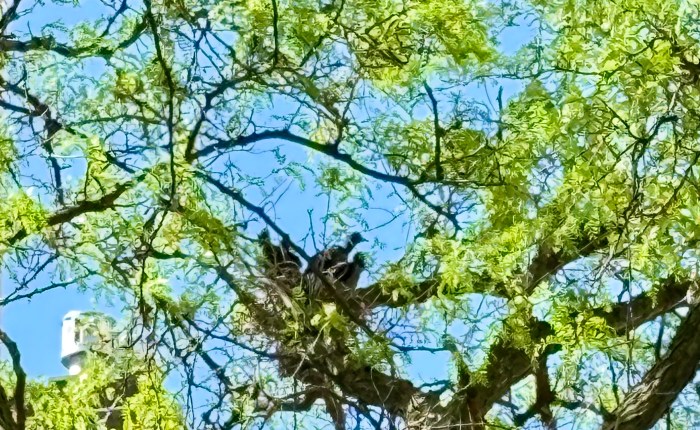
But Nature has once again reigned supreme in my city neighborhood. On my street, there is no human control over the crow’s nest and its four chicks that are flapping around in the branches. I watch them strengthen their young wings to fly out from their birthplace and fend for themselves. Wildlife never needs permission to be. But it does need protection.


The New York Times reported this week on one of Chicago’s best nature stories. The Lakeside Center at McCormick Place applied a treatment on its glass building to deter migrating birds from banging into it. Last year up to 1,000 birds died in one night at McCormick Place. This year, the deaths, due to the widow treatment, were down by 95%. Chicago’s unpopular mayor should take credit. For some of us this fact alone is enough to vote for his reelection.

Unfortunately there’s no treatment we can apply to protect ourselves from bumping up against the current man-made enemy that is called the United States of America. What can protect us from dirty air and water unleashed by industrial, vehicle and power plant toxins?

I envision a doomsday scenario, a post-apocalyptic environment like “the Last of Us.” Will my city’s native species die off and be replaced by invasive, toxic-loving kudzu? The White Christian Nationalists setting ecological policy have abandoned the Bible as their guide. Genesis 2:15, in all versions, clearly states we must tend to God’s creation.

NIV: The Lord God took the man and put him in the Garden of Eden to work it and take care of it.

KJV: And the LORD God took the man, and put him into the garden of Eden to dress it and to keep it.

NLT: The LORD God placed the man in the Garden of Eden to tend and watch over it.

CSB: The LORD God took the man and placed him in the garden of Eden to work it and watch over it.


NYT: An Illinois Building Was a Bird Killer. A Simple Change Made a World of Difference.


Chicago’s Urban Wildlife: Embracing Pluralism and Nature

Chicago’s Urban Wildlife: Embracing Pluralism and Nature

All over early-morning Chicago, garbage trucks back in and out of alleys using rapid beep-beep-beep signals announcing their hulking presence. Elsa the dog and I are indifferent to this annoyance as we take our morning walk. But in mid-April, we both jumped to attention. We heard what seemed like a hundred garbage trucks backing up. The wildly unfamiliar bellowed from a block down the street.

“What’s going on Elsa?” I shouted down to my agitated Westie on the sidewalk. All of a sudden two honking Sandhill Cranes flew through the center of the street below the treetops. Their wingspan swooped past us from sidewalk to sidewalk as they glided and bellowed toward Lake Michigan. 

Elsa flew into a barking rage. I lost my breath. My knees buckled. The Sandhill Crane is an ancient animal whose sole purpose is entertainment.

I love these four-foot high red-headed trumpeting birds. I once traveled to the Platte River on the edge of Nebraska’s Sandhills for their spring migration. My friends and I joined serious birders on the 5:00 am riverbank to view 600,000 roosting Sandhill Cranes. Their summer and winter homes are the northern and southern edges of the Great Plains. They are North Americans, Midwesterners.

Where did this duo come from and where were they going? They were likely in a flock following the Great Lakes Flyway, the migration route to their summer home in the boundary waters between the U.S. and Canada. Perhaps they were lured away by a mischief of rats feasting on the overflowing garbage bins in the alleys of nearby restaurants. Did a garage truck disturb their hunt? Whatever the story, I am deeply grateful they strayed from the flock and flew into my morning fugue.

Fugue? Yes, lately every morning I awake in a seemingly altered state. Oh, I tend a regular household routine, brain-fogged by radio news from the psycho-battleground that is my home country. Any diversion is welcome, particularly wildlife making its way through my city street.

But diversions, like bird spotting, are fleeting. The pluralistic society we’ve known as democracy is under siege. Pluralism, a word as ancient as the Sandhills themselves, one we learned in middle school, has been displaced of late by DEI or Diversity, Equity and Inclusion. DEI was corporate America’s answer to the communal guilt stemming from the sight of George Floyd’s on-air murder. The lofty goal of transforming Human Resource departments into offices of Diversity, Equity and Inclusion crashed and burned on the heels of Donald Trump’s name-calling presidential candidate Kamala Harris a “DEI” hire. Little did we know then, the summer of 2024. The weaponizing of DEI was not a diversion. Instead, it was a tactic in a larger strategy to destroy pluralism and make America White and Christian.

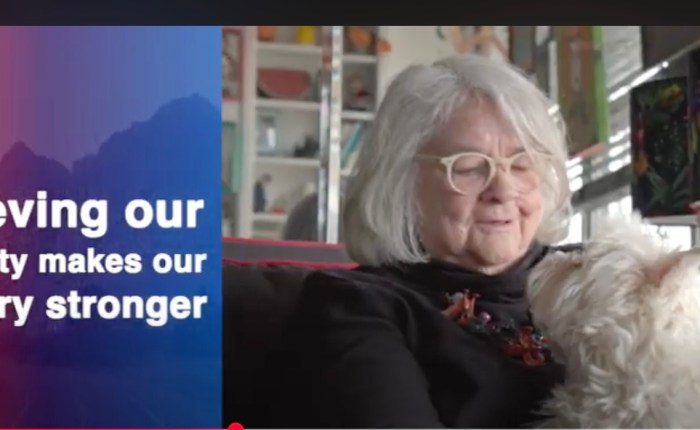
Interfaith America, the nation’s premier interfaith organization, has come to the battlefield now — taking the case for pluralism to the streets. A giant digital billboard in one of the most diverse locations in the country, Times Square, New York City, shows Interfaith America’s devotion to American pluralism. The message: diversity makes our country stronger. I’m in here, proud to represent my cohort, old white ladies with their dogs. Take a look.

Anita Bryant’s Legacy: Gay Rights Activism

Anita Bryant’s Legacy: Gay Rights Activism

As I was about to cross the threshold toward the elevator with Elsa tethered to my thick gloves, I reached back for the handle to close the door behind me. At that moment, WBBM news radio announced Anita Bryant had died. Out in the park, Elsa tiptoed on the crunchy December earth — a slower walk leading to a longer think. Memories arose about Anita Bryant and her anti-homosexual campaign in the 1970s.  

Anita Bryant, a Miss American pop singer who sold Tropicana Orange Juice on TV was so well-known in US culture that her startling attack on homosexuality betrayed her seemingly good-natured Christian persona.

Elders in the fundamentalist Christian cult where I spent a few years in the 1970s never addressed homosexuality. They also ignored any other moralistic culture clash that evolved because of Bryant’s media campaign. I doubt any of us in that community even knew a homosexual. Oh, there were instances of men going off on drug-addled toots and ending up in gay bath houses. They’d come crawling back to church asking forgiveness from an uncomfortable congregation that had no knowledge of gay life. I was never sure what we were meant to forgive since no sin was committed against us.

Bryant, sparked by a Dade County, Florida decision to protect sexual orientation as a civil right, created the Save Our Children coalition to build anti-gay public support. She succeeded. In June 1977, the Miami area voted against homosexuality as a civil right, an act that lasted twenty years. 

Fresh from the Florida victory,  Anita Bryant brought her teethy bigotry to Chicago to perform a white-bread repertoire including her signature “Paper Roses” at the Medinah Temple. She was met by 5,000 gay rights protesters.

Christian churches throughout the country were called upon to take a stand, including mine. Homosexuality was justified as sin through church elders’ literal interpretation of a few bible passages. It became a disqualifying dictum for church membership. I knew nothing about homosexuality. Shunning people, however, didn’t fit with what brought me to Jesus, namely the parable of the Good Samaritan, or love one another, especially the least among us. I’ve needed that Jesus all my life. Extending unconditional love is a hard practice. In fact, it’s really impossible. I’ve always known it’s required of me nonetheless. 

Anita Bryant’s anti-gay campaign invigorated gay activism in the civil rights movement. We had a new cause. We boycotted orange juice. We attended Chicago’s Gay Pride parade that year. We mocked Tropicana’s tagline by wearing t-shirts that said, “A day without human rights is like a day without sunshine.” Gay rights, women’s rights, equal rights, all blended into one big active advocacy movement. 

I moved on to La Salle Street Church, which made no small point of accepting all people. Founded by rejects from the Moody Bible Church down the street, these Christians were definitely descendants of the real Jesus. They left Moody because the church elders required blue-jeaned converts to sit in the balcony and wouldn’t allow them to receive the Eucharist. In the 1970s, no one wore blue jeans except anti-establishment long-haired hippies, known these days as Progressives. 

The noise generated by the blue-jeaned Christians galvanized the nascent Christian fundamentalists, known these days as White Christian Nationalists. 

I’m not sure what happened to separate the civil rights groups. Gay rights, abortion rights, voting rights and anti-violence organizations eventually established their own fundraising machines side-by-side with their own causes.  Everyone started marching to a different drummer. We came together to protest the Iraq war and for the pink-hatted Women’s March after the 2016 election. But not all my friends showed at the NATO protest in 2012.

As a straight white old lady, I’ve recently tried with scant success to advocate against ageism. I no longer wear blue jeans. Dress codes are almost extinct. This is evident by Elon Musk’s t-shirt, MAGA hat, and long, black, steampunk coat at an Oval Office press conference. 

Anti-ageism is the most difficult cause to rail against. It’s an implicit or subconscious bias, practiced by those who are discriminated against and by those who do the discriminating. Dismissing Elon Musks’ functionaries as teenagers and constantly stating their ages is a display of age-bias. The same applies when stating Joe Biden’s or Donald Trump’s age. Or mine.

“You don’t act like a 78-year old,” remarked a friend last week.

“Yes I do. This is what 78 acts like.” I shot back.

It’s not that age isn’t a good descriptor to place people in their lived experiences. But age as a descriptor is most often used to put people in their place. The unchecked functionaries have stolen my Social Security records inside the US Treasury Department. They are no better or worse than me because of age. They are wrong no matter how old or young they are.

As happened with Anita Bryant, is it too dreamy to imagine a galvanizing backlash? Is a movement forming to neutralize the extreme bigotry falling out of the dirty mouths of Washington DC?

____________________________

Click to see Anita Bryant sing, “Paper Roses” https://youtu.be/0UoRKstI8Q4?si=3ar2deoIWIu6YwVN

___________________________

The DOGE and Aging

The DOGE and Aging

Adlai Stevenson III (1930 – 2021) entered the 1982 race for Illinois governor just as I had become unemployed. My only memory of that forsaken job, like all the others, is my shameful obsequiousness to the forgettable male boss. 
 
A journalist friend, Paul Galloway (1934-2009) interceded on my behalf to the Stevenson campaign for a volunteer position. Yes, that was necessary. And still. The sublime expression, “We don’t want nobody nobody sent,” originated in a Chicago ward campaign office. Campaigns still scrutinize volunteers with more than an eye roll. Because of my juice through the local newspaper, people were cautious about what was said around me.

I floundered around the office of Adlai Stevenson’s wife, Nancy, who was usually out campaigning. One day, I had the great fortune to be tagged to drive her to Oak Park for an event. That fluke set off a campaign-long assignment as Nancy’s driver.

Nancy and I regularly stepped into community rooms where older adults were having lunch through the federal Meals on Wheels program. Older women would clasp Nancy’s wrist, pull her ear close to their lips and whisper messages for her to take back to her husband. The Meals on Wheels crowd assumed Adlai III was his father, Adlai II, the governor when most of them were young. Nancy, who had a gentle and keen understanding of aging, let most of them hold this holy untruth. She displayed genuine kindness in her friendly interactions with old people who were in obvious cognitive decline. This helped me admit my own subconscious bias toward the aging. My ageism has changed overtime, especially now that I’m old and experience age discrimination against myself and my friends.

Meals on Wheels is funded through the Older Americans Act Nutrition Program which was permanently authorized by Congress in 1972. The purpose is three-fold: 1) reduce hunger, food insecurity, and malnutrition; 2) promote socialization; 3) promote health and well-being by preventing health-related diseases. The Program is available to adults age 60 years and older. Priority is given to low-income individuals, racial or ethnic minorities, rural communities, those with limited English proficiency, and/or those at risk of institutionalization.

One of our campaign stops was a community space in the neighborhood of Hegewich. It is located on the far south side of Chicago, known as the perfect workingman’s neighborhood. When Chicago’s steel mills shut down in the 1980s, the Polish immigrants who’d settled in Hegewich lost their jobs. They also lost their pensions. People survived on government subsistence and odd jobs.

As Nancy began her round of shaking hands, bobbing up and down to lean over to hear the messages of the elderly, she announced, “You know, my husband, Ad, voted for Meals-on-Wheels when he was a senator in Washington.”

Before she could get out another word, a large woman in the corner who looked like a George Booth cartoon yelled: 

“Yeah? Well, he oughta be here now for the corned beef! ‘Cause it stinks!”

“Well, I’ll be sure to tell Adlai!” Nancy shouted back.

Funding runs out on December 31, 2024 for the Older Americans Act and the Meals on Wheels Program. If Congress doesn’t vote to reauthorize the Act, the Nutrition Program will be at the mercy of Elon Musk and Vivek Ramaswamy’s Department of Government Efficiency (DOGE). And they have vowed to eliminate all programs that have not been reauthorized by Congress.

My guess is neither of them have come to terms with ageism.

Election Distraction: Lincoln Park Hibiscus

Election Distraction:  Lincoln Park Hibiscus

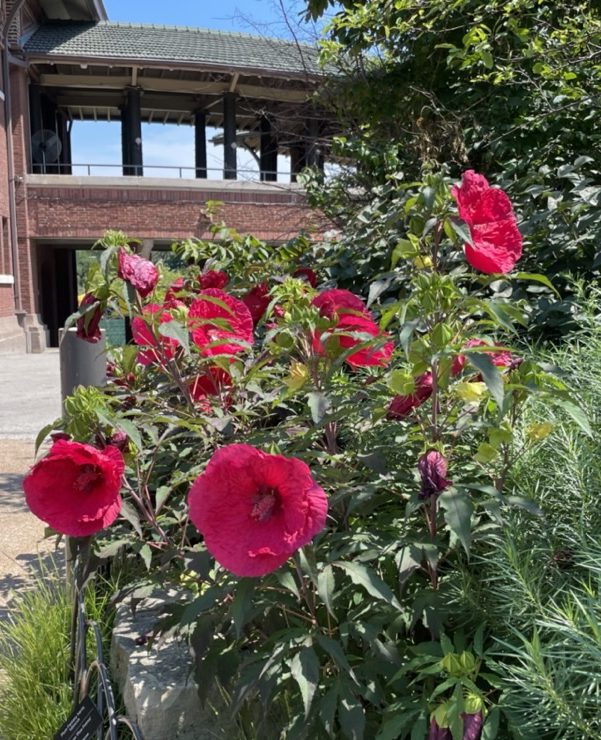
Rounding the corner by Cafe Brauer, the 115-year old red brick refectory on Lincoln Park Zoo’s South Pond, I stopped dead in my tracks at the sight of blooming Chinese-red hibiscus. Hundreds of blossoms the size and shape of CDs preened in the bright sun. They were onion-skin thin. I could practically see through them. I inched along the path flower by flower scanning each one for an answer. What. Were. They. Doing. There?

I’d rounded that corner hundreds of times in my life and had never seen those flowers. A woman in a dark green shirt marked with the telltale Lincoln Park Zoo logos wandered by.

“Do you know anything about these flowers?” I shouted.

“Yes, they’re Lord Baltimore hardy hibiscus.” 

“Were they here last year?”

“Nope. We cultivated them.”

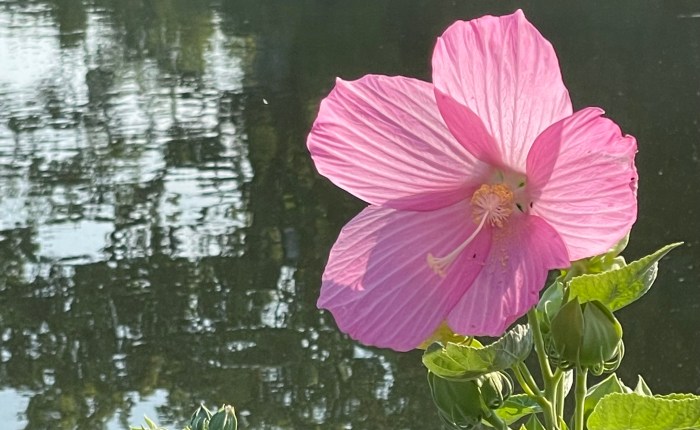
She introduced herself as the head horticulturist at the Zoo and gave me a hibiscus primer. There are four species of hibiscus native to Illinois around the Zoo and the South Pond.

“Everyone thinks they’re tropical. We have a unique collection — the only accredited perennial herbaceous native hibiscus collection in the country.” 

On the way home, I spotted a couple I’ve known for years taking their afternoon walk. They informed me they’re thinking of buying a summer house in Michigan.

“What? How could you leave here in the summer? Did you know we have four native hibiscus around the South Pond and the Zoo?”

At the time, I thought this fresh information established the best reason to summer in Chicago. I doubled down on what I’d just learned. Without taking a breath I told them the hibiscus feed bees, hummingbirds and butterflies. Each flower on a hibiscus stalk lives only for a day or two, like a daylily. But, the plants keep opening new blooms from July to September. Garden Clubs from all over the Midwest send busloads of flower lovers to gaze at our hibiscus.

“You must walk by the pond and see them!”

That was the summer of 2019. I see them walking from time to time now, a little slower, a little quieter. A few weeks ago, I’d been in the zoo luxuriating in what I’ve come to think of now, five years later, as my hibiscus. I ran into my friends on the way home and fed them new information.

“Did you see the news?” 

“What news?”

There’s so much real news or breaking news these days they looked anxious.

“My friend Karen who volunteers at the zoo told me it’s in the paper today. Lincoln Park Zoo has just been named a National Botanic Garden!”

“Oh.”

“Yep. It’s a big deal. There are only two zoos in the country that are botanic gardens.”

“Oh yeah? What’s the other one?”

“Dunno. Maybe San Diego.”

I had no idea what I was talking about. The media and Time Out have touted San Diego plenty. So, I used this acclaim to put the best spin on our zoo.

“And the international Botanic Garden show will be in Chicago in summer 2027. First time its been in the U.S, in 27 years.” I said.

“Wow, that’s great.  Is that like the Chelsea Garden Show?”

“Yes! Only better.” 

“Well, we’ll see you around. We need to keep walking.”

“Ok. Great to see you. Glad you didn’t buy that summer house in New Buffalo.” 

“Oh, we did buy it. Stayed for a few weekends before the pandemic hit. Tried it that summer for a few weeks. Mistake. Too lonely. You’re right. Theres’s nothing like Chicago in the summer.”

“Ah. It’s the flowers, right?”

“Maay-bee”.

‘There’s a special providence in the fall of a sparrow’

‘There’s a special providence in the fall of a sparrow’
There’s a special providence in the fall of a sparrow.

If it be now, ’tis not to come.

If it be not to come, it will be now.

If it be not now, yet it will come – the readiness is all.

— Hamlet

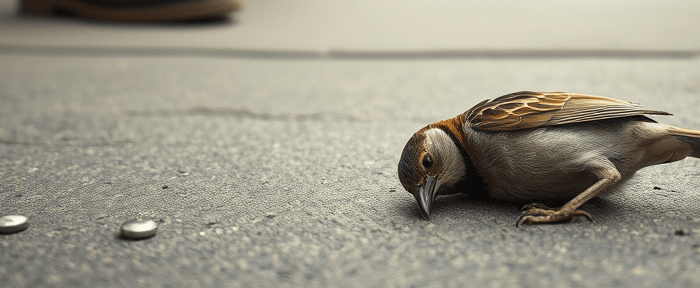
A sparrow fell from the sky and plopped down next to me on a sidewalk corner beside the church as neighbors, shoppers, and tourists bustled to their places.

“Damn! That’s disgusting!” Said a snap-back-hatted young man sidestepping around the splat. Looking the revenant himself as if returning from a dead weekend that probably started out fun on Friday night, he looked up. Was he searching for someone behind the clouds to blame?

“Look at it. So gross!” Looking down now, seemingly blaming the sparrow for its dead ugly existence.

Perhaps because I was headed to church, the sparrow’s lasting legacy in the bible came to mind. Scriptures tell us to look at how God cares for the lowly sparrow as a metaphor for how that same God cares even more for humans. But here I was, staring at a dead bird. Did that God in the bible throw the bird down beside me so I’d know who’s in charge around here? Is it an omen of a bad year ahead? A symbol of immortality? A sign to repent?

There’s a peregrine falcon nest directly east on Lake Michigan in the intake crib of Chicago’s water system. Those tricky raptors attack other birds in mid-air and sometimes miss their prey as they swoop down to catch them. On my dog walks, I’m constantly on the lookout for bird carcasses (sometimes impaled in the bushes) because Elsa will sneak a forbidden lick if I’m not vigilant.  I assumed the unfortunate sparrow was one of these victims.

If God set this complicated natural aerodynamic food chain in motion, so be it. I’ll accept that God. However, no God is going to snap me to attention about the upcoming election or remind me of some regrettable remark I’ve made by throwing foreboding dead birds at me. The same force may have set all the emotions of fear and regret in my DNA, but a god that powerful better not have my same human characteristics. I’m conscious of an impersonal force, something outside of myself, an unexplained presence. I believe there’s a higher power, that I call God. Holding that power out as a relatable, reasoned person that acts as a mean-spirited human, to get my attention is not my idea of a god. At least not today, or, not at this moment.

The ubiquitous house sparrow is not native to the United States, I’ve been told by birders. They chirp most of the US awake in the morning and nest outside our homes’ nooks and crannies. At Chicago’s Navy Pier, if you try to eat McDonald’s fries outside, you’ll be sharing them with sparrows. If you look at your phone outside the Pancake House to catch up on text messages, sparrows will swoop in and pluck at the remnants of your Dutch Baby. This diminutive invasive species is so plentiful that I give it short shrift, ignore it, as if it’s not important.

Until one drops from the sky on my way to church.

____________________________


Great Craic at the Democratic Convention

Great Craic at the Democratic Convention

On day two of the Democratic National Convention, I came face-to-face with a tall, long-haired, familiar beauty outside my local coffee shop in downtown Chicago.

“Hi! Are you Caitlin?”

“I am.”

“You’re at my coffee shop!”

“I love this place; come here every morning,” Caitlin said.

“Oh, gosh, I wish my friends were here to meet you. We’ve all been gathering for coffee in the Ritz Hotel lobby looking for you!”

“I wish I could meet them too!” She said.

“Well, I can’t speak for them, but I love you. My whole family loves you.”

And so went my encounter with Caitlin Collins of CNN. Neighborhood friends and I camped out in various hotel lobbies during Convention week hoping to spot famous people. We’re political junkies, more likely to screech at Mitch Landrieu, former mayor of New Orleans, than Golden Globe winner Greta Gerwig. Oh, there are exceptions. I longed to see Billy Porter. Why him? As soon as President Joe Biden announced he was stepping aside for Vice President Kamala Harris, Billy Porter jumped out of the starting gate to endorse her. Also, I love his outfits.

In January 2024, Convention organizers declared they needed 12,000 volunteers. Unenthusiastically, almost reluctantly, some of us registered on the convoluted DNC volunteer website in February, March, April, never receiving acknowledgment or confirmation. My constant refrain to anyone who asked (or didn’t ask) was: sign up—you never know what will happen. When the Biden-Harris Handover came down, the volunteer pool immediately swelled to 30,000, a nascent signal of unabashed support for Kamala Harris for President. Would-be volunteers came from around the country thinking they’d grab a plum “slot” from the AI-driven robot volunteer organizer. A few days before the Convention started, I was called to the basement of the United Center with about 100 others to “unfurl” flags as they rolled in from the loading dock. We were gleeful. Some were called back for various duties at the Convention. Not me. I never did secure a volunteer gig to check credentials, or sort the garbage for recyclables, or greet people at hotels, or direct delegates to buses. 

On the afternoon of Convention day four, I received a text, “I’m leaving a pass for you at the desk of my hotel,” from a lovely I’d known thirty years ago in the Clinton Administration. I hiked up my skirt, jumped on my three-wheel ADA electric scooter, and navigated my way through the exterior United Center maze of Secret Service, Chicago Police, Cook County Sheriffs, metal fencing, magnetometers, hawkers, protesters, volunteers, and a mile-long line of faithful ticket-holders. Vivienne from County Cork and Mark from St.Louis in section 202 texted every few minutes with updated instructions on how to squeeze through the crowds and get to the seat they were defending for my grateful butt.

“I just got in a fight,” texted Mark. “Standing firm. I told them you were waiting for the elevator. Viv meeting you.” Finally, from my cherished seat, I texted David, who I passed outside on the pedestrian line. “No seats.”

Vivienne–great craic at Democratic Convention

Lucky doesn’t begin to describe how it felt to be in Section 202 of the United Center on August 22, 2024, for Kamala Harris’ acceptance speech—the most blessed hurly-burly hoopla in memory.

Or, in the words of Irish Vivienne, “Best craic a’ me life.”

___________

Irish Craic Explained

“Craic is laughing at cellular level, finding the humour in everything and making yourself laugh when thinking about it all.”

Me & Pete Buttigieg

Me & Pete Buttigieg

Never have I felt so valued at church as I did last Sunday. Presbyterians I hardly knew tugged at my sleeve or grabbed my elbow or those less buttoned-up screeched in my face — all congratulating me on getting to meet Pete Buttigieg. I’d posted a photo of Pete and me on FaceBook that week. A well-heeled Democratic couple in Chicago’s Lakeview neighborhood scrambled a party together that raised $700,000 for the Presidential campaign of candidate Kamala Harris six days after she chose Governor Tim Walz as her Vice Presidential running mate. A friend bought two tickets he couldn’t use and asked if I’d like to have them.

Gulp. Yes. Yes. Yes. I said. Pete Buttigieg is the most poplar Democrat in the United States. He’s the youngest person ever to serve as US Secretary of Transportation, was the mayor of South Bend, ran for president in 2020, is married with two children and oh, he’s gay. When he kicked off his campaign for President in 2019, I traveled to South Bend with Amy, Peter and Mark in the pouring rain to be at his announcement in the leaky old Studebaker factory. Pete was on Kamala’s short list for Veep, but, well, he’s gay. The US electorate can stretch its collective imagination to accept only one major cultural shift at a time. I guess. Democrats like me are giddy over the historic candidacy of Vice President Kamala Harris, a black woman, running at the top of the ticket. We would have been rapturous if she’d chosen Pete, but honestly, we’re not far from that in her choice of Tim Walz, a funny smart former high school football coach who loves state fairs, teaching, sitting on Congressional committees, governing Minnesota, serving in the National Guard and traveling to China.

I just love campaigns. I love candidates, campaign organizers, campaign volunteers, campaign consultants, campaign buttons, campaign events and campaign offices. My high school held a student-led Democrat-Republican combined mock convention in 1964. I was assigned to be Republican candidate Nelson Rockefeller’s campaign manager. I wrote to Rockefeller’s campaign office in New York requesting his platform in order to write my nominating speech for the mock convention. The campaign responded by sending me free stuff: crates full of campaign buttons, posters, leaflets, scarves, ties, cufflinks, bracelets, position papers, and even a suggested stump speech. I plastered the school with Rockefeller posters and made sure every student had some sort of paraphernalia with “Nelson” on it. The students chanted “Nelson! Nelson!”, I delivered my nominating speech and Rockefeller won the student endorsement by a wide margin. 

I had already been steeped in soda-shop debates rebutting a freshman classmate’s anti-government racist diatribes. I read the boy’s constant companion, the 1958 publication The Blue Book of the John Birch Society ( a precursor to Trumpism and Project 2025) in order to prove him wrong point by point.

In the eighth grade my class was bussed to the airport and given hand-held American flags to wave and cheer as President Dwight Eisenhower deplaned from Air Force One. 

Sixty-five years later, I’m still at it.

The Peace of Non Closure

The Peace of Non Closure

A new concept popped up at the outset of a recent anti-racist training session. Among the familiar “courageous-conversation” ground rules, the leader added, “We commit to non-closure. (pause) Right?”

Whoa, really? My fellow attendees all yes’d the speaker as if they knew this already. I thought I must have ignored an inboxed message, or, in my long season of retirement, missed another new corporate buzz word. Non-closure.

On the brink of Juneteenth, the half-day session promised to address the backlash to Diversity, Equity and Inclusion programs and policies. That morning all of nature said yes! to Chicago. I wanted to say yes! too, and take a long walk in the park with my dog. Instead, I reluctantly ambled over to the dingy conference room in a church basement near my home. Anti-racism churned inside me and I had no organized outlet. I was curious to see if there was anything new.  Answers.

But here I was, swallowing a commitment to non-closure. No answers, no conclusions, no plans, no fantasies of what might be. Of the numerous anti-racism trainings I’ve attended since the murder of George Floyd this may be the first time I recognized that it’s safe to be in that liminal space of unknowing, of ambiguity. There would be no meaning-making, no sense-making, no closure.

Facilitators from Crossroads, an antiracism training organization, gathered us together, not to tell us what they know, but to find out what we know. They see, feel, but even more, they sense, not just a political backlash in anti-racism work but, an active softening in community and personal commitment. 

The air is leaking out of the tires.

This week Donald Trump and I had birthdays. We’re the same age. Several friends asked me how I planned to celebrate.

“I don’t really celebrate my birthday.”

“Why not?” Asked my favorite poet.

I had no answer. 

He asked about my writing.

“I’ve been thinking lately I may not write anymore.”

“Why?” He asked.

Another why question. And no good answer. Is that a failing? No answer? Does it mean I’m not sufficiently self-reflective?

Liminal, from the Latin, “threshold” puts time and space betwixt and between. On liminal days, birthdays dangle off the edge of time. The past no longer haunts me, the future no longer calls me. I neither wait nor wonder. Indeed, birthdays are liminal days.

Anthropologists say that memory disorder, pandemic uncertainty, authoritarianism, virtual reality, border disputes, old-age anxiety, environmental issues, and gender trouble put society in a self-protective liminal state. Whew! Thank you God. This beloved gift  allows me to live on the threshold where social norms, like answering the question “why” or reading every damn email are temporarily suspended. 

In the ninth grade, when I was consumed with past and future popularity by any means, I was inconveniently tormented with one living and one dead poet: T.S. Eliot and Alfred Lord Tennyson. A lot has been written about the spiritual liminality, the non-closure of their work. It’s only now (or is it?) that I see why these vexing lines captured me:

Tennyson’s Ulysses:
Yet all experience is an arch wherethro' 
Gleams that untravell'd world whose margin fades 
For ever and forever when I move.
TS Eliot’s Four Quartets:
Time past and time future
What might have been and what has been
Point to one end, which is always present
.

Smelly Lilacs

Smelly Lilacs

The tulips were showing their last droopy colors. The iris’ were ready to pop for a week or two of runway-like exhibitionism. The trees in the small park were half-dressed, embarrassed by their young fresh leaves, waiting for their green siblings to fill in around them. 

And oh those smelly lilacs. 

Their short-lived incarnation makes me holler 

thank you Jesus. 

And then, the warblers.

Every spring is the same. Year after year. And yet, every single time, I’m shocked out of winter doldrums by the sheer variety of beauty and fragrance in the cultivated and in the wild city gardens. A text or an email or an article from birding organizations will remind me to listen for migrating warblers. They pass through as the tulips fade. I hear them. Never see them. 

Warblers visit Chicago on their way up north from Central and South America. They’re tiny. My old eyes are acclimated to spotting bigger birds—starlings, blackbirds, crows. Even sparrows are larger than warblers. I look, but mistake the warbler for a leaf or a twig, even a large bug.

But the other day, on an unusually seventy-five-degree May morning, I passed under a tree while Elsa sniffed around the ground cover for messages from new and old pals. I heard a symphony of birdsong overhead and looked straight up to see tiny bright-colored warblers flitting from branch to branch, hunting insects. 

I switched on my iPhone, pressed the Merlin bird app, and recorded a Tennessee Warbler, Yellow Warbler, Yellowthroat, and American Redstart all singing their wee hearts out within shouting distance. I suddenly realized I was in a bird “fallout,” a phenomenon that occurs when curious weather slams into migrating songbirds in the air and they descend into the trees below. 

The weather systems predict the number of songbirds that may be migrating over Chicago on spring nights. Attracted to their reflections in the windows of highrises, they accidentally kill themselves by flying into lit buildings.

The uncommon migration fallout happened twelve hours after Chicago’s unusual sky-drenching from the northern lights—yes, the northern lights! The aurora borealis: blazing bits shooting out of the sun, hitting the diluting atmosphere with undulating ribbons that lit up the Chicago night. All this only a month after a solar eclipse. 

Hyde Park residents Meghan Hassett and her husband Max Smith captured the northern lights from Promontory Point Friday, May 10, 2024. Provided by Meghan Hassett

In the park, a dog-walking neighbor neared with Zeus, stopped, and looked up. 

“Whatcha lookin at?”

“Warblers.”

“Oh,” and he continued on. He lives in my building and told me a few days before that he’s planning a hiking trip to the Rockies because he “likes nature.”

Me too.