The DOGE and Aging

The DOGE and Aging

Adlai Stevenson III (1930 – 2021) entered the 1982 race for Illinois governor just as I had become unemployed. My only memory of that forsaken job, like all the others, is my shameful obsequiousness to the forgettable male boss. 
 
A journalist friend, Paul Galloway (1934-2009) interceded on my behalf to the Stevenson campaign for a volunteer position. Yes, that was necessary. And still. The sublime expression, “We don’t want nobody nobody sent,” originated in a Chicago ward campaign office. Campaigns still scrutinize volunteers with more than an eye roll. Because of my juice through the local newspaper, people were cautious about what was said around me.

I floundered around the office of Adlai Stevenson’s wife, Nancy, who was usually out campaigning. One day, I had the great fortune to be tagged to drive her to Oak Park for an event. That fluke set off a campaign-long assignment as Nancy’s driver.

Nancy and I regularly stepped into community rooms where older adults were having lunch through the federal Meals on Wheels program. Older women would clasp Nancy’s wrist, pull her ear close to their lips and whisper messages for her to take back to her husband. The Meals on Wheels crowd assumed Adlai III was his father, Adlai II, the governor when most of them were young. Nancy, who had a gentle and keen understanding of aging, let most of them hold this holy untruth. She displayed genuine kindness in her friendly interactions with old people who were in obvious cognitive decline. This helped me admit my own subconscious bias toward the aging. My ageism has changed overtime, especially now that I’m old and experience age discrimination against myself and my friends.

Meals on Wheels is funded through the Older Americans Act Nutrition Program which was permanently authorized by Congress in 1972. The purpose is three-fold: 1) reduce hunger, food insecurity, and malnutrition; 2) promote socialization; 3) promote health and well-being by preventing health-related diseases. The Program is available to adults age 60 years and older. Priority is given to low-income individuals, racial or ethnic minorities, rural communities, those with limited English proficiency, and/or those at risk of institutionalization.

One of our campaign stops was a community space in the neighborhood of Hegewich. It is located on the far south side of Chicago, known as the perfect workingman’s neighborhood. When Chicago’s steel mills shut down in the 1980s, the Polish immigrants who’d settled in Hegewich lost their jobs. They also lost their pensions. People survived on government subsistence and odd jobs.

As Nancy began her round of shaking hands, bobbing up and down to lean over to hear the messages of the elderly, she announced, “You know, my husband, Ad, voted for Meals-on-Wheels when he was a senator in Washington.”

Before she could get out another word, a large woman in the corner who looked like a George Booth cartoon yelled: 

“Yeah? Well, he oughta be here now for the corned beef! ‘Cause it stinks!”

“Well, I’ll be sure to tell Adlai!” Nancy shouted back.

Funding runs out on December 31, 2024 for the Older Americans Act and the Meals on Wheels Program. If Congress doesn’t vote to reauthorize the Act, the Nutrition Program will be at the mercy of Elon Musk and Vivek Ramaswamy’s Department of Government Efficiency (DOGE). And they have vowed to eliminate all programs that have not been reauthorized by Congress.

My guess is neither of them have come to terms with ageism.

Election Distraction: Lincoln Park Hibiscus

Election Distraction:  Lincoln Park Hibiscus

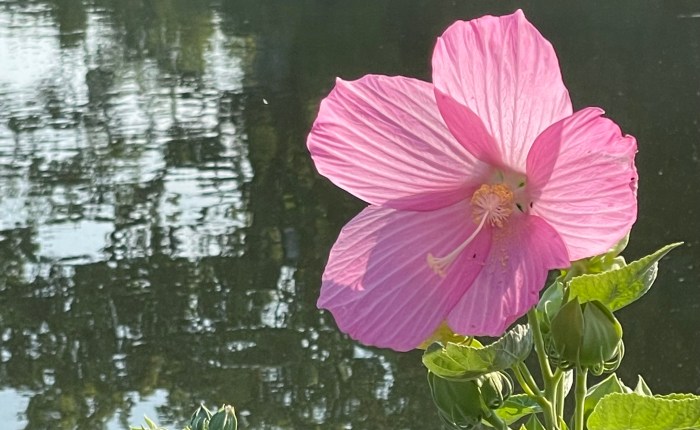
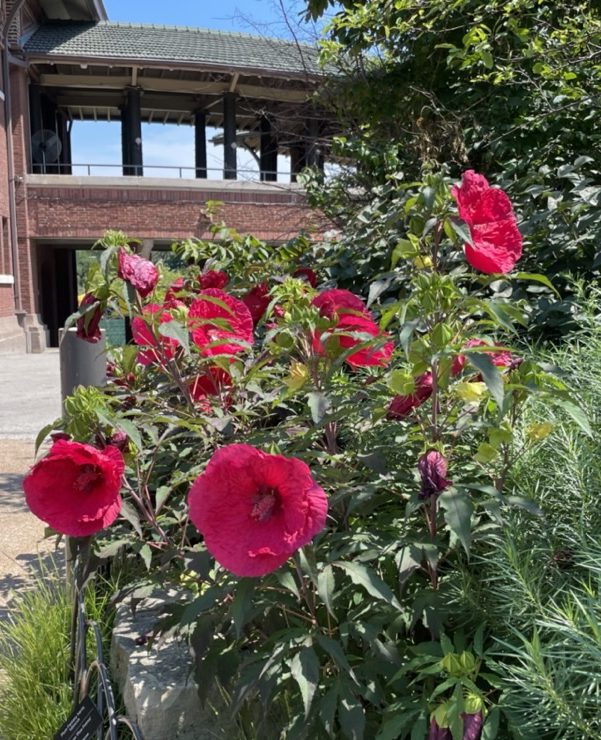
Rounding the corner by Cafe Brauer, the 115-year old red brick refectory on Lincoln Park Zoo’s South Pond, I stopped dead in my tracks at the sight of blooming Chinese-red hibiscus. Hundreds of blossoms the size and shape of CDs preened in the bright sun. They were onion-skin thin. I could practically see through them. I inched along the path flower by flower scanning each one for an answer. What. Were. They. Doing. There?

I’d rounded that corner hundreds of times in my life and had never seen those flowers. A woman in a dark green shirt marked with the telltale Lincoln Park Zoo logos wandered by.

“Do you know anything about these flowers?” I shouted.

“Yes, they’re Lord Baltimore hardy hibiscus.” 

“Were they here last year?”

“Nope. We cultivated them.”

She introduced herself as the head horticulturist at the Zoo and gave me a hibiscus primer. There are four species of hibiscus native to Illinois around the Zoo and the South Pond.

“Everyone thinks they’re tropical. We have a unique collection — the only accredited perennial herbaceous native hibiscus collection in the country.” 

On the way home, I spotted a couple I’ve known for years taking their afternoon walk. They informed me they’re thinking of buying a summer house in Michigan.

“What? How could you leave here in the summer? Did you know we have four native hibiscus around the South Pond and the Zoo?”

At the time, I thought this fresh information established the best reason to summer in Chicago. I doubled down on what I’d just learned. Without taking a breath I told them the hibiscus feed bees, hummingbirds and butterflies. Each flower on a hibiscus stalk lives only for a day or two, like a daylily. But, the plants keep opening new blooms from July to September. Garden Clubs from all over the Midwest send busloads of flower lovers to gaze at our hibiscus.

“You must walk by the pond and see them!”

That was the summer of 2019. I see them walking from time to time now, a little slower, a little quieter. A few weeks ago, I’d been in the zoo luxuriating in what I’ve come to think of now, five years later, as my hibiscus. I ran into my friends on the way home and fed them new information.

“Did you see the news?” 

“What news?”

There’s so much real news or breaking news these days they looked anxious.

“My friend Karen who volunteers at the zoo told me it’s in the paper today. Lincoln Park Zoo has just been named a National Botanic Garden!”

“Oh.”

“Yep. It’s a big deal. There are only two zoos in the country that are botanic gardens.”

“Oh yeah? What’s the other one?”

“Dunno. Maybe San Diego.”

I had no idea what I was talking about. The media and Time Out have touted San Diego plenty. So, I used this acclaim to put the best spin on our zoo.

“And the international Botanic Garden show will be in Chicago in summer 2027. First time its been in the U.S, in 27 years.” I said.

“Wow, that’s great.  Is that like the Chelsea Garden Show?”

“Yes! Only better.” 

“Well, we’ll see you around. We need to keep walking.”

“Ok. Great to see you. Glad you didn’t buy that summer house in New Buffalo.” 

“Oh, we did buy it. Stayed for a few weekends before the pandemic hit. Tried it that summer for a few weeks. Mistake. Too lonely. You’re right. Theres’s nothing like Chicago in the summer.”

“Ah. It’s the flowers, right?”

“Maay-bee”.

‘There’s a special providence in the fall of a sparrow’

‘There’s a special providence in the fall of a sparrow’
There’s a special providence in the fall of a sparrow.

If it be now, ’tis not to come.

If it be not to come, it will be now.

If it be not now, yet it will come – the readiness is all.

— Hamlet

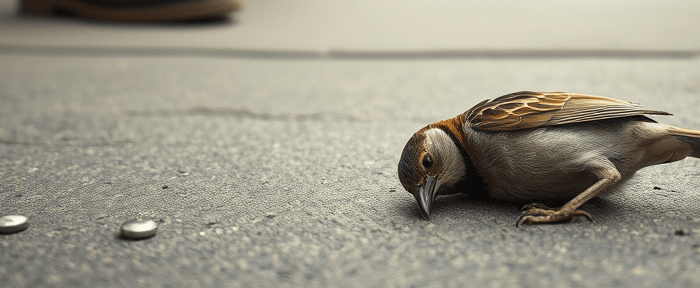
A sparrow fell from the sky and plopped down next to me on a sidewalk corner beside the church as neighbors, shoppers, and tourists bustled to their places.

“Damn! That’s disgusting!” Said a snap-back-hatted young man sidestepping around the splat. Looking the revenant himself as if returning from a dead weekend that probably started out fun on Friday night, he looked up. Was he searching for someone behind the clouds to blame?

“Look at it. So gross!” Looking down now, seemingly blaming the sparrow for its dead ugly existence.

Perhaps because I was headed to church, the sparrow’s lasting legacy in the bible came to mind. Scriptures tell us to look at how God cares for the lowly sparrow as a metaphor for how that same God cares even more for humans. But here I was, staring at a dead bird. Did that God in the bible throw the bird down beside me so I’d know who’s in charge around here? Is it an omen of a bad year ahead? A symbol of immortality? A sign to repent?

There’s a peregrine falcon nest directly east on Lake Michigan in the intake crib of Chicago’s water system. Those tricky raptors attack other birds in mid-air and sometimes miss their prey as they swoop down to catch them. On my dog walks, I’m constantly on the lookout for bird carcasses (sometimes impaled in the bushes) because Elsa will sneak a forbidden lick if I’m not vigilant.  I assumed the unfortunate sparrow was one of these victims.

If God set this complicated natural aerodynamic food chain in motion, so be it. I’ll accept that God. However, no God is going to snap me to attention about the upcoming election or remind me of some regrettable remark I’ve made by throwing foreboding dead birds at me. The same force may have set all the emotions of fear and regret in my DNA, but a god that powerful better not have my same human characteristics. I’m conscious of an impersonal force, something outside of myself, an unexplained presence. I believe there’s a higher power, that I call God. Holding that power out as a relatable, reasoned person that acts as a mean-spirited human, to get my attention is not my idea of a god. At least not today, or, not at this moment.

The ubiquitous house sparrow is not native to the United States, I’ve been told by birders. They chirp most of the US awake in the morning and nest outside our homes’ nooks and crannies. At Chicago’s Navy Pier, if you try to eat McDonald’s fries outside, you’ll be sharing them with sparrows. If you look at your phone outside the Pancake House to catch up on text messages, sparrows will swoop in and pluck at the remnants of your Dutch Baby. This diminutive invasive species is so plentiful that I give it short shrift, ignore it, as if it’s not important.

Until one drops from the sky on my way to church.

____________________________


Great Craic at the Democratic Convention

Great Craic at the Democratic Convention

On day two of the Democratic National Convention, I came face-to-face with a tall, long-haired, familiar beauty outside my local coffee shop in downtown Chicago.

“Hi! Are you Caitlin?”

“I am.”

“You’re at my coffee shop!”

“I love this place; come here every morning,” Caitlin said.

“Oh, gosh, I wish my friends were here to meet you. We’ve all been gathering for coffee in the Ritz Hotel lobby looking for you!”

“I wish I could meet them too!” She said.

“Well, I can’t speak for them, but I love you. My whole family loves you.”

And so went my encounter with Caitlin Collins of CNN. Neighborhood friends and I camped out in various hotel lobbies during Convention week hoping to spot famous people. We’re political junkies, more likely to screech at Mitch Landrieu, former mayor of New Orleans, than Golden Globe winner Greta Gerwig. Oh, there are exceptions. I longed to see Billy Porter. Why him? As soon as President Joe Biden announced he was stepping aside for Vice President Kamala Harris, Billy Porter jumped out of the starting gate to endorse her. Also, I love his outfits.

In January 2024, Convention organizers declared they needed 12,000 volunteers. Unenthusiastically, almost reluctantly, some of us registered on the convoluted DNC volunteer website in February, March, April, never receiving acknowledgment or confirmation. My constant refrain to anyone who asked (or didn’t ask) was: sign up—you never know what will happen. When the Biden-Harris Handover came down, the volunteer pool immediately swelled to 30,000, a nascent signal of unabashed support for Kamala Harris for President. Would-be volunteers came from around the country thinking they’d grab a plum “slot” from the AI-driven robot volunteer organizer. A few days before the Convention started, I was called to the basement of the United Center with about 100 others to “unfurl” flags as they rolled in from the loading dock. We were gleeful. Some were called back for various duties at the Convention. Not me. I never did secure a volunteer gig to check credentials, or sort the garbage for recyclables, or greet people at hotels, or direct delegates to buses. 

On the afternoon of Convention day four, I received a text, “I’m leaving a pass for you at the desk of my hotel,” from a lovely I’d known thirty years ago in the Clinton Administration. I hiked up my skirt, jumped on my three-wheel ADA electric scooter, and navigated my way through the exterior United Center maze of Secret Service, Chicago Police, Cook County Sheriffs, metal fencing, magnetometers, hawkers, protesters, volunteers, and a mile-long line of faithful ticket-holders. Vivienne from County Cork and Mark from St.Louis in section 202 texted every few minutes with updated instructions on how to squeeze through the crowds and get to the seat they were defending for my grateful butt.

“I just got in a fight,” texted Mark. “Standing firm. I told them you were waiting for the elevator. Viv meeting you.” Finally, from my cherished seat, I texted David, who I passed outside on the pedestrian line. “No seats.”

Vivienne–great craic at Democratic Convention

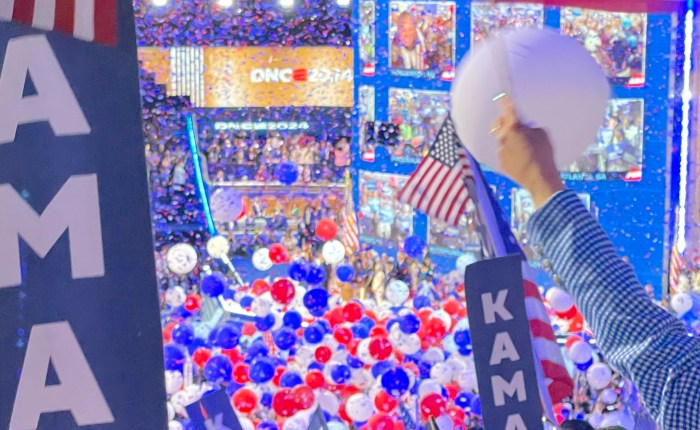
Lucky doesn’t begin to describe how it felt to be in Section 202 of the United Center on August 22, 2024, for Kamala Harris’ acceptance speech—the most blessed hurly-burly hoopla in memory.

Or, in the words of Irish Vivienne, “Best craic a’ me life.”

___________

Irish Craic Explained

“Craic is laughing at cellular level, finding the humour in everything and making yourself laugh when thinking about it all.”

Me & Pete Buttigieg

Me & Pete Buttigieg

Never have I felt so valued at church as I did last Sunday. Presbyterians I hardly knew tugged at my sleeve or grabbed my elbow or those less buttoned-up screeched in my face — all congratulating me on getting to meet Pete Buttigieg. I’d posted a photo of Pete and me on FaceBook that week. A well-heeled Democratic couple in Chicago’s Lakeview neighborhood scrambled a party together that raised $700,000 for the Presidential campaign of candidate Kamala Harris six days after she chose Governor Tim Walz as her Vice Presidential running mate. A friend bought two tickets he couldn’t use and asked if I’d like to have them.

Gulp. Yes. Yes. Yes. I said. Pete Buttigieg is the most poplar Democrat in the United States. He’s the youngest person ever to serve as US Secretary of Transportation, was the mayor of South Bend, ran for president in 2020, is married with two children and oh, he’s gay. When he kicked off his campaign for President in 2019, I traveled to South Bend with Amy, Peter and Mark in the pouring rain to be at his announcement in the leaky old Studebaker factory. Pete was on Kamala’s short list for Veep, but, well, he’s gay. The US electorate can stretch its collective imagination to accept only one major cultural shift at a time. I guess. Democrats like me are giddy over the historic candidacy of Vice President Kamala Harris, a black woman, running at the top of the ticket. We would have been rapturous if she’d chosen Pete, but honestly, we’re not far from that in her choice of Tim Walz, a funny smart former high school football coach who loves state fairs, teaching, sitting on Congressional committees, governing Minnesota, serving in the National Guard and traveling to China.

I just love campaigns. I love candidates, campaign organizers, campaign volunteers, campaign consultants, campaign buttons, campaign events and campaign offices. My high school held a student-led Democrat-Republican combined mock convention in 1964. I was assigned to be Republican candidate Nelson Rockefeller’s campaign manager. I wrote to Rockefeller’s campaign office in New York requesting his platform in order to write my nominating speech for the mock convention. The campaign responded by sending me free stuff: crates full of campaign buttons, posters, leaflets, scarves, ties, cufflinks, bracelets, position papers, and even a suggested stump speech. I plastered the school with Rockefeller posters and made sure every student had some sort of paraphernalia with “Nelson” on it. The students chanted “Nelson! Nelson!”, I delivered my nominating speech and Rockefeller won the student endorsement by a wide margin. 

I had already been steeped in soda-shop debates rebutting a freshman classmate’s anti-government racist diatribes. I read the boy’s constant companion, the 1958 publication The Blue Book of the John Birch Society ( a precursor to Trumpism and Project 2025) in order to prove him wrong point by point.

In the eighth grade my class was bussed to the airport and given hand-held American flags to wave and cheer as President Dwight Eisenhower deplaned from Air Force One. 

Sixty-five years later, I’m still at it.

The Peace of Non Closure

The Peace of Non Closure

A new concept popped up at the outset of a recent anti-racist training session. Among the familiar “courageous-conversation” ground rules, the leader added, “We commit to non-closure. (pause) Right?”

Whoa, really? My fellow attendees all yes’d the speaker as if they knew this already. I thought I must have ignored an inboxed message, or, in my long season of retirement, missed another new corporate buzz word. Non-closure.

On the brink of Juneteenth, the half-day session promised to address the backlash to Diversity, Equity and Inclusion programs and policies. That morning all of nature said yes! to Chicago. I wanted to say yes! too, and take a long walk in the park with my dog. Instead, I reluctantly ambled over to the dingy conference room in a church basement near my home. Anti-racism churned inside me and I had no organized outlet. I was curious to see if there was anything new.  Answers.

But here I was, swallowing a commitment to non-closure. No answers, no conclusions, no plans, no fantasies of what might be. Of the numerous anti-racism trainings I’ve attended since the murder of George Floyd this may be the first time I recognized that it’s safe to be in that liminal space of unknowing, of ambiguity. There would be no meaning-making, no sense-making, no closure.

Facilitators from Crossroads, an antiracism training organization, gathered us together, not to tell us what they know, but to find out what we know. They see, feel, but even more, they sense, not just a political backlash in anti-racism work but, an active softening in community and personal commitment. 

The air is leaking out of the tires.

This week Donald Trump and I had birthdays. We’re the same age. Several friends asked me how I planned to celebrate.

“I don’t really celebrate my birthday.”

“Why not?” Asked my favorite poet.

I had no answer. 

He asked about my writing.

“I’ve been thinking lately I may not write anymore.”

“Why?” He asked.

Another why question. And no good answer. Is that a failing? No answer? Does it mean I’m not sufficiently self-reflective?

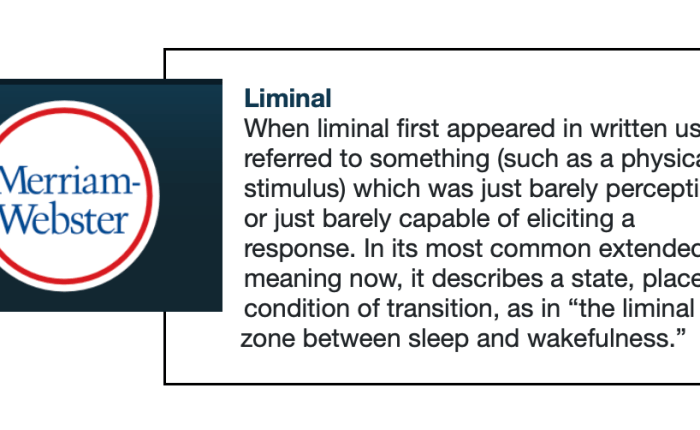
Liminal, from the Latin, “threshold” puts time and space betwixt and between. On liminal days, birthdays dangle off the edge of time. The past no longer haunts me, the future no longer calls me. I neither wait nor wonder. Indeed, birthdays are liminal days.

Anthropologists say that memory disorder, pandemic uncertainty, authoritarianism, virtual reality, border disputes, old-age anxiety, environmental issues, and gender trouble put society in a self-protective liminal state. Whew! Thank you God. This beloved gift  allows me to live on the threshold where social norms, like answering the question “why” or reading every damn email are temporarily suspended. 

In the ninth grade, when I was consumed with past and future popularity by any means, I was inconveniently tormented with one living and one dead poet: T.S. Eliot and Alfred Lord Tennyson. A lot has been written about the spiritual liminality, the non-closure of their work. It’s only now (or is it?) that I see why these vexing lines captured me:

Tennyson’s Ulysses:
Yet all experience is an arch wherethro' 
Gleams that untravell'd world whose margin fades 
For ever and forever when I move.
TS Eliot’s Four Quartets:
Time past and time future
What might have been and what has been
Point to one end, which is always present
.

Smelly Lilacs

Smelly Lilacs

The tulips were showing their last droopy colors. The iris’ were ready to pop for a week or two of runway-like exhibitionism. The trees in the small park were half-dressed, embarrassed by their young fresh leaves, waiting for their green siblings to fill in around them. 

And oh those smelly lilacs. 

Their short-lived incarnation makes me holler 

thank you Jesus. 

And then, the warblers.

Every spring is the same. Year after year. And yet, every single time, I’m shocked out of winter doldrums by the sheer variety of beauty and fragrance in the cultivated and in the wild city gardens. A text or an email or an article from birding organizations will remind me to listen for migrating warblers. They pass through as the tulips fade. I hear them. Never see them. 

Warblers visit Chicago on their way up north from Central and South America. They’re tiny. My old eyes are acclimated to spotting bigger birds—starlings, blackbirds, crows. Even sparrows are larger than warblers. I look, but mistake the warbler for a leaf or a twig, even a large bug.

But the other day, on an unusually seventy-five-degree May morning, I passed under a tree while Elsa sniffed around the ground cover for messages from new and old pals. I heard a symphony of birdsong overhead and looked straight up to see tiny bright-colored warblers flitting from branch to branch, hunting insects. 

I switched on my iPhone, pressed the Merlin bird app, and recorded a Tennessee Warbler, Yellow Warbler, Yellowthroat, and American Redstart all singing their wee hearts out within shouting distance. I suddenly realized I was in a bird “fallout,” a phenomenon that occurs when curious weather slams into migrating songbirds in the air and they descend into the trees below. 

The weather systems predict the number of songbirds that may be migrating over Chicago on spring nights. Attracted to their reflections in the windows of highrises, they accidentally kill themselves by flying into lit buildings.

The uncommon migration fallout happened twelve hours after Chicago’s unusual sky-drenching from the northern lights—yes, the northern lights! The aurora borealis: blazing bits shooting out of the sun, hitting the diluting atmosphere with undulating ribbons that lit up the Chicago night. All this only a month after a solar eclipse. 

Hyde Park residents Meghan Hassett and her husband Max Smith captured the northern lights from Promontory Point Friday, May 10, 2024. Provided by Meghan Hassett

In the park, a dog-walking neighbor neared with Zeus, stopped, and looked up. 

“Whatcha lookin at?”

“Warblers.”

“Oh,” and he continued on. He lives in my building and told me a few days before that he’s planning a hiking trip to the Rockies because he “likes nature.”

Me too.

Jews

Jews

Jesus, my lifelong friend, accompanied me through chicken pox, mumps, and measles when quarantine isolated me from my sisters, parents, and friends. No, I didn’t have Mother Theresa-like visions. He was more of an imaginary friend for my waxing brain, like an animated Pooh Bear.  Clergy at St. Mary’s school in Terre Haute, Indiana, taught that Jesus was born in Bethlehem and died in Jerusalem. Due to those back-to-back pre-vaccine childhood illnesses, I heard these Jesus facts my second time around in the first grade. The teaching doubled down in my malleable brain, which had grown to ninety-five percent of its total capacity, normal for a six-year-old.

There was never any question that Jesus was born of Jewish parents. Israel, presented as a holy place, not a political state, was sacred ground because that’s where Jesus lived. There was always the implication that we, as Catholics, were in Jesus’s family, that somehow we had Jewish roots. If Jews believed in Jesus, they got to go to heaven, like us Catholics. But no other religion. Such was my Roman Catholic schooling.

Our single black-and-white family television transmitted few programs into our living room in the 1950s. Roy Rogers and I Love Lucy were allowed, but my parents insisted we watch the nightly news. My sisters and I didn’t dare whine for fear of verbal reprisals like, “Shut up and listen—maybe you’ll learn something.” 

They’d let us watch “This is Your Life,” a forerunner to PBS’ “Finding Your Roots’. In 1953, This is Your Life broadcasted the story of 32-year-old Hanna Bloch-Kohner, a Holocaust survivor. I wasn’t much interested in the not-so-famous Hanna, but I did wonder about the Holocaust.

When I was ten years old, as my brain power peaked, local TV stations advertised the opening of Old Orchard Shopping Center in Skokie, Illinois. We lived in Wilmette, on the border of Skokie.

“Where’s Skokie?” I asked my mother.

“That’s where all the Jews live.” She answered.

All my thoughts screeched to a halt. I’d never seen a Jew. I assumed that whatever Jews were leftover from the time of Jesus surely had died in that mysterious “Holocaust,” a word adults uttered in a hush. Of course, I couldn’t ask my mother what Jews were doing in Skokie. She expected me to know what she knew, no matter the subject. She would have ridiculed me with a sarcastic, “You’re kidding me. Don’t you watch the news?”

From that moment on, I looked for Jews in supermarkets, at the beach, in the record store, and even at school. It’s possible I looked for men who resembled Jesus. In high school, I met a Jewish brother and sister. I stared them into my spiritual family. I wondered how they got to New Jersey from Bethlehem or Jerusalem or Israel, those holy places whose ancient remnants had settled in my bones, with Jesus. 

My brain, now waning, has reformed itself through evidence, facts, and logic into knowing and loving the Jewish story. There may be evidence, and there may be facts, but there’s no logic to knowing Jesus. 

That’s still a belief. 

Sensemaking: The Eclipse

Sensemaking: The Eclipse

From my window, I can see Lake Shore Drive’s curve at Oak Street, an “S” curve fraught with danger. Some days, as many as five separate car crashes occur from unsuspecting or inexperienced drivers speeding toward the curve and sliding off the road. Heavy gauge ribbed steel barriers prevent errant vehicles from jumping the curb, flying off across a small park, and crashing into the Drake Hotel and vintage apartment buildings on East Lake Shore Drive.

On eclipse day, April 8, 2024, an East Lake Shore Drive building was an arrival point for President Joe Biden’s visit to Chicago. To augment the threat of car bombs speeding down Lake Shore Drive and intentionally barreling off into the building, city salt trucks lined up bumper to bumper on a half-mile stretch of the S curve that hugs the small park on one side and Lake Michigan on the other.

At 2:07 pm, the moon blocked the sun by 94% as I waited in the park with my dog Elsa. A few other dogs tethered to humans stood nearby. 

“Is the eclipse happening soon?” I called out to one.

“Yes, right now,” a neighbor announced.

“Here!” He rushed over and handed me his solar glasses so I could see the shadow of the moon crossing the sun. 

“Oh, there it is,” I whispered, “I thought the sky would be dark.”

At 94% sunshine, the sky doesn’t turn dark. Even a tiny sliver of the sun is so bright it can light up the sky. I hadn’t been paying much attention to the details of the solar cycle or lunar eclipses. I knew light from that 6% sunshine is so intense it can fry your eyeballs, but I didn’t know that 6% sunshine gives off an intense, vibrant light capable of eliminating shadows.

As I handed the solar glasses back to my neighbor, I looked down at Elsa, standing in the projection of overhead tree limbs. April brought out buds, but still no shady foliage. The images of the boughs, branches, and twigs on the ground were as clear as they were on the trees, like a photo. A perfect mirror image of the deep brown arbor architecture above. Nothing in my memory compared to this. I sensed, though, a deep knowing, as if ancient benevolent familiars had brought me the seeing of a thousand ancestors.


Elsa in the eclipse

“The sun is about a million times brighter than the full moon,” explains Angela Speck, an astronomer at the University of Texas at San Antonio, “So if 99.9% of the sun is obscured,” she says, “there will still be a thousand times more light than the full moon.

I read that in the days before the eclipse, but it held no meaning and slipped my memory. I still had a preconceived notion that the sky would turn black. Experiencing the solar light on the ground, mine and Elsa’s ground, in the valley between the salt trucks and the highrises, revved up my consciousness. 

Now it makes sense.

Lunch Money Reparations

Lunch Money Reparations

At the Goodman Theater Chicago’s Storytelling class, teaching artist Julie Ganey prompted us to write a “story of changed perspective” based on Goodman’s production of Margaret Atwood’s Penelopiad. 

I had a story in the can, Lunch Money, about a changed perspective, and decided to revise it for the storytelling assignment before I saw the Penelopiad performance. When I finally saw Peneliopiad, I couldn’t see the change in perspective theme—still can’t. Did Penelope change her perspective? Did Odysseus? Who? What? 

Had I seen Peneiopiad first (one of the best productions I’ve ever seen in any theater anywhere), I would have written about an experience in honest storytelling.  I have lots of those. But, alas, it’s best I don’t sermonize on truthtelling. The following is my change-in-perspective story, which I’ll soon be reciting in person at the Goodman Theater’s “Lobby Stories.” If you’re a regular blog reader, thank you; you’ll understand why retelling this story is important.

Lunch Money Reparations

Reparations are a program of acknowledgment, redress, and closure for a grievous injustice. — From Here to Equality, Reparations for Black Americans in the 21st Century, by William A. Darity, Jr. and A. Kirsten Mullen 

When I started working as a part-time receptionist in downtown Chicago, I lived with my nine-year-old son in a high-rise apartment and periodically spent more money than I had. Glitzy earrings or a new red lipstick often called to me as I passed through Marshall Field and Company on State Street. I once had my entire purse stolen off the counter as I adjusted my scarf in the mirror. 

Over the years, I’ve faced down quite a few street scams and purse snatchings. The worst was the time three teenage boys trapped me in a revolving door at the old Carson, Pirie Scott building. One had yanked on my purse as I entered, but I grabbed the shoulder straps while the accomplice pushed the door in the section in front of me. The accomplice stopped abruptly and held his hands on both glass doors. This left each of us stuck in a different section of the revolving door, awkwardly staring at each other through the glass. They all ran off when a security guard came to my rescue.

I added this grievance story to others like it. Joining the ranks of privileged pseudo-traumatized victims, I loudly condemned an exaggerated version of the bands of criminals marauding downtown Chicago. 

As a pensioner, I’ve inoculated myself against criminal assault by carrying nothing but my iPhone and a pocket-size purse where my bus pass, credit cards, and a small amount of cash are stored. Costume jewelry and cosmetics are no longer a retail draw. But I cannot resist accepting Dutch treat lunch invitations from friends, paying no attention to my budget or bank balance. 

One day, I sat waiting for a fellow retiree, Peter McLennon, in the lobby of a busy hotel where we’d planned to have lunch. I delved into my ever-present iPhone with heightened curiosity to see if anything big had happened between the time I had gotten off the bus, walked the two blocks to the hotel lobby, and plopped down in the overstuffed chair. 

I was so engrossed in the breaking news of a car accident on a distant highway that my senses were dulled to a body stirring in the chair next to me. When the body started in on her story, I momentarily jolted to attention. 

“My husband beat me for the last time. I been hidin’ in a women’s shelter but he found me, and now I need to move.”

“What?” I said as much to her as to myself since I was not quite tuned into her voice, my mind drifting in and out of her story while half-wondering what happened to the people in the car crash that was reporting out of my phone behind the now blank screen. 

“My social worker found a place in Cincinnati. They gonna hold a room 24 hours. I need $19 for the bus. Can you lend it to me?”

“What?” I looked around to see if Peter was nearby to rescue me. 

She repeated her story, adding some details about injuries inflicted by the husband. 

“As soon as I get situated in Cincinnati with a place to stay and a job, I’ll pay you back.” 

I tested her by asking if she was taking the mega-bus since $19 didn’t seem like enough money for a bus to Cincinnati. That stumped her, but she recovered nicely by describing where the bus station was. 

And for one shimmering split second, we caught each other’s eyes and I sensed she knew I was on to her. But she kept up the hustle. I admired that. She was working hard for her money.

I unzipped my little red purse and happily handed her my $20 lunch money. Before I zipped up, she was gone. The scam worked. Relief washed over me as I exhaled the stress of her desperation. Even if I doubted her, she deserved all the money I had for all the years I’d spent harboring both silent and noisy racial bias.

When Peter arrived, he commented on how serene I looked. As we walked toward the restaurant, I asked if he could pick up the tab for lunch. 

“Yes, of course.” He said.

And I didn’t even have to tell the story.