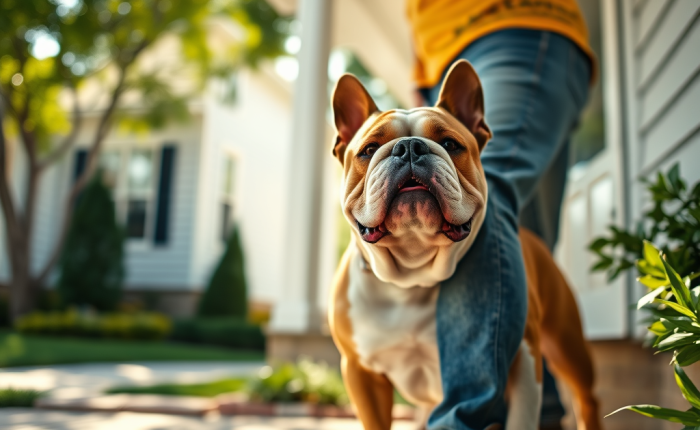
In Kenosha, at the door of a new white house in a new white neighborhood with curvy streets, low trees and developer-landscaped gardens, I knocked on the storm door, bang, ba-bang, bang. A huge white old English bulldog slid around the corner from the kitchen to me, the stranger, barking as hard as his docile voice would allow. His owner appeared looking as if she could barely hold him back.
I shouted through the door, “I love dogs! It’s ok. Can I pet him?” We all smiled, dog included, and he came out to greet me with a gentle push of his massive short body against my legs.
“Hi, I’m with the Kenosha Democrats. Have you voted yet?”
“No, we’re voting tomorrow.”
“What’s his name?”
“Arnold.”
“Arnold? Like Schwarzenegger?”
“Yes.” We both cracked up as Arnold dutifully looked one to the other, pleased to hear his name.
“You know, Schwarzenegger just endorsed Kamala Harris.”
Thus, I established my purpose in knocking on her door on a bright white Saturday afternoon.
“I know!” she said. Then she mouthed the words, “I’m voting for her.”
“Oh great,” I said, “”Thank you.”
Canvassers use a handy cell phone app, Minivan, to record voters’ responses. The drop down menu lists Strong Democrat, Lean Democrat, Undecided, Lean Republican and Strong Republican. Since my voter didn’t give it her all, I decided she was a Lean Democrat, punched it in and moved on to the house across the street.
As I came back to the sidewalk, all of a sudden a white SUV sped out of Arnold’s driveway and stopped in front of me. She rolled down the window and shouted, “I’m for Kamala! Going to vote right now! Good luck!”
I thought back to her open door and realized someone else had been rattling around in the kitchen. A husband? She couldn’t let her husband know she was voting for Kamala Harris?
This gave me hope. I changed her in Minivan to Strong Democrat. Voting Harris.
Perhaps she represented a political ad where Julia Roberts voiced, “in the one place in America where women still have a right to choose, you can vote any way you want, and no one will ever know,” suggesting women can lie to their husbands about their vote. Apparently Fox News went berserk over this ad, as if spouses never lie to each other.
Today, the day before election day, it hit me how different life will soon be. No matter who wins, I’ll have no more reason to hope — for the vote, for my candidates, that the country will be at peace, or that democracy survives. It-is-what-it-is acceptance will necessarily move in to care for me.
Saturday afternoon trips from Chicago to Kenosha, stopping in the bustling Democratic headquarters then out to canvass voters will halt. My calves will never forget the two-step entrances to every house in Kenosha County. But memories of coffee and sandwiches at The Buzz Cafe on Sixth Avenue will fade.
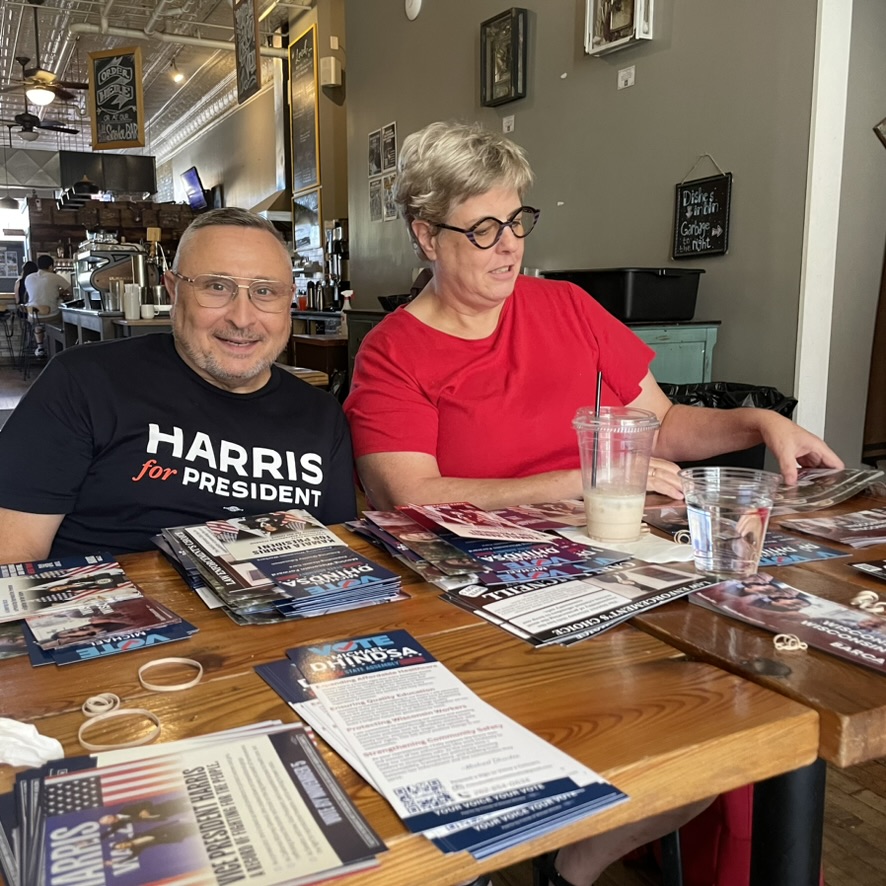
I do have something to hope for.
Incoming texts and emails will be reduced to a trickle.
 tall navy-suited body seemed to shift the atmosphere, moving the dust molecules away from him and clearing the air as he moved. He gave a hardy salutation and proceeded to introduce himself to each person while he circumnavigated the room, one-by-one. I was halfway around the table, and when he reached me I stood and looked up to his bemused rosy face, full of laugh lines. He had a big red nose, like Santa Claus. As I tried to introduce myself, he interrupted me by saying he knew who I was— the Executive Director of the state Democratic Party. He asked if I knew my name was the same as one of King Lear’s daughters. “Yes,” I said, “My name came from her.” He leaned over and whispered let’s keep that between us since she wasn’t such a great character. And just like that we had a best-buddies pact.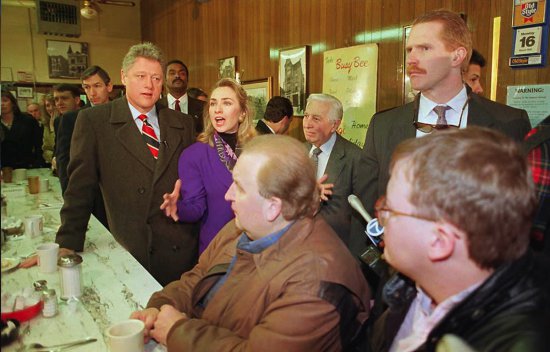
 Regan Burke