The Big Freak Out

The Big Freak Out

Metaphors have frittered away from me. To be fair, they hadn’t much choice. In conveying messages to contemporaries over the past few years, whether speaking, emailing, texting or DM’ing, I’ve developed a necessary plain spokenness, lest the meaning be misconstrued, misunderstood or confusing. Fallout from this mind-bending prosaic language is living at a level of plain thinking, another aspect of old age (I’m 78) that I wish I’d been warned about.
While watching Joe Biden perform at the now-famous CNN debate in June, I came unstrung in the grip of knowing that Biden’s plain-thinking, plain-speaking style was killing any chance of beating Trump in the November election. 

“Oh. my. god. He’s like my neighbor Ray,” I thought. Ray, who used to converse like a college professor and remember your name like you were his student, but now he talks only sports and weather. Ray, who cannot grasp metaphors unless they’re baseball sayings he’s used all his life, like “on the ball” or “step up to the plate” when he motions for you to exit the elevator before him.

On an unsually quiet afternoon, that is to say, no sirens, no gas-powered lawn mowers, no garbage trucks beep, beep, beeping as they backed out of the alley, I was studying David Montero’s new book, The Stolen Wealth of Slavery: A Case for Reparations. My book group decided to read two chapters at a time in order to absorb a history none of us had ever known. The premise that the intellect is stimulated through awe and wonder has proven true in this group, with this book. Montero’s research thoroughly tracks how the free labor of Black people in the South became the basis of the entire US economy and her dominance over world markets. His writing is loaded with similes and metaphors.

“The energies of three million enslaved people were organized into an industry, industrial enterprises were increasingly fertilized by slavery, and the output of the system was shipped across the world.”

(All of a sudden, a swift “click-clum” in the room interrupted my reading. I turned and saw a ragged chunk of dried-up old paint on the floor, fallen from the ceiling. Surely there’s a metaphor here. Chip off the old block? Chip on your shoulder? Paint the town red? Naw. Nothing. I got nothing.)

In the chapter, “The Union Must Perish,” Montero included a white abolitionist’s account of his travels to the slave market of Virginia. Published in the New York Daily Tribune in 1850, part of it reads:

“…this was the most heart-sickening sight I ever saw. I involuntarily exclaimed, “Is it possible that this is permited in my own native country—the country I have loved so well, and whose institutions I have exultingly pointed to as an example for the world. If this is Christianity, don’t call me a Christian.”

The emotons expressed are precisely what I feel now that the Trump-appointed United States Supreme Court ruled that the President is unbound from the rule of law and can freely engage in criminal activity. Our Christian Nationalist Supreme Court looks forward to the next president closing the borders to anyone but White Christian Europeans, slashing gay rights, civil rights, and women’s rights, and requiring biblical education in public schools. Echoing the 1850 abolitionist, if this is Christianity, don’t call me a Christian.

There ain’t no metaphor for that.

Cold Wars

Cold Wars

The 2019 Polar Vortex slid down from the North Pole, threatening to lock Chicago into subzero stillness. I prepared for the warring cold by teeing up the entire 18-hour series of The Marvelous Mrs. Mazel. Then I threw stale bread crumbs onto my balcony to nourish the house sparrows, finches, and chickadees before they huddled together in eaves and cracked soffits to wait it out. I shuttered in and Dapped all the little crevices around the balcony door that were spritzing air into my not-so-insulated living room. That was the extent of my preparation for the coldest two days ever recorded in Chicago.

Day one brought minus 23 degrees. I woke to a thick film of silver ice covering all the windows. The ice curtain obscured the humanity moving around behind the windows across the street and any fool pedestrian walking in the feels-like-minus 40.

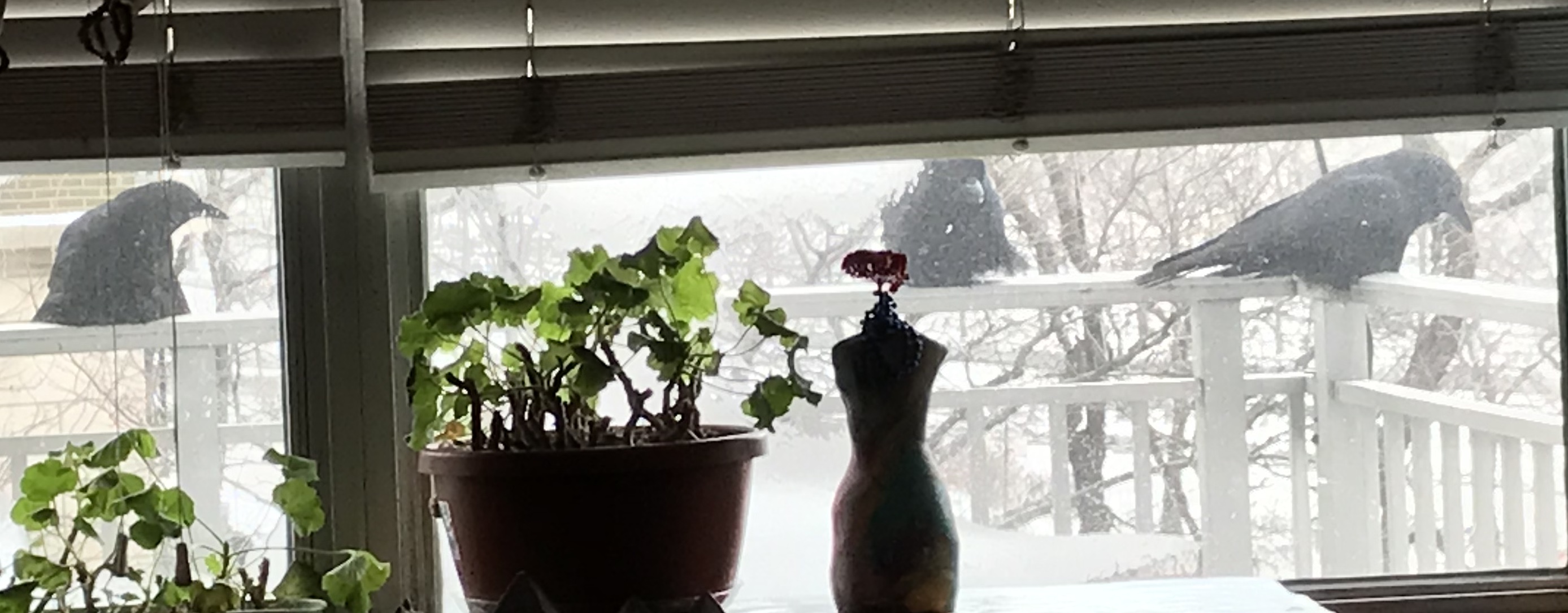
My binge-watching was interrupted mid-morning by a thrashing whomp, whomp whomp on the concealed balcony. I inched toward a clearing in the frosty glass.

A murder of crows had come to forage.

The much-studied American Black Crow might be the most intelligent animal other than primates. They hide their food and come back for it. If a crow looks you in the eye, she will remember you, follow you down the street, and caw at you for attention like a wild pet. 

On day two, the temperature was 21 degrees below. The ice wall on my windows melted enough for a small lookout. I abandoned Mrs. Mazel and placed a chair well away from the clearing to observe the crows without startling them. They first landed in late morning. A mighty set of black wings fluttered a plumped-up body onto the balcony railing, and the rest followed—a family of five dipping to the balcony floor for leftovers. They flew off and came back. Again. And again. And again. I remained still throughout, trying to lock eyes with the birds. In the afternoon, the weather broke and allowed the dog and me to walk outside—under the watchful eyes of noisy new friends.

The first cold days of 2023 were predicted for the weekend after Thanksgiving. Though nowhere near the 2019 plunge, 30-degree temperatures heightened awareness of asylum-seeking families living on cardboard slabs outside police stations. I sought diversion through another favorite TV series, Julia.

The TV automatically tuned in CNN, though, where there was live coverage of the hostages being released from Gaza. A mysterious and curious need for every scrap of information gripped me. Who are they? What are their stories? Where are they going? I saw six women over the age of 70. One 85-year-old was helped onto a bus. I winced, feeling my own arthritic pain. Four children appeared—ages 2, 4, 5, and 9. I squinted to see if they were clutching teddy bears.

After watching for two tearful days, unrelenting shivers overcame me. And when I took the dog for a walk, that murder of crows cawed to us from the barren trees.

Blest Be The Ties That Bind

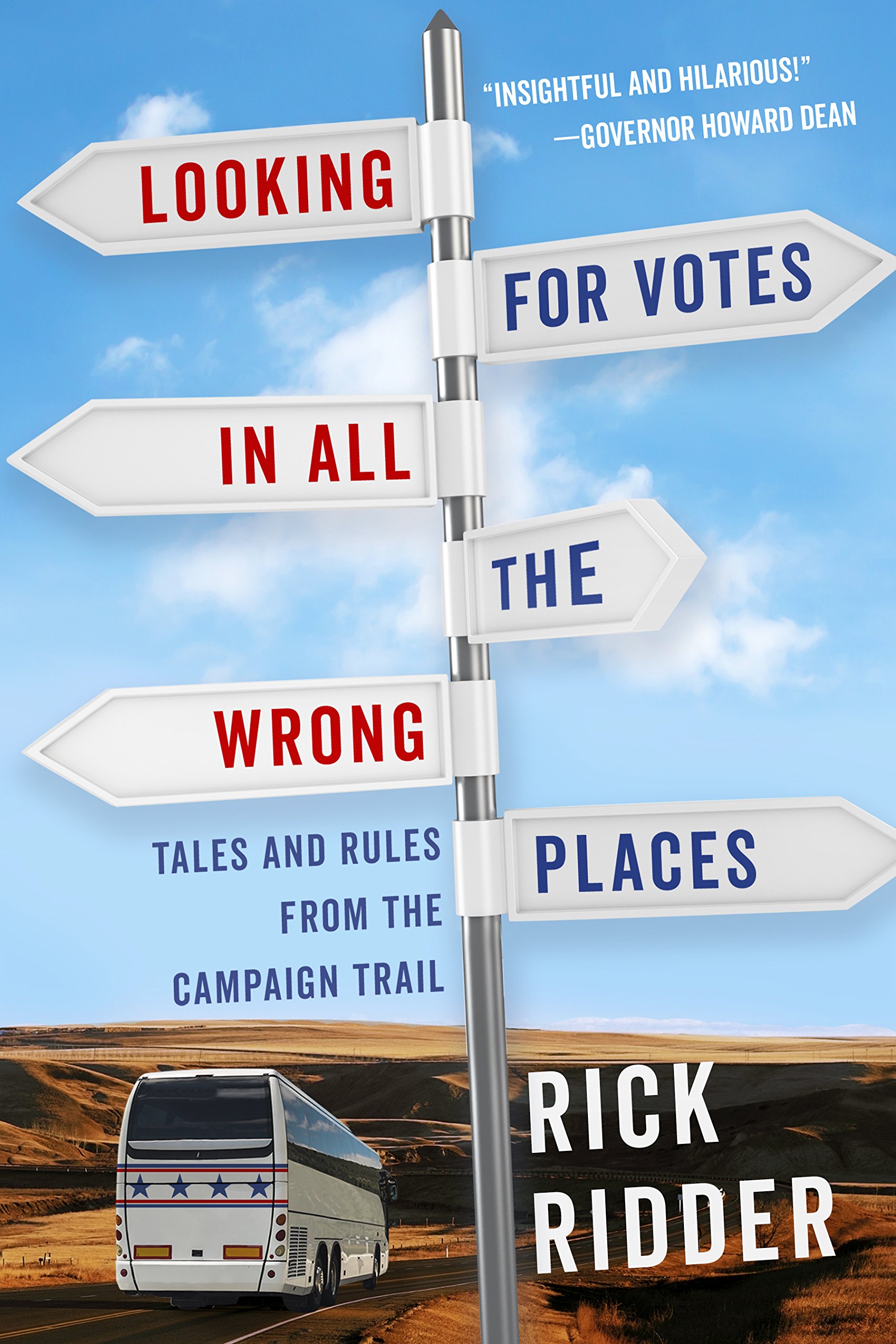
I haven’t seen Rick Ridder in years but loved reading his 2016 book, Looking for Votes in All the Wrong Places. I bought it to add to his sales numbers, support him in my own 81JbkJ1jA8Lsmall way. We both survived the 1980s Gary Hart presidential campaigns. So when it comes to making room on the shelves for other sympathy books, the ties that bind keep Rick’s book in place.

My built-in bookshelf clings to the entire southern wall of my small living-dining room. It’s stuffed. Books, old Vanity Fairs, photos, souvenirs, dog sculptures, used conference binders, scrabble, dominoes, a small portable heater and my writing notebooks all collide on the faded white sagging shelves. 

When the time comes to rack the newer books, stockpiled on all the flat surfaces in my living space, I painstakingly pull the old prisoners from their slots on the shelves. They sit on the floor for hours, days, weeks, awaiting sentencing. I stare at the titles. Agonize over their fate. I wish then, more than at any other time in the hours before twilight, for a piece of someone to discuss the disposition of the hoard and share in my decision-making.

“What about this one? Remember this? Dimitir by William Peter Blatty. Mark suggested it when I told him Blatty named the girl in The Exorcist after me. Did I read it? Should I save it?” 

“Oh, then there’s: Age Doesn’t Matter Unless You’re a Cheese. Jeanette gave me that when I turned 70. Maybe there’s something in it I can use for my writing.”

“Oh yeah. Listen to this. Ram Dass: ‘I used to have a sign over my computer that read OLD DOGS CAN LEARN NEW TRICKS, but lately I ask myself how many more new tricks I want to learn—isn’t it better to be outdated.’”

“Outdated! Is that how I should think of these old darlings?”

Oh, I tried long ago to get help with this salvage operation. It broke down, however, when I plunged into the stories behind my keepsake books. No matter how good a friend I netted, my stories bored in the telling and the telling and the telling. I sit alone now on a stool wheeling around the wreckage from title to title. 

“These? Oh no, must save Ian Rankin, my favorite mystery author. Oh, c’mon, Regan. It’s not as if they’re going in the garbage. Put them on the bookshelves in the laundry room. Someone’s bound to enjoy them before they get carted off to the used book sale at the Newberry Library.”

“Ok, these can go—two books by David Ellis. Oh, well, maybe. He’s the lawyer-turned-mystery-writer who prosecuted Rod Blagojevich. A good lawyer. And a good writer.”

“Richard North Patterson’s, Exile, needs to go. It’s old and smells. Musty. But I’m so grateful that it helped me understand the Israel-Palestine mess. Maybe I’ll read it again.”

Loneliness has its price. Out of this last 24-book pile-up, only one goes to the graveyard: The Complete Book of Food Counts.