Magpie Wedding Guests

Magpie Wedding Guests

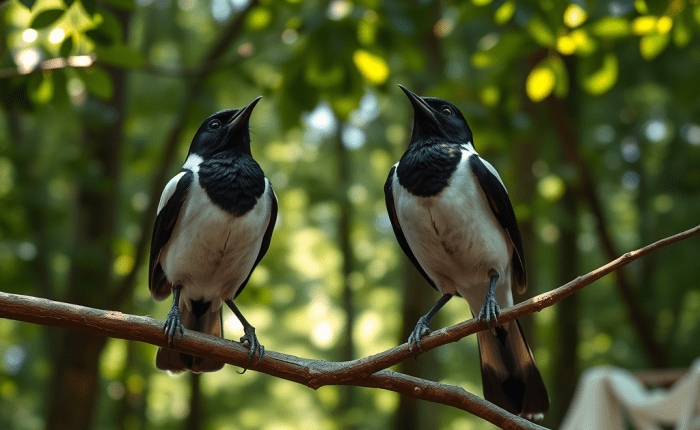
The Merlin app in my iPhone reported two singing Magpies above the deck built into the trees surrounding the wedding. Standing at the rail with my 19-year old grandson, we looked to the sounds — to one side of the dense forest, then to the other.

“We should be able to see them,” I said. “They’re the size of a crow, with white bellies and flashy black wings.” 

The Merlin Bird-ID developed by the Cornell Lab of Ornithology, identifies birds by their song. It works like this: I open the app, Merlin tells me the name of the bird it hears, and I look for that bird. I’m satisfied, thrilled actually, with knowing who they are even if I don’t spot them.

We were in Salt Lake City for Kirby and Nate Green’s wedding. My granddaughter. I had walked around my hotel neighborhood earlier looking for birds. Many North American birds, like the Magpie, never come over to my side of the Mississippi River in Chicago. They stay out West. On my morning walk, I spotted only the ubiquitous house sparrow.

Magpies! Known as the world’s most intelligent animal, they are in the equally-smart crow family. Magpies have even been observed mimicking human speech. Trying to spot the Magpies on the on the deck, I thought of a time I visited Los Olivos, California. 

In the garden of a gift shop, I noticed a gregarious Magpie couple roosting on a shed.

“Look them in the eye!” 

The proprietor instructed me to interact with the birds because of my exaggerated curiosity. My friend, Cappi Quigley, tried unsuccessfully to lure me away to the California artists’ original wares displayed around the garden.

“They are wild pets,” the owner explained. “They’ll follow you, protect you. Lock onto their eyes and you will not be forgotten.”

We drove out of Los Olivos five miles up Figueroa Mountain Road to Michael Jackson’s Neverland Ranch for a look-see. MJ had been dead for about two years then. We managed to snap each other’s photos in front of Neverland’s iron gates, just as the guard shooed us away.

Two Magpies yacked and magged at us the whole time from low hanging olive trees. They had followed us up from Los Olivos and all the way back to town, swooping down on the car and yelling, as if they were warning us away from Michael Jackson’s ranch.

Folklorists report that Native Americans believe the sight of a single Magpie brings bad luck. But a pair of Magpies, as heard in the trees above the wedding, brings joy. I heard the Magpies again as Kirby and Nate exchanged their vows. There is a world where we might believe that those two Magpies have found their way from the trees above the wedding to Kirby and Nate’s backyard. And that the Magpies will roost on the shed, bringing joy to Kirby and Nate’s lives together as long as they live. 

Smelly Lilacs

Smelly Lilacs

The tulips were showing their last droopy colors. The iris’ were ready to pop for a week or two of runway-like exhibitionism. The trees in the small park were half-dressed, embarrassed by their young fresh leaves, waiting for their green siblings to fill in around them. 

And oh those smelly lilacs. 

Their short-lived incarnation makes me holler 

thank you Jesus. 

And then, the warblers.

Every spring is the same. Year after year. And yet, every single time, I’m shocked out of winter doldrums by the sheer variety of beauty and fragrance in the cultivated and in the wild city gardens. A text or an email or an article from birding organizations will remind me to listen for migrating warblers. They pass through as the tulips fade. I hear them. Never see them. 

Warblers visit Chicago on their way up north from Central and South America. They’re tiny. My old eyes are acclimated to spotting bigger birds—starlings, blackbirds, crows. Even sparrows are larger than warblers. I look, but mistake the warbler for a leaf or a twig, even a large bug.

But the other day, on an unusually seventy-five-degree May morning, I passed under a tree while Elsa sniffed around the ground cover for messages from new and old pals. I heard a symphony of birdsong overhead and looked straight up to see tiny bright-colored warblers flitting from branch to branch, hunting insects. 

I switched on my iPhone, pressed the Merlin bird app, and recorded a Tennessee Warbler, Yellow Warbler, Yellowthroat, and American Redstart all singing their wee hearts out within shouting distance. I suddenly realized I was in a bird “fallout,” a phenomenon that occurs when curious weather slams into migrating songbirds in the air and they descend into the trees below. 

The weather systems predict the number of songbirds that may be migrating over Chicago on spring nights. Attracted to their reflections in the windows of highrises, they accidentally kill themselves by flying into lit buildings.

The uncommon migration fallout happened twelve hours after Chicago’s unusual sky-drenching from the northern lights—yes, the northern lights! The aurora borealis: blazing bits shooting out of the sun, hitting the diluting atmosphere with undulating ribbons that lit up the Chicago night. All this only a month after a solar eclipse. 

Hyde Park residents Meghan Hassett and her husband Max Smith captured the northern lights from Promontory Point Friday, May 10, 2024. Provided by Meghan Hassett

In the park, a dog-walking neighbor neared with Zeus, stopped, and looked up. 

“Whatcha lookin at?”

“Warblers.”

“Oh,” and he continued on. He lives in my building and told me a few days before that he’s planning a hiking trip to the Rockies because he “likes nature.”

Me too.

Discovering Urban Birds by Dorothy Pirovano

Discovering Urban Birds by Dorothy Pirovano

We showed up at the April birdwatching walk at the zoo, opera glasses ready, joining a small group of people earnestly comparing the high-transmission glass, baffle systems, prisms and ergonomics of their binoculars. It was our first birding adventure and we decided we might be best off keeping to the edge of the group, much like those who nonchalantly approach a tour group led by a man with a red umbrella, hanging around at the periphery, just close enough to hear him talk and trying to not be obvious in their lack of belonging.

There were ones we knew – robins, cardinals. Small and medium sized brown birds were given names like “nuthatch,” “wren” and “junco.” A flicker was called out, distinguished by the red slash around his neck. A red-headed woodpecker was attacking the bark of a maple. Not that we actually saw any of them, for our puny glasses were made to watch big people with big voices on a stage hundreds of feet away rather than things that flit and fly.

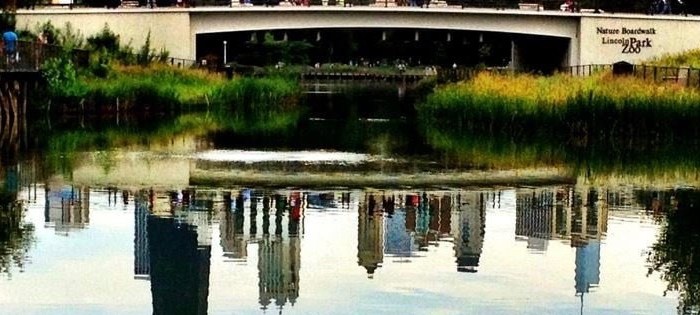
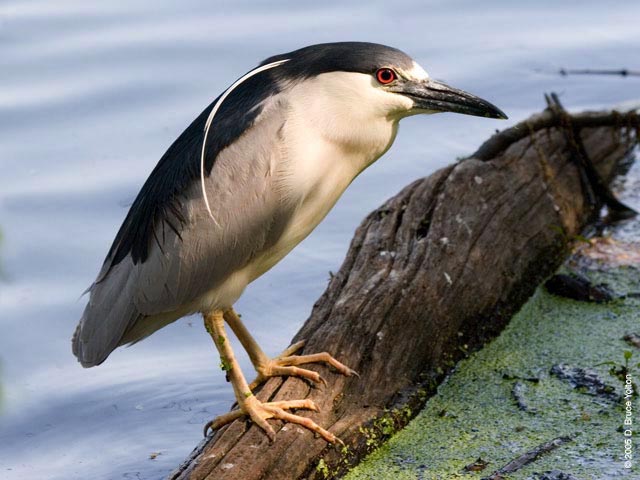
Except for the black-crowned night-heron, a fat, squat bird, so big we didn’t need magnification to see him perched on a branch overlooking the zoo’s lily pond, red beady

Black-crowned Night Heron
Mature Black-crowned Night Heron

eyes intent on spotting a ripple set off by a fin, foot or wing. A common sighting, said our birder guide. A first for us, we novices who, since moving near the zoo in 1996 made it a favored destination for our almost daily walks. Somehow during four years of discovering the zoo’s nooks and crannies, we managed to miss spotting these white bellied giants with their distinctive black crowns and long white feather that pops out of the middle of their heads, curving along one side. That’s its ponytail, our birder noted as the group moved on. We didn’t move until the heron gave up and flew over our heads, no longer just a two-foot tall giant, but massive with a four-foot wingspan that rustled the air as he let out loud, annoyingly throaty squawks.

Imagine our amazement to see one flying in from the lake a week later as we walked past the little island in the pond south of the Farm In The Zoo. The bird, graceful in flight, landed with a thud in a messy twig nest on one of the island’s large willow trees. Then another, then a dozen returning from what must have been a successful fishing expedition. We came to know them on our many return trips.

They had a peaceful community that grew to hundreds of birds, wok wok woking as they approached their island at dusk. One day their nests were occupied when they glided back, then vacated after some back-and-forth squawking, so the returning fishermen could take a turn on the nests while their mates headed out. Weeks later, little heads, mouths agape, jutted up from the twigs, squeaking frantically as they begged for dinner. We became the-crazy-couple-with-binoculars – our new purchase – who stopped people as they strolled by, urging them to take a look at this wonder.

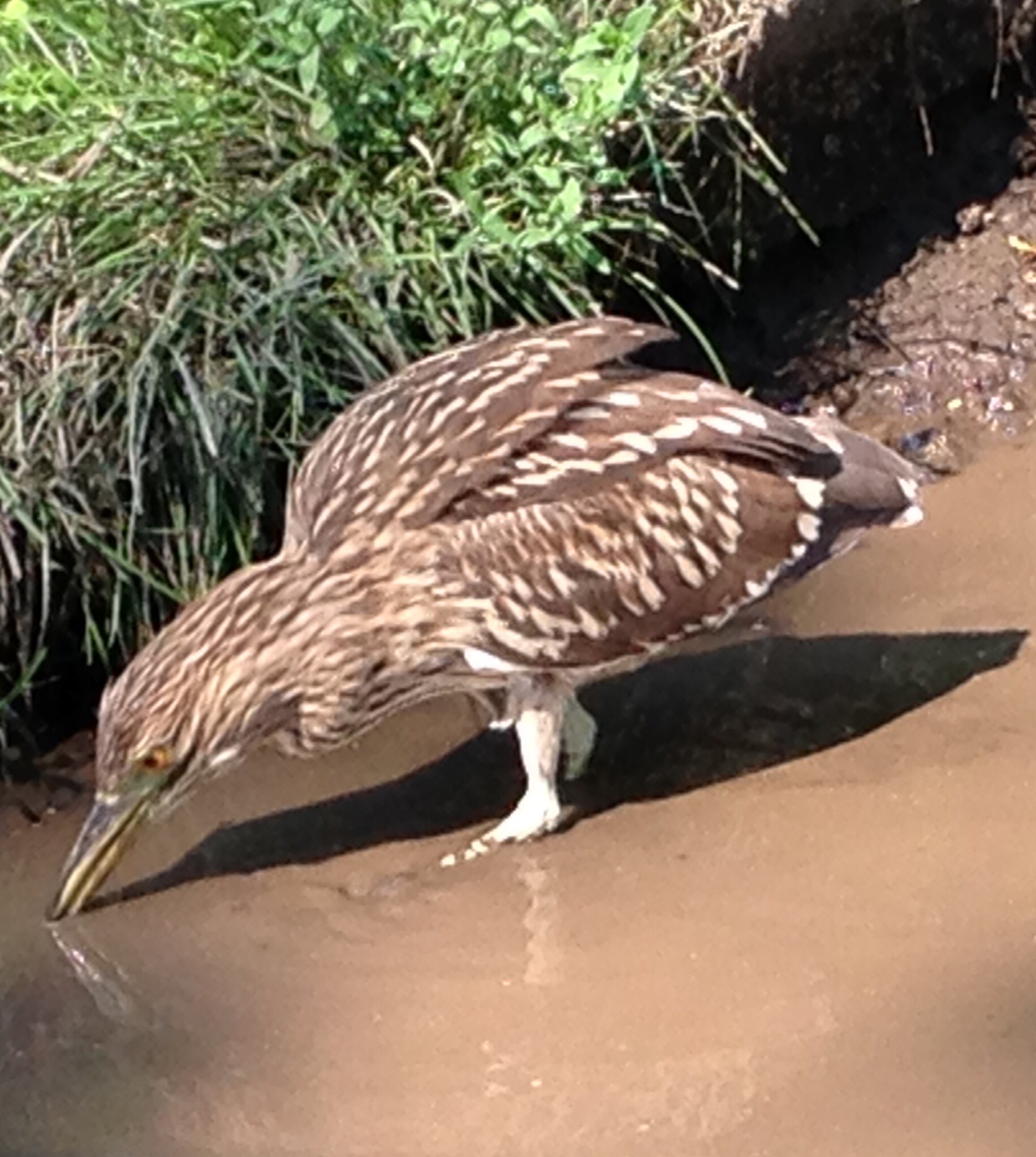
Fat, ugly babies emerged from their nests, hanging tight to branches as they flapped their wings, gaining courage to let go.  Impatient parents would nudge a dallier off the branch,

IMG_0035_2
Immature Black-crowned Night Heron

forcing an attempt at flying. The bodies of fledglings beneath the trees showed this tough-love technique didn’t always work, but with multiple babies in each nest, parents turned their attention to others and their survival-of-the-fittest life went on.  Those who did master flying soon joined their parents, sometimes holding their heads up, mouths open, hoping to be fed. Ignored, they would join the flock in twos and threes on morning and evening runs to the lake, awkward looking brown spotted youngsters standing out next to the white and black adults.

And then they were gone. Nests abandoned, headed south, no doubt, as the shortened days of late October told their body clocks it was time. The chirping of frogs could be heard again around the island, heralding their relief that the predators had moved on.

No one is sure why these notoriously shy birds that have earned a place on the endangered species list, chose this urban patch of land. The zoo has taken over their management, keeping a headcount, monitoring their health, rescuing and caring for the injured, hauling away the dead as part of a research initiative. When the pond was drained, overhauled and improved a couple years ago, it was feared that the night-herons would move on to a more hospitable place without construction, but they simply moved over to the large trees that lined the walkway near the pond, built new messy nests and set up housekeeping. When the pond renovation was complete, some moved back to their old trees while others in the colony stayed by the sidewalk. Flocks have branched out to establish night-heron neighborhoods at the Farm In The Zoo and near the Lincoln Memorial statue by the Chicago History Museum.

Each year they return – more than 600 a year occupying old nests and building new ones each spring. As common a sight as robins if you know where to look – with or without binoculars.