There’s a special providence in the fall of a sparrow.

If it be now, ’tis not to come.

If it be not to come, it will be now.

If it be not now, yet it will come – the readiness is all.

— Hamlet
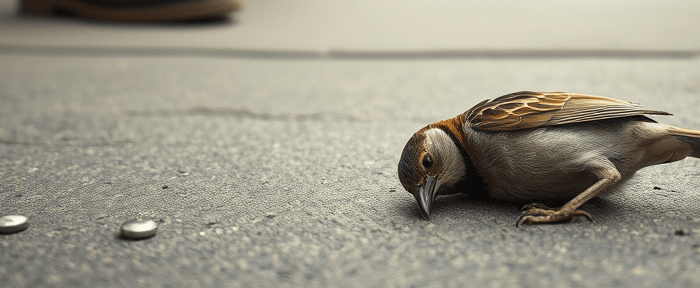
A sparrow fell from the sky and plopped down next to me on a sidewalk corner beside the church as neighbors, shoppers, and tourists bustled to their places.
“Damn! That’s disgusting!” Said a snap-back-hatted young man sidestepping around the splat. Looking the revenant himself as if returning from a dead weekend that probably started out fun on Friday night, he looked up. Was he searching for someone behind the clouds to blame?
“Look at it. So gross!” Looking down now, seemingly blaming the sparrow for its dead ugly existence.
Perhaps because I was headed to church, the sparrow’s lasting legacy in the bible came to mind. Scriptures tell us to look at how God cares for the lowly sparrow as a metaphor for how that same God cares even more for humans. But here I was, staring at a dead bird. Did that God in the bible throw the bird down beside me so I’d know who’s in charge around here? Is it an omen of a bad year ahead? A symbol of immortality? A sign to repent?
There’s a peregrine falcon nest directly east on Lake Michigan in the intake crib of Chicago’s water system. Those tricky raptors attack other birds in mid-air and sometimes miss their prey as they swoop down to catch them. On my dog walks, I’m constantly on the lookout for bird carcasses (sometimes impaled in the bushes) because Elsa will sneak a forbidden lick if I’m not vigilant. I assumed the unfortunate sparrow was one of these victims.
If God set this complicated natural aerodynamic food chain in motion, so be it. I’ll accept that God. However, no God is going to snap me to attention about the upcoming election or remind me of some regrettable remark I’ve made by throwing foreboding dead birds at me. The same force may have set all the emotions of fear and regret in my DNA, but a god that powerful better not have my same human characteristics. I’m conscious of an impersonal force, something outside of myself, an unexplained presence. I believe there’s a higher power, that I call God. Holding that power out as a relatable, reasoned person that acts as a mean-spirited human, to get my attention is not my idea of a god. At least not today, or, not at this moment.
 The ubiquitous house sparrow is not native to the United States, I’ve been told by birders. They chirp most of the US awake in the morning and nest outside our homes’ nooks and crannies. At Chicago’s Navy Pier, if you try to eat McDonald’s fries outside, you’ll be sharing them with sparrows. If you look at your phone outside the Pancake House to catch up on text messages, sparrows will swoop in and pluck at the remnants of your Dutch Baby. This diminutive invasive species is so plentiful that I give it short shrift, ignore it, as if it’s not important.
Until one drops from the sky on my way to church.
____________________________


 Regan Burke