80th Birthday Celebration: Justice for Wrongly-Accused

Featured80th Birthday Celebration: Justice for Wrongly-Accused

Eighty years ago this week, my father, a lawyer, was in the middle of a complicated trial in the military court at the Annapolis Naval Academy. Throughout my childhood I’d heard that my father asked for a pause in the trial to visit my mother and newborn me in the hospital. My birth was announced in the newspaper as part of the daily coverage of the court proceedings.

When I was old enough to ask, I heard from both parents that my father defended Navy personnel for stealing from supply depots. They created a sympathetic narrative, as if the defendants were either wrongly accused or were poor and the crime was justified. When I was old enough to brag about my father to my friends I added color to the defendants’ stories—petty officers sending necessities home to their poor families.

In my fifties I searched the archives in the Naval Academy Library for the article announcing my birth. Before I started rolling through microfiche, I called my father and asked for some common names and dates to research besides my birth date.

“I can’t remember,” he said, “call me when you get home.”

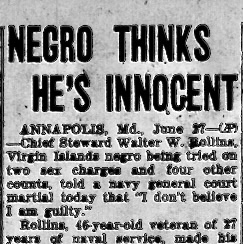
Newspaper articles from 1946 report details of my father’s part in the trial. In the Judge Advocate General’s Corps (JAG), he worked not as a defender of the disadvantaged but as a prosecutor.

The day my birth interrupted the trial, June 13, 1946, my father was about to call an important witness to testify against former Chief Steward Walter W. Rollins. Rollins, “a Negro”, was accused of throwing an all-night party in his basement quarters of the Officers’ Mess with five White people. As the trial continued, the witness testified they all played penny-ante poker from 1:30 am until 9:30 am, but no money changed hands. The unsubstantiated charges against Rollins included adultery with a White woman, a morals offense, gambling, embezzlement, misconduct and theft. He reportedly took a jug of whiskey from the Officers’ Mess. Rollins was sentenced to two years in federal prison.

None of the White people involved were held accountable, though trial records indicate Rollins felt pressured into submitting to the demands of the White partiers. After twenty-seven years of service to the Navy, Rollins was demoted to First Mate and received a bad conduct discharge.

No wonder my father dodged the truth about his JAG history at Annapolis. Until late 1944, he had been in the elite Naval Air Corps, trained on the prestigious Grumman Avenger torpedo bomber. Headquartered in Key West, he patrolled the Florida Straits for German submarines. He’d been arrested for drunken brawls and jailed for extended periods leaving his New Jersey bride alone in a strange town with no friends or family. He acquired illegal Cuban rum, cigars and dry goods, flew the contraband back to Key West and sold it to his fellow sailors.

After the war, as a new law school graduate, he reported for duty to the military court at the Naval Academy in Annapolis. He had just been commissioned a Lieutenant Commander, had been a scholarship student at Georgetown University and Law School. For all his college and post graduate years, he secretly funded extracurriculars with illegal money he earned at all-night high-stakes bridge games.

White privilege saved my father, a conspicuous law-breaker, from prison. I hope he and my mother were so ashamed of his part in ruining Rollins life that they lied about it for the rest of their lives. As a lawyer he never took on trial work again.

Walter W. Rollins was the father of Jazz legend Sonny Rollins. On his sixteenth birthday, Sonny, his mother and brother watched their father get hauled off to jail for two years. My father surely knew what I discovered in the Naval Academy archives. When I returned home to Chicago with my old newspaper printouts, I had questions. He refused to discuss it. I never overcame fear of my father’s wrath in his lifetime — not sure I’ve done so even now– and this was clearly an issue I had not the courage to pursue.

Sonny Rollins spent decades trying to clear his father’s name. In September, 2025, the Secretary of the Navy finally reversed the court-martialed conviction. Sonny died on May 25 at the age of ninety-five. One of the last things he saw was a draft of an article in The Nation reporting the story of justice for his wrongly-accused father. It appears in the July-August edition.

I’m deeply grateful for visits, gifts, celebrations and tributes for my eightieth birthday. However, reading about Walter R. Rollins’ overturned racially motivated conviction, prosecuted by my father eighty years ago, thrills to a depth I’ve never known.

The arc of the moral universe is long, but it does indeed bend towards justice.
An Inauspicious Birth

An Inauspicious Birth

Until late 1944, my father had been a Navy pilot headquartered in Key West where he patrolled the Florida Straits for German submarines. After the war, as a new law school graduate, he reported for duty to the military court at the Naval Academy in Annapolis, as ordered.

Two of my sisters and I were born in the Naval Academy Hospital. On the day I was born, my father was in the middle of a complicated trial. All my life I’d heard that my father asked for a pause in the trial to visit my mother and me in the hospital. My birth was announced in the newspaper as part of the daily coverage of the court proceedings. When I was old enough to ask, I heard from my mother and him that he defended Navy personnel for stealing food from the Officers’ Mess. It sounded admirable. I fabricated stories about men he defended—petty officers sending necessities home to their poor families— and bragged about him to my friends.

In my fifties I went to Annapolis to search the archives for the article announcing my birth. Before I started rolling through microfiche, I called my father and asked for some common names and dates to look for besides my birth date.

“I can’t remember,” he said. “Call me when you get home.”

Newspaper articles from 1946 report details of my father’s part in the trial. In the Judge Advocate General’s Corps (JAG), he worked not as a defender of the disadvantaged but as a prosecutor.

The day my arrival interrupted the trial, June 13, 1946, my father was about to call an important witness to testify against former Chief Steward Walter W. Rollins. Rollins, “a Negro”, was accused of throwing an all-night party in his basement quarters of the Officers’ Mess with five white people. The day after my birth, the witness would testify they played penny-ante poker from 1:30 am until 9:30 am, but no money changed hands. The charges against Rollins included adultery with a white woman, a morals offense, gambling, embezzlement, misconduct and theft. He apparently took a jug of whiskey from the Officers’ Mess. Rollins was sentenced to two years in federal prison. After twenty-seven years of service to the Navy, he was demoted to First Mate and received a bad conduct discharge.

No wonder my father evaded his history at Annapolis. He had just been commissioned a Lieutenant Commander, had flown the prestigious Grumman Avenger torpedo bombers in the elite Air Corps. He’d been a scholarship student at Georgetown University and Law School. And yet, for years, he secretly funded all extracurriculars with money he earned at all-night high-stakes bridge games. He’d been arrested for drunken brawls and flown illegal rum and cigars home from Cuba. A much worse law-breaker than Rollins, my father tried to blot out his part in the Rollins’ trial.

He never served as a trial lawyer again.

And I never told him what I knew.

Someone’s Living In The Attic?

Someone’s Living In The Attic?

Two of my sisters and I were born in Annapolis immediately after World War II. My father, stationed at the Naval Academy, defended Naval personnel on trial for war-time petty thefts and black market racketeering. At night he drove the hour-long commute back and forth to Georgetown Law School in Washington to complete his final year. Upon entering the District of Columbia Bar, he moved us to a Georgetown townhouse and began his civilian law career. Powerful union boss John L. Lewis hired him as general counsel to the United Mineworkers. They held the same liberal political views but Lewis, a devout Mormon, and my father, a binge-drinker already in the first stage of alcoholism, had battling temperaments. Lewis suspended his zero-alcohol intolerance long enough for my father to write and implement the landmark UMWA 1950 Pension Plan, the first retirement benefits ever negotiated for American labor.

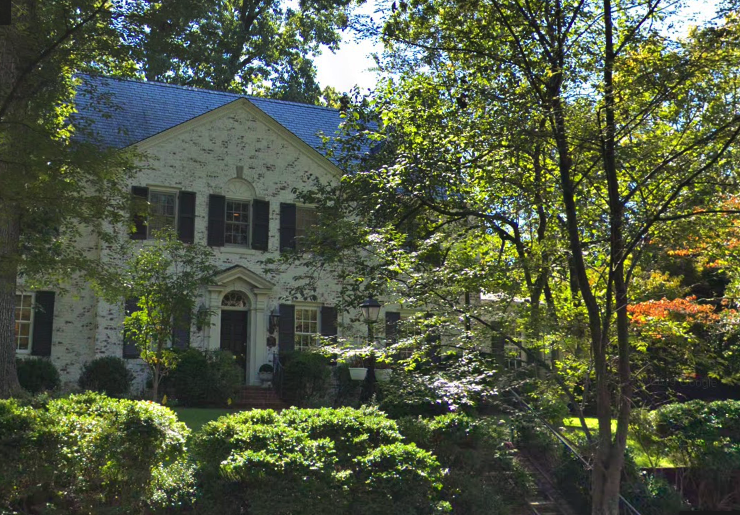
The backyard of our Georgetown townhouse abutted the garden of a young senator from Massachusetts, John F. Kennedy. After my father’s few successful years, we moved to a five-bedroom brick colonial at the corner of Fox Hall Road and Edmunds Street in Northwest Washington. Both of my parents had friends and relatives living, working and matriculating in the District. They all found an open door at our house. I never knew who would be joining my sisters and me at the breakfast table or who’d be passed out on the living room couch from all-night parties. No one ever cared where their cigarette ashes landed or bothered to clean up their spilled drinks. 

One of my parents’ friends lived in the attic. I know he came out at night because all the adults told morning-after stories and he was a prominent source of laughs. I finally came EdmundsStupon him once in the kitchen. He was guzzling a bottle of orange juice standing in front of the open ice box wearing a buttoned up wrinkled trench coat and loafers, no socks, bare legs. 


“Hi, I’m Ted,” he said.

“Hi. I’m Regan. It’s from Shakespeare.”

My mother taught me to tell everyone that so she wouldn’t have to answer how I got my name.

“Well, what’s your favorite thing to do, Regan?”

“I like monkeys,” I said.

“Want to go to the zoo?”

“Yes!” 

“Ok, get your sisters and get in the car.”

Ted had no car. He meant my mother’s car. The keys were always in the ignition.

We drove down Fox Hall Road toward the Washington National Zoo and crashed into a telephone pole. No one was hurt. My father represented Ted in court and got the charges dismissed but Ted had to pay for the telephone pole. 

“Your honor, I have no funds and no income. I live off the bounty of my friends,” he proclaimed.

Ted would have gone to jail had my father not forked over the cash. My parents howled over this incident for all the rest of their days. All their friends loved re-telling the story. 

There was never mention of the danger his drunken driving posed to the three little girls in the back seat.

Watch It! There Are Thorns in Those Roses

Watch It! There Are Thorns in Those Roses

My mother woke me very early one morning on my fourth or fifth birthday. Men were waiting downstairs to wallpaper and paint. This was my birthday present—new wallpaper. I had to quickly dress and stay out of my room until they were finished at the end of the day.

“C’mon, we’ll get your sisters and go visit Joanne!”

It may have been that day or another that my mother took my two sisters and I to see her youngest sister, Joanne, who was in the Maryland countryside about an hour from our home in Washington. Joanne was 10 years younger than my mother so she would have been about 20. She attended Georgetown Visitation high school and junior college with the Smith girls who lived at an 18th century Maryland estate, Mt. Airy. During her school breaks Joanne stayed with the Smiths and in mid-June they would have been lounging around the pool with their cigarettes and tanning lotion.

We all got our hair washed and were set out in the sunshine to dry while my mother, Joanne and the Smith girls painted their nails, gossiped and laughed over beer in the estate’s coach house.

My mother directed me to sit in an oversized lounge chair near the shade of a mighty Southern Magnolia.

“Lay down there, Regan,” she said, “Don’t get up until your hair is dry.”

The old-growth evergreen burst with sturdy white flowers that looked like folded linen, sweet-smelling like the Smith girls. This is the first time I remember birds flying in and out of tree branches. The sun fell through the breeze into the dark fleshy leaves and lulled me into a meditative reverie that I can easily reconstruct whenever I’m under a summer tree or feel the whiff of magnolias or their cousin gardenias drift past me.

At the close of day we returned home and I ran upstairs to my new room. Everything was covered in red roses—the walls, the ceiling, the bedspread and pillows. It was the best birthday present I’ve ever received and indeed, the only one I can remember as a child.

My sisters and I were born one after another in the Naval Academy Hospital in Annapolis where we lived in the years immediately following World War II. After myth father left the Navy, we moved to a red brick colonial on Fox Hall Road in Washington and my father started his first job as a labor lawyer for John L. Lewis, founder of the United Mine Workers. They held the same liberal political views but Lewis, a devout, moralistic Mormon and my father, in the early stage of his alcoholism had battling temperaments. 
By the time I was in the first grade, the job, the house and the rose-filled room had all gone south.

My father picked up work in law firms and corporations throughout the Midwest, and my family started moving around the country with him.