Great Craic at the Democratic Convention

Great Craic at the Democratic Convention

On day two of the Democratic National Convention, I came face-to-face with a tall, long-haired, familiar beauty outside my local coffee shop in downtown Chicago.

“Hi! Are you Caitlin?”

“I am.”

“You’re at my coffee shop!”

“I love this place; come here every morning,” Caitlin said.

“Oh, gosh, I wish my friends were here to meet you. We’ve all been gathering for coffee in the Ritz Hotel lobby looking for you!”

“I wish I could meet them too!” She said.

“Well, I can’t speak for them, but I love you. My whole family loves you.”

And so went my encounter with Caitlin Collins of CNN. Neighborhood friends and I camped out in various hotel lobbies during Convention week hoping to spot famous people. We’re political junkies, more likely to screech at Mitch Landrieu, former mayor of New Orleans, than Golden Globe winner Greta Gerwig. Oh, there are exceptions. I longed to see Billy Porter. Why him? As soon as President Joe Biden announced he was stepping aside for Vice President Kamala Harris, Billy Porter jumped out of the starting gate to endorse her. Also, I love his outfits.

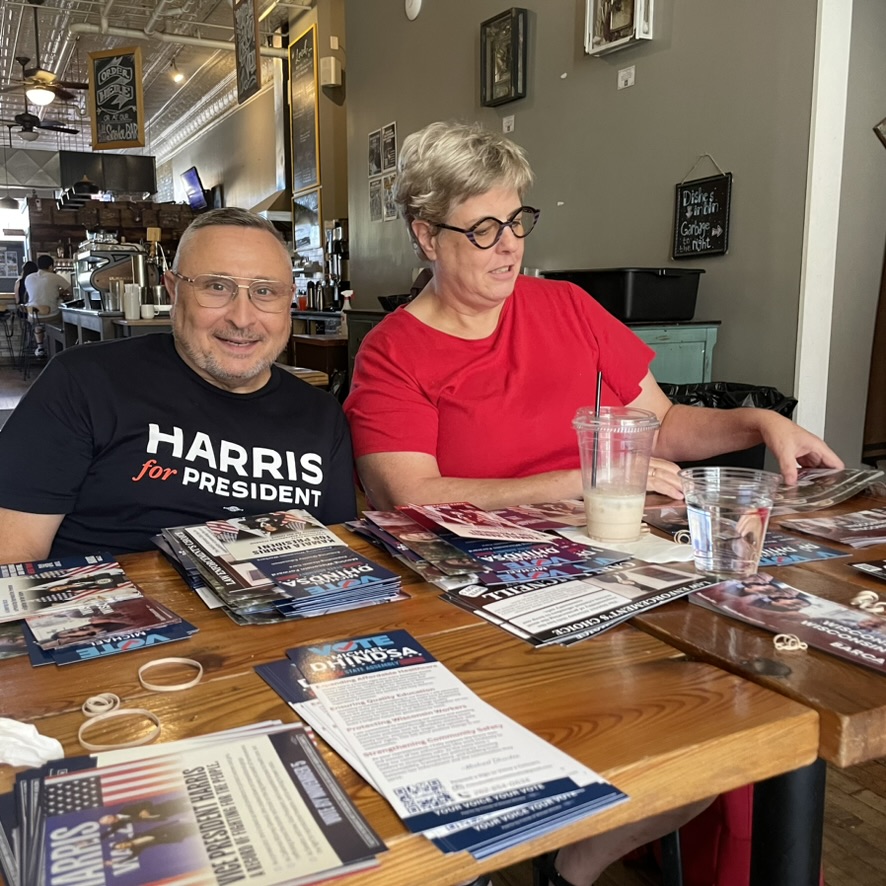
In January 2024, Convention organizers declared they needed 12,000 volunteers. Unenthusiastically, almost reluctantly, some of us registered on the convoluted DNC volunteer website in February, March, April, never receiving acknowledgment or confirmation. My constant refrain to anyone who asked (or didn’t ask) was: sign up—you never know what will happen. When the Biden-Harris Handover came down, the volunteer pool immediately swelled to 30,000, a nascent signal of unabashed support for Kamala Harris for President. Would-be volunteers came from around the country thinking they’d grab a plum “slot” from the AI-driven robot volunteer organizer. A few days before the Convention started, I was called to the basement of the United Center with about 100 others to “unfurl” flags as they rolled in from the loading dock. We were gleeful. Some were called back for various duties at the Convention. Not me. I never did secure a volunteer gig to check credentials, or sort the garbage for recyclables, or greet people at hotels, or direct delegates to buses. 

On the afternoon of Convention day four, I received a text, “I’m leaving a pass for you at the desk of my hotel,” from a lovely I’d known thirty years ago in the Clinton Administration. I hiked up my skirt, jumped on my three-wheel ADA electric scooter, and navigated my way through the exterior United Center maze of Secret Service, Chicago Police, Cook County Sheriffs, metal fencing, magnetometers, hawkers, protesters, volunteers, and a mile-long line of faithful ticket-holders. Vivienne from County Cork and Mark from St.Louis in section 202 texted every few minutes with updated instructions on how to squeeze through the crowds and get to the seat they were defending for my grateful butt.

“I just got in a fight,” texted Mark. “Standing firm. I told them you were waiting for the elevator. Viv meeting you.” Finally, from my cherished seat, I texted David, who I passed outside on the pedestrian line. “No seats.”

Vivienne–great craic at Democratic Convention

Lucky doesn’t begin to describe how it felt to be in Section 202 of the United Center on August 22, 2024, for Kamala Harris’ acceptance speech—the most blessed hurly-burly hoopla in memory.

Or, in the words of Irish Vivienne, “Best craic a’ me life.”

___________

Irish Craic Explained

“Craic is laughing at cellular level, finding the humour in everything and making yourself laugh when thinking about it all.”

Me & Pete Buttigieg

Me & Pete Buttigieg

Never have I felt so valued at church as I did last Sunday. Presbyterians I hardly knew tugged at my sleeve or grabbed my elbow or those less buttoned-up screeched in my face — all congratulating me on getting to meet Pete Buttigieg. I’d posted a photo of Pete and me on FaceBook that week. A well-heeled Democratic couple in Chicago’s Lakeview neighborhood scrambled a party together that raised $700,000 for the Presidential campaign of candidate Kamala Harris six days after she chose Governor Tim Walz as her Vice Presidential running mate. A friend bought two tickets he couldn’t use and asked if I’d like to have them.

Gulp. Yes. Yes. Yes. I said. Pete Buttigieg is the most poplar Democrat in the United States. He’s the youngest person ever to serve as US Secretary of Transportation, was the mayor of South Bend, ran for president in 2020, is married with two children and oh, he’s gay. When he kicked off his campaign for President in 2019, I traveled to South Bend with Amy, Peter and Mark in the pouring rain to be at his announcement in the leaky old Studebaker factory. Pete was on Kamala’s short list for Veep, but, well, he’s gay. The US electorate can stretch its collective imagination to accept only one major cultural shift at a time. I guess. Democrats like me are giddy over the historic candidacy of Vice President Kamala Harris, a black woman, running at the top of the ticket. We would have been rapturous if she’d chosen Pete, but honestly, we’re not far from that in her choice of Tim Walz, a funny smart former high school football coach who loves state fairs, teaching, sitting on Congressional committees, governing Minnesota, serving in the National Guard and traveling to China.

I just love campaigns. I love candidates, campaign organizers, campaign volunteers, campaign consultants, campaign buttons, campaign events and campaign offices. My high school held a student-led Democrat-Republican combined mock convention in 1964. I was assigned to be Republican candidate Nelson Rockefeller’s campaign manager. I wrote to Rockefeller’s campaign office in New York requesting his platform in order to write my nominating speech for the mock convention. The campaign responded by sending me free stuff: crates full of campaign buttons, posters, leaflets, scarves, ties, cufflinks, bracelets, position papers, and even a suggested stump speech. I plastered the school with Rockefeller posters and made sure every student had some sort of paraphernalia with “Nelson” on it. The students chanted “Nelson! Nelson!”, I delivered my nominating speech and Rockefeller won the student endorsement by a wide margin. 

I had already been steeped in soda-shop debates rebutting a freshman classmate’s anti-government racist diatribes. I read the boy’s constant companion, the 1958 publication The Blue Book of the John Birch Society ( a precursor to Trumpism and Project 2025) in order to prove him wrong point by point.

In the eighth grade my class was bussed to the airport and given hand-held American flags to wave and cheer as President Dwight Eisenhower deplaned from Air Force One. 

Sixty-five years later, I’m still at it.

It’s not lucky to be almost assassinated

It’s not lucky to be almost assassinated

She came to me at nine years old with an incomplete backstory. No longer a viable breeder after age five or six, the owners kept her way past her financial contribution to the family. She’d delivered two litters a year, about 100 puppies. “We just liked her,” they told me. My inquiry, “I’m an old lady dog-lover, looking for an old-lady dog companion,” hit just the right tone. “You’re an answer to our prayers.” And so I got Elsa.

The day after the attempted assassination of the former president, I hungered for Sunday air. You know, the first day of the week kind of air, where everything starts over. Air that requires nothing. No lofty thoughts, no reflection, no opinions, judgments, or conclusions. Sunday air. I breathe Sunday air when singing a well-known hymn like “It is well with My Soul”.

When peace like a river, attendeth my way

When sorrows like sea billows roll

Whatever my lot

Thou hast taught me to say

It is well, it is well, with my soul

And when the preacher elevates my being with no effort on my part, I breathe in the Sunday air of love. 

Sunday air was unattainable at church last week, though. It was not well with my soul. Right off, the preacher prayed “for former President Trump, grateful he did not succumb to political violence. This world is in love with violence, a violence that threatens the best in us, so renew in us a commitment to the Christ, who calls us to turn the other cheek, to love our neighbor, to love our enemies.” On receiving this, I sucked in a big chunk of we’re-gonna-lose and couldn’t seem to exhale.

The sermon choked off any puff of relief— a parable about prayer that meant nothing to me. My diaphragm would have swelled during hymn-singing, but the tunes were unfamiliar yawns.

And so, airless, I vamoosed to the outdoors, home to fetch Elsa for a trip to the park to watch tennis players sweat it out. She was too hot to sniff around the edges and lazed in the shade instead. Until a tennis ball bounced toward her behind the chain link fence. She bolted for it and dug into the wire to try to slay that green fuzzy rodent stunt double. She would have broken her teeth to get to it. A tennis player picked up the ball, a good ball, and tossed it over the fence with big Sunday air to Elsa, who received it with the gusto of a kid catching bubbles. She flaunted her prize using all the primal dog moves that delight dog-loving humans. I never knew she was a ball dog. 

Echoing Bill Maher, Bulwark podcaster Tim Miller asked his spirit guide and Managing Editor, Sam Stein: 

“Can I say Trump is the luckiest dog on the planet?”

“No! You can’t say that.”

“I can’t?” Asked Miler.

“No! It’s not lucky to be almost assassinated.” Said Stein.

But Elsa. She’s a lucky dog.

The Big Freak Out

The Big Freak Out

Metaphors have frittered away from me. To be fair, they hadn’t much choice. In conveying messages to contemporaries over the past few years, whether speaking, emailing, texting or DM’ing, I’ve developed a necessary plain spokenness, lest the meaning be misconstrued, misunderstood or confusing. Fallout from this mind-bending prosaic language is living at a level of plain thinking, another aspect of old age (I’m 78) that I wish I’d been warned about.

While watching Joe Biden perform at the now-famous CNN debate in June, I came unstrung in the grip of knowing that Biden’s plain-thinking, plain-speaking style was killing any chance of beating Trump in the November election. 

“Oh. my. god. He’s like my neighbor Ray,” I thought. Ray, who used to converse like a college professor and remember your name like you were his student, but now he talks only sports and weather. Ray, who cannot grasp metaphors unless they’re baseball sayings he’s used all his life, like “on the ball” or “step up to the plate” when he motions for you to exit the elevator before him.

On an unsually quiet afternoon, that is to say, no sirens, no gas-powered lawn mowers, no garbage trucks beep, beep, beeping as they backed out of the alley, I was studying David Montero’s new book, The Stolen Wealth of Slavery: A Case for Reparations. My book group decided to read two chapters at a time in order to absorb a history none of us had ever known. The premise that the intellect is stimulated through awe and wonder has proven true in this group, with this book. Montero’s research thoroughly tracks how the free labor of Black people in the South became the basis of the entire US economy and her dominance over world markets. His writing is loaded with similes and metaphors.

“The energies of three million enslaved people were organized into an industry, industrial enterprises were increasingly fertilized by slavery, and the output of the system was shipped across the world.”

(All of a sudden, a swift “click-clum” in the room interrupted my reading. I turned and saw a ragged chunk of dried-up old paint on the floor, fallen from the ceiling. Surely there’s a metaphor here. Chip off the old block? Chip on your shoulder? Paint the town red? Naw. Nothing. I got nothing.)

In the chapter, “The Union Must Perish,” Montero included a white abolitionist’s account of his travels to the slave market of Virginia. Published in the New York Daily Tribune in 1850, part of it reads:

“…this was the most heart-sickening sight I ever saw. I involuntarily exclaimed, “Is it possible that this is permited in my own native country—the country I have loved so well, and whose institutions I have exultingly pointed to as an example for the world. If this is Christianity, don’t call me a Christian.”

The emotons expressed are precisely what I feel now that the Trump-appointed United States Supreme Court ruled that the President is unbound from the rule of law and can freely engage in criminal activity. Our Christian Nationalist Supreme Court looks forward to the next president closing the borders to anyone but White Christian Europeans, slashing gay rights, civil rights, and women’s rights, and requiring biblical education in public schools. Echoing the 1850 abolitionist, if this is Christianity, don’t call me a Christian.

There ain’t no metaphor for that.

The Peace of Non Closure

The Peace of Non Closure

A new concept popped up at the outset of a recent anti-racist training session. Among the familiar “courageous-conversation” ground rules, the leader added, “We commit to non-closure. (pause) Right?”

Whoa, really? My fellow attendees all yes’d the speaker as if they knew this already. I thought I must have ignored an inboxed message, or, in my long season of retirement, missed another new corporate buzz word. Non-closure.

On the brink of Juneteenth, the half-day session promised to address the backlash to Diversity, Equity and Inclusion programs and policies. That morning all of nature said yes! to Chicago. I wanted to say yes! too, and take a long walk in the park with my dog. Instead, I reluctantly ambled over to the dingy conference room in a church basement near my home. Anti-racism churned inside me and I had no organized outlet. I was curious to see if there was anything new.  Answers.

But here I was, swallowing a commitment to non-closure. No answers, no conclusions, no plans, no fantasies of what might be. Of the numerous anti-racism trainings I’ve attended since the murder of George Floyd this may be the first time I recognized that it’s safe to be in that liminal space of unknowing, of ambiguity. There would be no meaning-making, no sense-making, no closure.

Facilitators from Crossroads, an antiracism training organization, gathered us together, not to tell us what they know, but to find out what we know. They see, feel, but even more, they sense, not just a political backlash in anti-racism work but, an active softening in community and personal commitment. 

The air is leaking out of the tires.

This week Donald Trump and I had birthdays. We’re the same age. Several friends asked me how I planned to celebrate.

“I don’t really celebrate my birthday.”

“Why not?” Asked my favorite poet.

I had no answer. 

He asked about my writing.

“I’ve been thinking lately I may not write anymore.”

“Why?” He asked.

Another why question. And no good answer. Is that a failing? No answer? Does it mean I’m not sufficiently self-reflective?

Liminal, from the Latin, “threshold” puts time and space betwixt and between. On liminal days, birthdays dangle off the edge of time. The past no longer haunts me, the future no longer calls me. I neither wait nor wonder. Indeed, birthdays are liminal days.

Anthropologists say that memory disorder, pandemic uncertainty, authoritarianism, virtual reality, border disputes, old-age anxiety, environmental issues, and gender trouble put society in a self-protective liminal state. Whew! Thank you God. This beloved gift  allows me to live on the threshold where social norms, like answering the question “why” or reading every damn email are temporarily suspended. 

In the ninth grade, when I was consumed with past and future popularity by any means, I was inconveniently tormented with one living and one dead poet: T.S. Eliot and Alfred Lord Tennyson. A lot has been written about the spiritual liminality, the non-closure of their work. It’s only now (or is it?) that I see why these vexing lines captured me:

Tennyson’s Ulysses:
Yet all experience is an arch wherethro' 
Gleams that untravell'd world whose margin fades 
For ever and forever when I move.
TS Eliot’s Four Quartets:
Time past and time future
What might have been and what has been
Point to one end, which is always present
.

Oh no! Parables

A few months ago, I wrote about a preaching at church on the parable of the ten virgins, or bridesmaids as they say in modern versions of the New Testament. In the story, told by Jesus in the gospel of Matthew, the ten women are waiting for the arrival ceremony outside the gates of the wedding venue. Five of them, known as the wise bridesmaids, came prepared with full oil lamps, greeted the wedding party, and they all entered the gates to the feast. The other five, known as the foolish bridesmaids, were out buying lamp oil, took too much time in the shop, and got locked out of the party. The preacher says the oil is a metaphor for hope. Always have a little hope stored up because you never know when God will present herself with the next great opportunity.

I really hate parables. They’ve always made me feel bad about myself. Oil as a metaphor for hope seems a stretch, but it still makes me cringe. In this and all Bible stories, I relate to the foolish ones, the worst person in the story. I’m never ready, always late, and a failure at time management. 

The question arises: why would Jesus, my earliest-remembered friend, use the parables to traumatize me with such heavy doses of self-blame? No wonder people have stopped attending Christian churches.

At the church I attend, the Sunday bulletin at the end of May included this statement: 

This summer, we will take our messages from the stories that Jesus loved to tell: Parables. 

Oh Jeez. That gives me about thirteen Sundays’ worth of sermons to learn and absorb some wider spiritual truths that have eluded me thus far. I have hope that the preacher is up to the task. In his kick-off to the summer pulpit, he talked about the parable of the Sower. Do you know that one? The farmer throws seeds around willy-nilly throughout the land, giving no thought to where they settle. Some seeds settle on rocks, some on thorns. I’ve always considered myself the thorny soul who has choked off God’s seeds through my own self-will. Another parable evoking self-blame.

When I was younger, I used to buy cheap packets of wildflower seeds at Walgreens and toss them around Lincoln Park on my morning run in places that needed a bit of sprucing up. I never bothered cultivating them; I simply hoped a few would spring to life. It was a labor of rebellious love. 

The preacher reminded me of those long-ago spring days. He interprets the seeds as love, God spreading love around. Sometimes, love takes. Sometimes, it doesn’t. But God keeps throwing it out there, just like I kept throwing out seeds of wildflowers. Love is power, says the preacher,  tender power, vulnerable but power nonetheless, capable of changing people. The sighting of Spring’s first tulips makes me happy, no matter how anti-happy I may be. That’s powerful love.

Perhaps a summer of parables will be ok. 

Smelly Lilacs

Smelly Lilacs

The tulips were showing their last droopy colors. The iris’ were ready to pop for a week or two of runway-like exhibitionism. The trees in the small park were half-dressed, embarrassed by their young fresh leaves, waiting for their green siblings to fill in around them. 

And oh those smelly lilacs. 

Their short-lived incarnation makes me holler 

thank you Jesus. 

And then, the warblers.

Every spring is the same. Year after year. And yet, every single time, I’m shocked out of winter doldrums by the sheer variety of beauty and fragrance in the cultivated and in the wild city gardens. A text or an email or an article from birding organizations will remind me to listen for migrating warblers. They pass through as the tulips fade. I hear them. Never see them. 

Warblers visit Chicago on their way up north from Central and South America. They’re tiny. My old eyes are acclimated to spotting bigger birds—starlings, blackbirds, crows. Even sparrows are larger than warblers. I look, but mistake the warbler for a leaf or a twig, even a large bug.

But the other day, on an unusually seventy-five-degree May morning, I passed under a tree while Elsa sniffed around the ground cover for messages from new and old pals. I heard a symphony of birdsong overhead and looked straight up to see tiny bright-colored warblers flitting from branch to branch, hunting insects. 

I switched on my iPhone, pressed the Merlin bird app, and recorded a Tennessee Warbler, Yellow Warbler, Yellowthroat, and American Redstart all singing their wee hearts out within shouting distance. I suddenly realized I was in a bird “fallout,” a phenomenon that occurs when curious weather slams into migrating songbirds in the air and they descend into the trees below. 

The weather systems predict the number of songbirds that may be migrating over Chicago on spring nights. Attracted to their reflections in the windows of highrises, they accidentally kill themselves by flying into lit buildings.

The uncommon migration fallout happened twelve hours after Chicago’s unusual sky-drenching from the northern lights—yes, the northern lights! The aurora borealis: blazing bits shooting out of the sun, hitting the diluting atmosphere with undulating ribbons that lit up the Chicago night. All this only a month after a solar eclipse. 

Hyde Park residents Meghan Hassett and her husband Max Smith captured the northern lights from Promontory Point Friday, May 10, 2024. Provided by Meghan Hassett

In the park, a dog-walking neighbor neared with Zeus, stopped, and looked up. 

“Whatcha lookin at?”

“Warblers.”

“Oh,” and he continued on. He lives in my building and told me a few days before that he’s planning a hiking trip to the Rockies because he “likes nature.”

Me too.

Happy Birthday Hellraiser

Happy Birthday Hellraiser

The long call of a spring robin woke me from a dream about Mother Jones. She was organizing my group to protest the nightmarish abolition of women’s rights, as in Margaret Atwood’s The Handmaid’s Tale

“I don’t march anymore. I can’t run!” I muttered in half-sleep.

I tugged to escape her visitation as I was tugging the covers to get up and contemplate the robin’s daybreak anthem. The common backyard robin is unusual along the Lake Michigan shoreline where I live. Its song is one of the few teachings I remember from my own mother. 

I’d been to a Mother Jones birthday party at the Irish American Heritage Center in Chicago. Mary Harris Jones, born in County Cork in 1837, immigrated when she was ten years old. Her husband and four children all died of yellow fever in 1867. Four years later her dress-making shop was destroyed in the Great Chicago Fire. Undaunted, this fierce, five-foot-tall Irish American became an organizer for workers’ rights, particularly the United Mine Workers.

On May 1, 1886, there was a general strike for the eight-hour workday which led to the Haymarket Riot in Chicago. Mary Harris Jones declared her birth date as May 1, to honor the Haymarket Martyrs. Her exact birthday is unknown. Most records of peasants born in western and southern Ireland were lost or destroyed during the Irish Potato Famine (1845 to 1852). This is true of my own ancestry. 

Mother Jones helped coordinate major strikes in the coal mines and on the railroads where my great-grandfather and great-uncles worked. Her protest marches included children who wore banners saying, “We Want to Go to School and Not to the Mines.” They could easily have been my relatives.

Women activists belittled her lack of commitment to women’s suffrage.  She said “you don’t need the vote to raise hell!”  Jones believed it was more important to advocate for the working class—black, white, men, women and children—than to support women’s causes alone.

Like Mother Jones’ family, my father’s forebearers were discriminated against due to their immigrant status, their Catholic faith, and their Irish heritage. The shame of the Irish hung heavy in their Kentucky and Indiana homes. But still, my father, fresh out of law school in the late 1930s, working for the United Mine Workers, wrote the first union pension legislation in the United States.  And, family lore supposes his father, my grandfather, was a union organizer on the railroad.

When Mary Harris Jones turned 60, she began calling herself “Mother” Jones. She dressed in matronly black, wore old-fashioned hats and referred to the laborers she helped as “her boys.”

When I was 60, I took up offense for workers in my office. Wage inequality, discordant work assignments, and unfair discipline reeked of cruelty. In the end, I got canned, but their jobs were secured. 

Like the robin wake-up call at dawn, Mother Jones calls from the graveyard and wakes me to the oppressed and wronged.

I bow to her. In gratitude.

Happy Birthday Mother Jones.

Jews

Jews

Jesus, my lifelong friend, accompanied me through chicken pox, mumps, and measles when quarantine isolated me from my sisters, parents, and friends. No, I didn’t have Mother Theresa-like visions. He was more of an imaginary friend for my waxing brain, like an animated Pooh Bear.  Clergy at St. Mary’s school in Terre Haute, Indiana, taught that Jesus was born in Bethlehem and died in Jerusalem. Due to those back-to-back pre-vaccine childhood illnesses, I heard these Jesus facts my second time around in the first grade. The teaching doubled down in my malleable brain, which had grown to ninety-five percent of its total capacity, normal for a six-year-old.

There was never any question that Jesus was born of Jewish parents. Israel, presented as a holy place, not a political state, was sacred ground because that’s where Jesus lived. There was always the implication that we, as Catholics, were in Jesus’s family, that somehow we had Jewish roots. If Jews believed in Jesus, they got to go to heaven, like us Catholics. But no other religion. Such was my Roman Catholic schooling.

Our single black-and-white family television transmitted few programs into our living room in the 1950s. Roy Rogers and I Love Lucy were allowed, but my parents insisted we watch the nightly news. My sisters and I didn’t dare whine for fear of verbal reprisals like, “Shut up and listen—maybe you’ll learn something.” 

They’d let us watch “This is Your Life,” a forerunner to PBS’ “Finding Your Roots’. In 1953, This is Your Life broadcasted the story of 32-year-old Hanna Bloch-Kohner, a Holocaust survivor. I wasn’t much interested in the not-so-famous Hanna, but I did wonder about the Holocaust.

When I was ten years old, as my brain power peaked, local TV stations advertised the opening of Old Orchard Shopping Center in Skokie, Illinois. We lived in Wilmette, on the border of Skokie.

“Where’s Skokie?” I asked my mother.

“That’s where all the Jews live.” She answered.

All my thoughts screeched to a halt. I’d never seen a Jew. I assumed that whatever Jews were leftover from the time of Jesus surely had died in that mysterious “Holocaust,” a word adults uttered in a hush. Of course, I couldn’t ask my mother what Jews were doing in Skokie. She expected me to know what she knew, no matter the subject. She would have ridiculed me with a sarcastic, “You’re kidding me. Don’t you watch the news?”

From that moment on, I looked for Jews in supermarkets, at the beach, in the record store, and even at school. It’s possible I looked for men who resembled Jesus. In high school, I met a Jewish brother and sister. I stared them into my spiritual family. I wondered how they got to New Jersey from Bethlehem or Jerusalem or Israel, those holy places whose ancient remnants had settled in my bones, with Jesus. 

My brain, now waning, has reformed itself through evidence, facts, and logic into knowing and loving the Jewish story. There may be evidence, and there may be facts, but there’s no logic to knowing Jesus. 

That’s still a belief. 

Falsely Accused

Falsely Accused

Fresh off a Zoom webinar titled Midwest Reparations, I rushed to my local coffee shop for a takeaway to sip during my upcoming current events group.

“12-ounce coffee in a 16-ounce cup?” The White barista asked. That’s my usual, with room for cream.

“Yes, please. What are all these new pastries? Chocolate cake? Key lime pie?”

“Yep, they’re new. All from different bakeries” said the barista.

“I’ll be back later with friends. They. Will. Love. These.” I said.

The Blackroots Alliance webinar that morning enlightened me on reparations projects in the Midwest. These are nascent activities reviving the 159-year-old “40 Acres and a Mule” policy for emancipated slaves that was promised and then revoked during Reconstruction. The initial focus of current reparations projects is research to uncover the descendants of enslaved people and how they’ve been impacted. Non-Black allies join at the end of the process when it’s time to distribute funds. Research is conducted by the harmed community, Black Americans, particularly African descendants, who look through the eyes of the tortured generations of chattel slavery. Non-Black Americans cannot be trusted to do this research since they see through a different lens: the eyes of the colonizers, the enslavers, the guardians of the dominant culture.

With this new information,  I was wondering how I, an old White woman, could fit into the reparations movement as I filled my coffee with half and half and rushed over to my current events group.

The group discussed the news of familiar territory: TFG, the former guy, and his latest legal shenanigans, immigration, climate change, gun control, and the ever-evolving White Christian Nationalism. Afterward, a small group sauntered over to the coffee shop where I’d spotted the new pastries. Six of us pulled up around a small table, coats draped over our chairs, rising one by one to fetch our drinks. 

I was the last one to the counter.

“I’m sorry, we can’t serve you.” said the barista.

“What?”

“We can’t serve you. The manager wants to talk to you.”  I joined my friends and announced what happened. The manager appeared and asked to speak to me privately.

“We can’t serve you because there’s been a report of you using a racial slur this morning.”

“What? What racial slur?

“The “N” word.”

“Well, there’s a mistake. I’ve never used that word in my life.’

“You understand we have to investigate when something like this is reported?”

“Wait. Are you accusing me of this?

“We have to investigate. Meanwhile, we cannot serve you.”

“For how long?”

“For the unforeseeable future.”

“You’re kidding. Look at me. I really don’t have an unforeseeable future.”

My friends were incredulous. ‘You? Boy, have they got the wrong person.’ They were ready to mount a protest in front of the building, signs and all.

In the following days, I connected with the company’s Chief Operating Officer. She apologized and emailed me a store voucher for $150. That’s a lot of coffee.

The coffee reparations, however, failed to dispel the lingering notion that I’m not a credible witness to my own story, that I’m not sufficiently worthy to be believed. How can we expect descendants of enslaved Africans to automatically manifest self-worth after enduring generations of false accusations, lynchings, and pressed-down powerlessness? 

We owe them a lot.