Author "In That Number" from local booksellers or Amazon
Author: Regan Burke
Regan Burke's book, "In That Number" was a finalist for Chicago Writers Association non-fiction Book of the Year. Her brief memoirs and personal essays appear in the Christian Science Monitor, Sun Magazine, Chicago History Museum "In This Together" Project, City Creatures, Safe 'n Sound, Easter Seals Blog. Chaleur, Rise Up Review, Bird Garden's Murder of Writers and Writing Out Loud. She lives on Potawatomi land in downtown Chicago with Elsa, the West Highland Terrier. Her main activity is reducing the weight of the here and now.
Rabbits are born and live out their stories in the same patch their entire lives. The lineage of the fat rabbit I see in the spring may have begun sixty-seven generations back, when the park was first established. After a month or so of observing her in April, she allows me the honor of seeing her two small cottontails, the next generation. They’re never in sight for long before they scurry away to the low brush.
My dog Elsa has old eyes. They may catch the bunnies on the run. Yet, her little legs tire as soon as the furries stop moving. Neither can her thinning olfactory glands sniff out their burrows. I’m pretty sure the rabbits are on to her as they don’t go far. All to say, the wildlife in the little city park seems safe.
Except it isn’t.
On a chilly November morning, I approached the far side of the park with Elsa. I wondered if the rabbits had burrowed in for the winter. I glanced over to the street side of the park to see gardeners unloading a backhoe from their truck. They wasted no time starting that thing up and ramming through the waist-high boxwood hedge to the middle of the garden, ripping out vegetation where the rabbits live.
“Hey! Stop!”
With Elsa at my heels, I barged through the boxwood on my side of the park, flailing my arms. I was about to jump in front of the moving machinery. The driver stopped. His companion came to me.
“What about the bunnies?” I shouted.
“No English!” he shrugged.
“The rabbits! The rabbits! They live there!”
He laughed at me and signaled to the backhoe driver to keep going. They were having a ball.
That was it. I had no choice in the matter. The feral gardeners yanked all the underbrush, faded lilies and droopy irises. They removed the clumpy hostas that cover wild animals and the prairie asters that catch goldfinches and warblers. The backhoe dug holes for six newly planted baby trees.
December is here now. Arborists removed honey locusts and hackberries that no one realized were distressed. The winter trellis of bare branches is spare. Above and below the wide open space leaves no comfort. No place to hide. The left-behind soft brown and grey prairie grass, goldenrod and hydrangea are fallow and forlorn.
But all will be lovely in the spring. And the ancestral rabbits will return.
Whenever one of my dogs died I experienced profound grief that turned to sadness, for a time. A season of sadness. These days, sadness lasts longer. It’s not because my dog died but because so much is out of my control, like the displaced rabbits. I pray not for the sadness to leave me, but to manage to live with it. I have a sense many seasons of sadness are afoot. All may not be lovely this spring.
Adlai Stevenson III (1930 – 2021) entered the 1982 race for Illinois governor just as I had become unemployed. My only memory of that forsaken job, like all the others, is my shameful obsequiousness to the forgettable male boss.
A journalist friend, Paul Galloway (1934-2009) interceded on my behalf to the Stevenson campaign for a volunteer position. Yes, that was necessary. And still. The sublime expression, “We don’t want nobody nobody sent,” originated in a Chicago ward campaign office. Campaigns still scrutinize volunteers with more than an eye roll. Because of my juice through the local newspaper, people were cautious about what was said around me.
I floundered around the office of Adlai Stevenson’s wife, Nancy, who was usually out campaigning. One day, I had the great fortune to be tagged to drive her to Oak Park for an event. That fluke set off a campaign-long assignment as Nancy’s driver.
Nancy and I regularly stepped into community rooms where older adults were having lunch through the federal Meals on Wheels program. Older women would clasp Nancy’s wrist, pull her ear close to their lips and whisper messages for her to take back to her husband. The Meals on Wheels crowd assumed Adlai III was his father, Adlai II, the governor when most of them were young. Nancy, who had a gentle and keen understanding of aging, let most of them hold this holy untruth. She displayed genuine kindness in her friendly interactions with old people who were in obvious cognitive decline. This helped me admit my own subconscious bias toward the aging. My ageism has changed overtime, especially now that I’m old and experience age discrimination against myself and my friends.
Meals on Wheels is funded through the Older Americans Act Nutrition Program which was permanently authorized by Congress in 1972. The purpose is three-fold: 1) reduce hunger, food insecurity, and malnutrition; 2) promote socialization; 3) promote health and well-being by preventing health-related diseases. The Program is available to adults age 60 years and older. Priority is given to low-income individuals, racial or ethnic minorities, rural communities, those with limited English proficiency, and/or those at risk of institutionalization.
One of our campaign stops was a community space in the neighborhood of Hegewich. It is located on the far south side of Chicago, known as the perfect workingman’s neighborhood. When Chicago’s steel mills shut down in the 1980s, the Polish immigrants who’d settled in Hegewich lost their jobs. They also lost their pensions. People survived on government subsistence and odd jobs.
As Nancy began her round of shaking hands, bobbing up and down to lean over to hear the messages of the elderly, she announced, “You know, my husband, Ad, voted for Meals-on-Wheels when he was a senator in Washington.”
Before she could get out another word, a large woman in the corner who looked like a George Booth cartoon yelled:
“Yeah? Well, he oughta be here now for the corned beef! ‘Cause it stinks!”
“Well, I’ll be sure to tell Adlai!” Nancy shouted back.
Funding runs out on December 31, 2024 for the Older Americans Act and the Meals on Wheels Program. If Congress doesn’t vote to reauthorize the Act, the Nutrition Program will be at the mercy of Elon Musk and Vivek Ramaswamy’s Department of Government Efficiency (DOGE). And they have vowed to eliminate all programs that have not been reauthorized by Congress.
My guess is neither of them have come to terms with ageism.
Hal Lindsey’s doomsday prophecies in “The Late Great Planet Earth,” stoked the born-again Christian fundamentalists in the cult I surrendered to in the early 1970s. One hundred disparate spiritual seekers in Toms River, New Jersey, accepted Jesus Christ as a personal savior, a necessity for inclusion in the Fellowship.
Churchmen directed every aspect of the lives of their blue-jeaned outcasts. Husbands were the heads of the household, women didn’t work. We lived in separate homes but were discouraged from socializing outside the Fellowship, lest we be influenced by 1970s secular humanist ideas — like having credit cards. The proliferation of credit cards, one of Satan’s tools to create a global economy, was a sign of the end times. We boycotted the Bank of America because the bank sought to legalize interstate branch banking, thereby centralizing all the country’s money into a single entity, another Satanic plan, a.k.a. globalism.
Based on his interpretations of the Book of Revelations in the Christian Bible, Hal Lindsey in “The Late Great Planet Earth” sensationalized end-of-the-world Biblical prophecies. He connected them to current events as proof of the coming Rapture where Christians would be plucked from the earth and taken right to heaven, thus avoiding Armageddon. Satan’s plans to form a one-world government and religion, as prophesied, were triggered by the establishment of the state of Israel and the World Council of Churches — both in 1948. Everywhere I looked in the 1970s, I saw signs of the end times: an increase in the divorce rate, recreational drugs, new technology, the gasoline shortage, religious ecumenism, and the birth of the European Union.
When my son joined Little League in the first grade, I sat away from the other parents in the bleachers. I feared the wrath of God if I talked to anyone outside the Fellowship. Church members accepted my volunteering for Jimmy Carter for President in 1976 only because my husband supported Carter. They doubted his born-again bona fides because of his family policy.
After four years, I extricated myself from the Fellowship, left my abusive husband, and drove my nine-year-old son 800 miles west to a new life in Chicago. A group of Christians at La Salle Street Church who had experienced similar religious cults nursed me back to spiritual and emotional health. The ideas of Hal Lindsey dissipated into the ether of bad dreams. After a few years, I no longer looked for signs of the end times.
Until now.
Donald Trump, in a 2017 speech to the Joint Congress, announced he was not the President of the world. Instead, he stated he was the President of America. These words and those of Trump apologist Steve Bannon announcing a nationalistic government free from links to other countries sent a signal to anti-globalists around the world. Alexander Dugin, a friend of Russian President Vladimir Putin, commented on Trump’s 2024 presidential victory, proclaiming that traditionalism won and globalism lost. Alex Jones uses globalism interchangeably with the New World Order and the Deep State. Are these guys aware they’re heeding Hal Lindsey’s warning to resist Satan’s plans for a global economy and one-world government?
In Kenosha, at the door of a new white house in a new white neighborhood with curvy streets, low trees, and developer-landscaped gardens, I knocked on the storm door, bang, ba-bang, bang. A huge white Old English Bulldog slid around the corner from the kitchen. He ran to the front door and barked as loudly as his docile voice would allow. His owner barely held him back.
I shouted through the door, “I love dogs. It’s ok. Can I pet him?” We all smiled, including the dog. He came out to greet me and gently pushed his massive stubby body against my legs.
‘Hi, I’m with the Kenosha Democrats. Have you voted yet?”
“No, we’re voting tomorrow.”
“What’s his name?”
“Arnold.”
“Arnold? Like Schwarzenegger?”
“Yes.” We both cracked up as Arnold dutifully looked one to the other, pleased to hear his name.
“You know, Schwarzenegger just endorsed Kamala Harris.”
Thus, I established my purpose in knocking on her door on a bright white Saturday afternoon.
“I know!” she said. Then she mouthed the words, “I’m voting for her.”
“Oh great,” I whispered, “Thank you.”
As I crossed the street to my next house, a white SUV suddenly sped out of Arnold’s driveway. It stopped in front of me. She rolled down the window and shouted, “I’m for Kamala! Going to vote right now!”
I thought back to her open door and realized someone else had been rattling around in the kitchen. A husband? She couldn’t let her husband know she was voting for Kamala Harris? Is this a sign of renewed influence of Christian fundamentalism?
Anthropologists say that authoritarianism, old-age anxiety, border disputes, memory disorder, pandemic uncertainty, virtual reality, environmental issues, and gender trouble put society in a self-protective liminal state. We now stand in the doorway between the Biden and Trump administrations. The entire Trump presidency may turn into a self-protective liminal state.
Liminal, from the Latin, “threshold,” puts time and space betwixt and between. On liminal days, we often wander aimlessly, unsure where to go, what to do, stare out the window, quiet down. Hush. The past and the future dangle off the edge of time. Do you feel it?
“Why did God dump Trump on us again?” a friend asked, squirming in her liminal state.
“God didn’t do this,” I said. “We did it.”
It began long ago. The anti-globalist cult surrounding Trump follows bunny trails through the woods of end-times literature, movies and evangelists that we have derided, failed to understand, take seriously, refute or diffuse.
Pastor Tom Are of Fourth Presbyterian Church Chicago says, “The church is not always lost in wonder, love, and praise; sometimes, it’s just lost.”
When we step over the threshold, away from our involuntary liminality, into the perfect, friendly, and loving world created for us, we’ll find the wisdom we need to activate our role in the future. Some will join the opposition party. Some will move to Costa Rica. Some will run for office. Some will hide immigrants. Some will help women. Some will march with the saints. And some will find a no-news thin space to wait it out.
While we wait, we can practice letting go of the obsessive hope that the built world of institutions will save us. It won’t. Let it go. Instead, lean on the unseen, the un-built, and the natural world. Eat and sleep.
In the Hebrew Bible, God said to a self-pitying Elijah, “Get up! Eat something!” And after Elijah spent forty days indulging in self-care, God came back and said, “Why are you still here? Get back to it. You’ve got work to do!”
And so we do.
______________________
Reprinted from Interfaith America Magazine, November 14, 2024
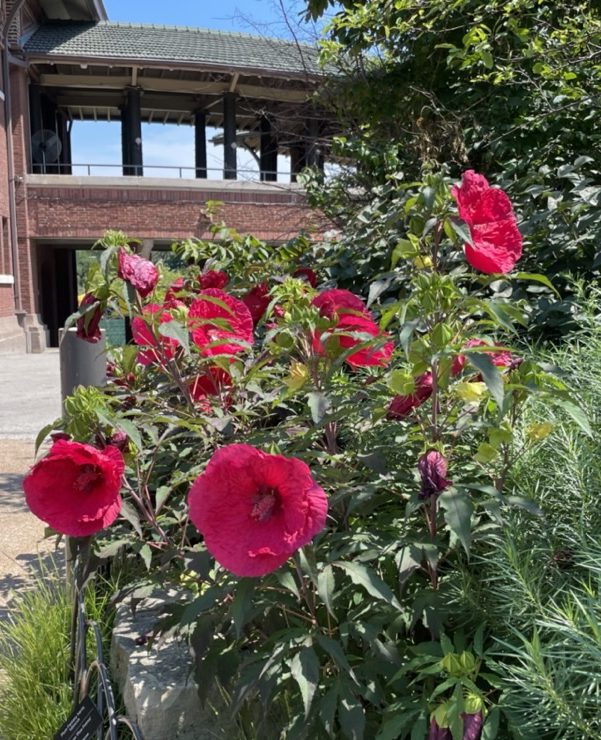
Rounding the corner by Cafe Brauer, the 115-year old red brick refectory on Lincoln Park Zoo’s South Pond, I stopped dead in my tracks at the sight of blooming Chinese-red hibiscus. Hundreds of blossoms the size and shape of CDs preened in the bright sun. They were onion-skin thin. I could practically see through them. I inched along the path flower by flower scanning each one for an answer. What. Were. They. Doing. There?
I’d rounded that corner hundreds of times in my life and had never seen those flowers. A woman in a dark green shirt marked with the telltale Lincoln Park Zoo logos wandered by.
“Do you know anything about these flowers?” I shouted.
“Yes, they’re Lord Baltimore hardy hibiscus.”
“Were they here last year?”
“Nope. We cultivated them.”
She introduced herself as the head horticulturist at the Zoo and gave me a hibiscus primer. There are four species of hibiscus native to Illinois around the Zoo and the South Pond.
“Everyone thinks they’re tropical. We have a unique collection — the only accredited perennial herbaceous native hibiscus collection in the country.”
On the way home, I spotted a couple I’ve known for years taking their afternoon walk. They informed me they’re thinking of buying a summer house in Michigan.
“What? How could you leave here in the summer? Did you know we have four native hibiscus around the South Pond and the Zoo?”
At the time, I thought this fresh information established the best reason to summer in Chicago. I doubled down on what I’d just learned. Without taking a breath I told them the hibiscus feed bees, hummingbirds and butterflies. Each flower on a hibiscus stalk lives only for a day or two, like a daylily. But, the plants keep opening new blooms from July to September. Garden Clubs from all over the Midwest send busloads of flower lovers to gaze at our hibiscus.
“You must walk by the pond and see them!”
That was the summer of 2019. I see them walking from time to time now, a little slower, a little quieter. A few weeks ago, I’d been in the zoo luxuriating in what I’ve come to think of now, five years later, as my hibiscus. I ran into my friends on the way home and fed them new information.
“Did you see the news?”
“What news?”
There’s so much real news or breaking news these days they looked anxious.
“My friend Karen who volunteers at the zoo told me it’s in the paper today. Lincoln Park Zoo has just been named a National Botanic Garden!”
“Oh.”
“Yep. It’s a big deal. There are only two zoos in the country that are botanic gardens.”
“Oh yeah? What’s the other one?”
“Dunno. Maybe San Diego.”
I had no idea what I was talking about. The media and Time Out have touted San Diego plenty. So, I used this acclaim to put the best spin on our zoo.
“And the international Botanic Garden show will be in Chicago in summer 2027. First time its been in the U.S, in 27 years.” I said.
“Wow, that’s great. Is that like the Chelsea Garden Show?”
“Yes! Only better.”
“Well, we’ll see you around. We need to keep walking.”
“Ok. Great to see you. Glad you didn’t buy that summer house in New Buffalo.”
“Oh, we did buy it. Stayed for a few weekends before the pandemic hit. Tried it that summer for a few weeks. Mistake. Too lonely. You’re right. Theres’s nothing like Chicago in the summer.”
In Kenosha, at the door of a new white house in a new white neighborhood with curvy streets, low trees and developer-landscaped gardens, I knocked on the storm door, bang, ba-bang, bang. A huge white old English bulldog slid around the corner from the kitchen to me, the stranger, barking as hard as his docile voice would allow. His owner appeared looking as if she could barely hold him back.
I shouted through the door, “I love dogs! It’s ok. Can I pet him?” We all smiled, dog included, and he came out to greet me with a gentle push of his massive short body against my legs.
“Hi, I’m with the Kenosha Democrats. Have you voted yet?”
“No, we’re voting tomorrow.”
“What’s his name?”
“Arnold.”
“Arnold? Like Schwarzenegger?”
“Yes.” We both cracked up as Arnold dutifully looked one to the other, pleased to hear his name.
“You know, Schwarzenegger just endorsed Kamala Harris.”
Thus, I established my purpose in knocking on her door on a bright white Saturday afternoon.
“I know!” she said. Then she mouthed the words, “I’m voting for her.”
“Oh great,” I said, “”Thank you.”
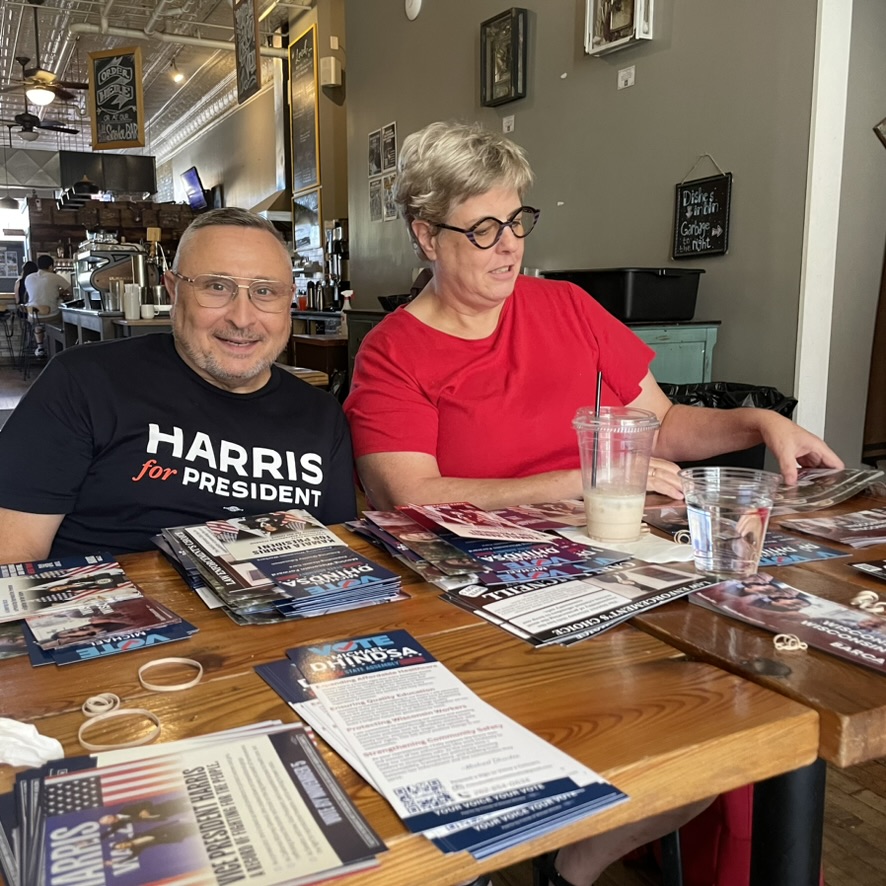
Canvassers use a handy cell phone app, Minivan, to record voters’ responses. The drop down menu lists Strong Democrat, Lean Democrat, Undecided, Lean Republican and Strong Republican. Since my voter didn’t give it her all, I decided she was a Lean Democrat, punched it in and moved on to the house across the street.
As I came back to the sidewalk, all of a sudden a white SUV sped out of Arnold’s driveway and stopped in front of me. She rolled down the window and shouted, “I’m for Kamala! Going to vote right now! Good luck!”
I thought back to her open door and realized someone else had been rattling around in the kitchen. A husband? She couldn’t let her husband know she was voting for Kamala Harris?
This gave me hope. I changed her in Minivan to Strong Democrat. Voting Harris.
Perhaps she represented a political ad where Julia Roberts voiced, “in the one place in America where women still have a right to choose, you can vote any way you want, and no one will ever know,” suggesting women can lie to their husbands about their vote. Apparently Fox News went berserk over this ad, as if spouses never lie to each other.
Today, the day before election day, it hit me how different life will soon be. No matter who wins, I’ll have no more reason to hope — for the vote, for my candidates, that the country will be at peace, or that democracy survives. It-is-what-it-is acceptance will necessarily move in to care for me.
Saturday afternoon trips from Chicago to Kenosha, stopping in the bustling Democratic headquarters then out to canvass voters will halt. My calves will never forget the two-step entrances to every house in Kenosha County. But memories of coffee and sandwiches at The Buzz Cafe on Sixth Avenue will fade.
The Buzz Cafe Kenosha Wisconsin
I do have something to hope for.
Incoming texts and emails will be reduced to a trickle.
Transistor radios first appeared on the shelf behind the cashier at Walgreen’s, alongside the cigarettes, in the 1950s. The purchase price was cheap enough for my mother. I can’t imagine what my life would have been had it not been for the radio.
In our teens, we lay on the floor, smoking pot and singing to the Beatles on the radio. A friend once mused, “our lives would be more manageable if it weren’t for the radio.” Every half hour DJs stopped spinning records and announced the news. Radio news. It stirred me up for life.
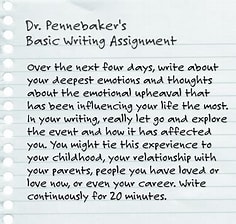
The radio these days is an Amazon Echo. It is set to turn on NPR at 7:00 am in my house these days. On Sundays, I usually ignore a 7:00 am show called Hidden Brain. A neuroscientist interviews interesting enough people, but I just want to hear the news at 8. Recently I put off walking the dog and making coffee when I heard the voice of Dr. James Pennebaker on Hidden Brain. He talked about how people’s language, written and vocal, signals what’s happening inside their heads.
James Pennebaker is a social psychologist at the University of Texas-Austin. He taught me that chronic pain can be healed through expressive writing. His recipe, grounded in scientific research, consists of writing it down. Just write it down. It’s cheap, easy. And it works. My writing teacher Beth Finke and I used to call it bibliotherapy. Pennebaker’s books are sweet old friends. The same goes for Jon Kabat-Zinn’s Full Catastrophe Living, John Sarno’s Healing Back Pain, and Howard Schubiner’s Unlearn Your Pain. Thinking of these now butters my memory with gratitude. I write because these authors taught me words can heal. And, for the most part, they have.
I’m not particularly interested in interpreting the language of my friends. I don’t want to know what’s happening in their noggins as Pennebaker does with his research subjects. No, what’s tasty lately about Pennebaker is what he says about Donald Trump.
He examined Trump interviews from 2015 to 2024 and found a whopping 44% increase in words plated in the past. What’s that mean? Well, usually presidential candidates dish out rhetoric about the future. Pennebaker says Trump whips up such simple words and sentences that he can only be described as “an incredibly simplistic thinker.”
“I can’t tell you how staggering this is,” he told Stat News. “He does not think in a complex way at all.”
I loved hearing this. And there I was again, glomming on to any tidbit that humiliates and demeans Trump. It’s called schadenfreude. I love that word but ashamed how I delight in its meaning: the experience of pleasure, joy, or self-satisfaction that comes from learning of or witnessing the troubles, failures, pain, suffering, or humiliation of another.”
Schadenfreude is one of the delicious habits I metabolized, after using Pennebaker’s and others’ writing exercises to relieve chronic pain. Obviously this is not a vice easily kept at bay. Availing myself of some form of spirituality, like meditation, helps. And the writing, of course.
There’s a special providence in the fall of a sparrow.

If it be now, ’tis not to come.

If it be not to come, it will be now.

If it be not now, yet it will come – the readiness is all.

— Hamlet
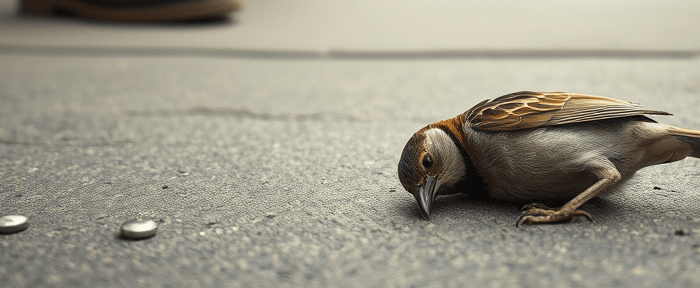
A sparrow fell from the sky and plopped down next to me on a sidewalk corner beside the church as neighbors, shoppers, and tourists bustled to their places.
“Damn! That’s disgusting!” Said a snap-back-hatted young man sidestepping around the splat. Looking the revenant himself as if returning from a dead weekend that probably started out fun on Friday night, he looked up. Was he searching for someone behind the clouds to blame?
“Look at it. So gross!” Looking down now, seemingly blaming the sparrow for its dead ugly existence.
Perhaps because I was headed to church, the sparrow’s lasting legacy in the bible came to mind. Scriptures tell us to look at how God cares for the lowly sparrow as a metaphor for how that same God cares even more for humans. But here I was, staring at a dead bird. Did that God in the bible throw the bird down beside me so I’d know who’s in charge around here? Is it an omen of a bad year ahead? A symbol of immortality? A sign to repent?
There’s a peregrine falcon nest directly east on Lake Michigan in the intake crib of Chicago’s water system. Those tricky raptors attack other birds in mid-air and sometimes miss their prey as they swoop down to catch them. On my dog walks, I’m constantly on the lookout for bird carcasses (sometimes impaled in the bushes) because Elsa will sneak a forbidden lick if I’m not vigilant. I assumed the unfortunate sparrow was one of these victims.
If God set this complicated natural aerodynamic food chain in motion, so be it. I’ll accept that God. However, no God is going to snap me to attention about the upcoming election or remind me of some regrettable remark I’ve made by throwing foreboding dead birds at me. The same force may have set all the emotions of fear and regret in my DNA, but a god that powerful better not have my same human characteristics. I’m conscious of an impersonal force, something outside of myself, an unexplained presence. I believe there’s a higher power, that I call God. Holding that power out as a relatable, reasoned person that acts as a mean-spirited human, to get my attention is not my idea of a god. At least not today, or, not at this moment.
The ubiquitous house sparrow is not native to the United States, I’ve been told by birders. They chirp most of the US awake in the morning and nest outside our homes’ nooks and crannies. At Chicago’s Navy Pier, if you try to eat McDonald’s fries outside, you’ll be sharing them with sparrows. If you look at your phone outside the Pancake House to catch up on text messages, sparrows will swoop in and pluck at the remnants of your Dutch Baby. This diminutive invasive species is so plentiful that I give it short shrift, ignore it, as if it’s not important.
On day two of the Democratic National Convention, I came face-to-face with a tall, long-haired, familiar beauty outside my local coffee shop in downtown Chicago.
“Hi! Are you Caitlin?”
“I am.”
“You’re at my coffee shop!”
“I love this place; come here every morning,” Caitlin said.
“Oh, gosh, I wish my friends were here to meet you. We’ve all been gathering for coffee in the Ritz Hotel lobby looking for you!”
“I wish I could meet them too!” She said.
“Well, I can’t speak for them, but I love you. My whole family loves you.”
And so went my encounter with Caitlin Collins of CNN. Neighborhood friends and I camped out in various hotel lobbies during Convention week hoping to spot famous people. We’re political junkies, more likely to screech at Mitch Landrieu, former mayor of New Orleans, than Golden Globe winner Greta Gerwig. Oh, there are exceptions. I longed to see Billy Porter. Why him? As soon as President Joe Biden announced he was stepping aside for Vice President Kamala Harris, Billy Porter jumped out of the starting gate to endorse her. Also, I love his outfits.
In January 2024, Convention organizers declared they needed 12,000 volunteers. Unenthusiastically, almost reluctantly, some of us registered on the convoluted DNC volunteer website in February, March, April, never receiving acknowledgment or confirmation. My constant refrain to anyone who asked (or didn’t ask) was: sign up—you never know what will happen. When the Biden-Harris Handover came down, the volunteer pool immediately swelled to 30,000, a nascent signal of unabashed support for Kamala Harris for President. Would-be volunteers came from around the country thinking they’d grab a plum “slot” from the AI-driven robot volunteer organizer. A few days before the Convention started, I was called to the basement of the United Center with about 100 others to “unfurl” flags as they rolled in from the loading dock. We were gleeful. Some were called back for various duties at the Convention. Not me. I never did secure a volunteer gig to check credentials, or sort the garbage for recyclables, or greet people at hotels, or direct delegates to buses.
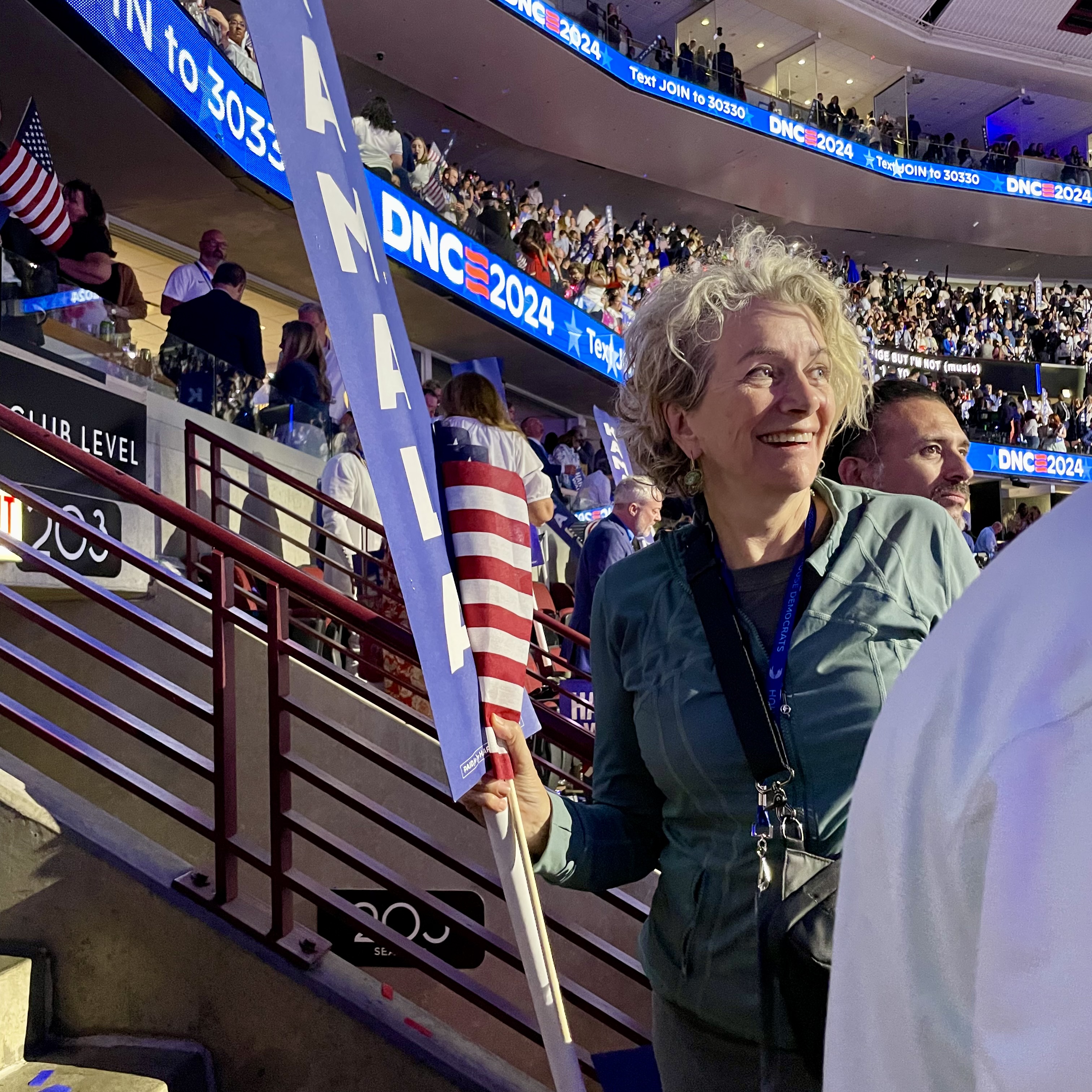
On the afternoon of Convention day four, I received a text, “I’m leaving a pass for you at the desk of my hotel,” from a lovely I’d known thirty years ago in the Clinton Administration. I hiked up my skirt, jumped on my three-wheel ADA electric scooter, and navigated my way through the exterior United Center maze of Secret Service, Chicago Police, Cook County Sheriffs, metal fencing, magnetometers, hawkers, protesters, volunteers, and a mile-long line of faithful ticket-holders. Vivienne from County Cork and Mark from St.Louis in section 202 texted every few minutes with updated instructions on how to squeeze through the crowds and get to the seat they were defending for my grateful butt.
“I just got in a fight,” texted Mark. “Standing firm. I told them you were waiting for the elevator. Viv meeting you.” Finally, from my cherished seat, I texted David, who I passed outside on the pedestrian line. “No seats.”
Vivienne–great craic at Democratic Convention
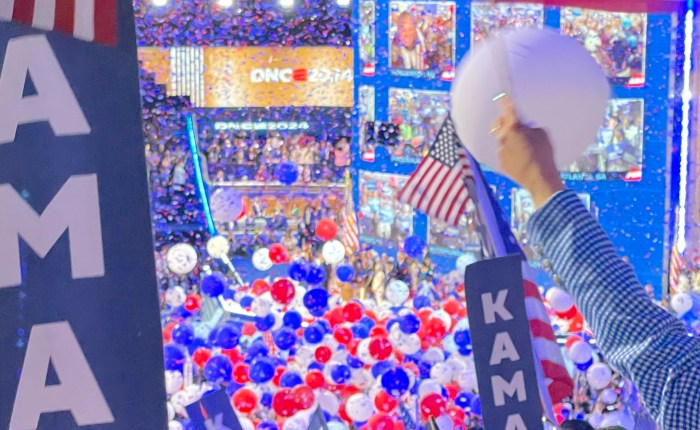
Lucky doesn’t begin to describe how it felt to be in Section 202 of the United Center on August 22, 2024, for Kamala Harris’ acceptance speech—the most blessed hurly-burly hoopla in memory.
Or, in the words of Irish Vivienne, “Best craic a’ me life.”
Never have I felt so valued at church as I did last Sunday. Presbyterians I hardly knew tugged at my sleeve or grabbed my elbow or those less buttoned-up screeched in my face — all congratulating me on getting to meet Pete Buttigieg. I’d posted a photo of Pete and me on FaceBook that week. A well-heeled Democratic couple in Chicago’s Lakeview neighborhood scrambled a party together that raised $700,000 for the Presidential campaign of candidate Kamala Harris six days after she chose Governor Tim Walz as her Vice Presidential running mate. A friend bought two tickets he couldn’t use and asked if I’d like to have them.
Gulp. Yes. Yes. Yes. I said. Pete Buttigieg is the most poplar Democrat in the United States. He’s the youngest person ever to serve as US Secretary of Transportation, was the mayor of South Bend, ran for president in 2020, is married with two children and oh, he’s gay. When he kicked off his campaign for President in 2019, I traveled to South Bend with Amy, Peter and Mark in the pouring rain to be at his announcement in the leaky old Studebaker factory. Pete was on Kamala’s short list for Veep, but, well, he’s gay. The US electorate can stretch its collective imagination to accept only one major cultural shift at a time. I guess. Democrats like me are giddy over the historic candidacy of Vice President Kamala Harris, a black woman, running at the top of the ticket. We would have been rapturous if she’d chosen Pete, but honestly, we’re not far from that in her choice of Tim Walz, a funny smart former high school football coach who loves state fairs, teaching, sitting on Congressional committees, governing Minnesota, serving in the National Guard and traveling to China.
I just love campaigns. I love candidates, campaign organizers, campaign volunteers, campaign consultants, campaign buttons, campaign events and campaign offices. My high school held a student-led Democrat-Republican combined mock convention in 1964. I was assigned to be Republican candidate Nelson Rockefeller’s campaign manager. I wrote to Rockefeller’s campaign office in New York requesting his platform in order to write my nominating speech for the mock convention. The campaign responded by sending me free stuff: crates full of campaign buttons, posters, leaflets, scarves, ties, cufflinks, bracelets, position papers, and even a suggested stump speech. I plastered the school with Rockefeller posters and made sure every student had some sort of paraphernalia with “Nelson” on it. The students chanted “Nelson! Nelson!”, I delivered my nominating speech and Rockefeller won the student endorsement by a wide margin.
I had already been steeped in soda-shop debates rebutting a freshman classmate’s anti-government racist diatribes. I read the boy’s constant companion, the 1958 publication The Blue Book of the John Birch Society ( a precursor to Trumpism and Project 2025) in order to prove him wrong point by point.
In the eighth grade my class was bussed to the airport and given hand-held American flags to wave and cheer as President Dwight Eisenhower deplaned from Air Force One.
She came to me at nine years old with an incomplete backstory. No longer a viable breeder after age five or six, the owners kept her way past her financial contribution to the family. She’d delivered two litters a year, about 100 puppies. “We just liked her,” they told me. My inquiry, “I’m an old lady dog-lover, looking for an old-lady dog companion,” hit just the right tone. “You’re an answer to our prayers.” And so I got Elsa.
The day after the attempted assassination of the former president, I hungered for Sunday air. You know, the first day of the week kind of air, where everything starts over. Air that requires nothing. No lofty thoughts, no reflection, no opinions, judgments, or conclusions. Sunday air. I breathe Sunday air when singing a well-known hymn like “It is well with My Soul”.
When peace like a river, attendeth my way
When sorrows like sea billows roll
Whatever my lot
Thou hast taught me to say
It is well, it is well, with my soul
And when the preacher elevates my being with no effort on my part, I breathe in the Sunday air of love.
Sunday air was unattainable at church last week, though. It was not well with my soul. Right off, the preacher prayed “for former President Trump, grateful he did not succumb to political violence. This world is in love with violence, a violence that threatens the best in us, so renew in us a commitment to the Christ, who calls us to turn the other cheek, to love our neighbor, to love our enemies.” On receiving this, I sucked in a big chunk of we’re-gonna-lose and couldn’t seem to exhale.
The sermon choked off any puff of relief— a parable about prayer that meant nothing to me. My diaphragm would have swelled during hymn-singing, but the tunes were unfamiliar yawns.
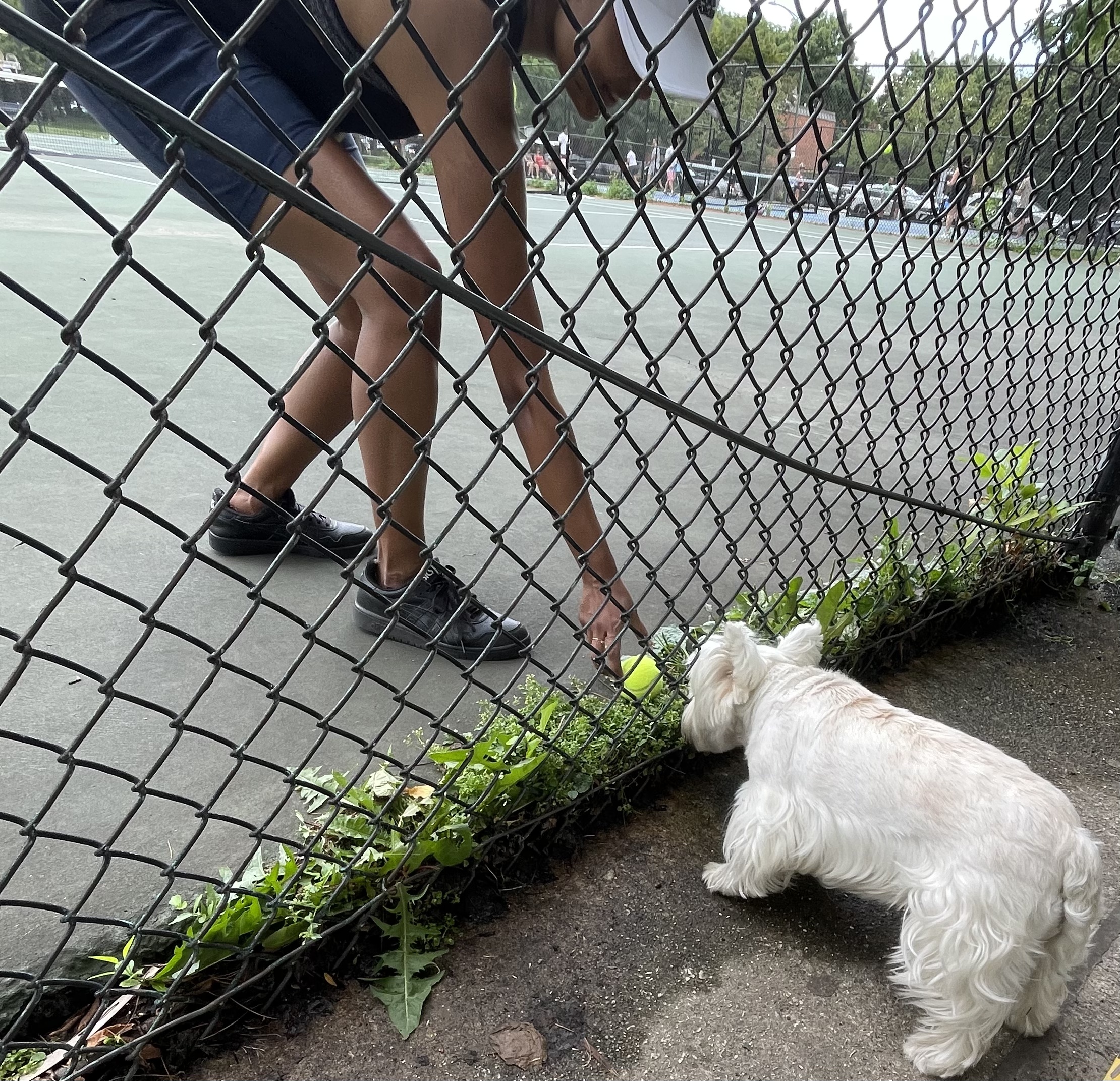
And so, airless, I vamoosed to the outdoors, home to fetch Elsa for a trip to the park to watch tennis players sweat it out. She was too hot to sniff around the edges and lazed in the shade instead. Until a tennis ball bounced toward her behind the chain link fence. She bolted for it and dug into the wire to try to slay that green fuzzy rodent stunt double. She would have broken her teeth to get to it. A tennis player picked up the ball, a good ball, and tossed it over the fence with big Sunday air to Elsa, who received it with the gusto of a kid catching bubbles. She flaunted her prize using all the primal dog moves that delight dog-loving humans. I never knew she was a ball dog.
Echoing Bill Maher, Bulwark podcaster Tim Miller asked his spirit guide and Managing Editor, Sam Stein:
“Can I say Trump is the luckiest dog on the planet?”
“No! You can’t say that.”
“I can’t?” Asked Miler.
“No! It’s not lucky to be almost assassinated.” Said Stein.











 Regan Burke