Gifts and Omens from the Polar Vortex

Gifts and Omens from the Polar Vortex

In 1982 newspaperman Paul Galloway made arrangements for me to volunteer on the Adlai Stevenson for governor campaign. Paul wrote features for the Chicago Sun Times and knew the campaign press secretary. It’s best to have a reference when volunteering on a campaign or you’ll get stuck answering phones or standing on a street corner passing out brochures. I was entrusted with driving Nancy Stevenson around to her scheduled events. She is one helluva quick-witted woman. I’ve never known any two people as funny as Paul Galloway and Nancy Stevenson. At the end of every day, I’d have hilarious conversations with Paul recapping the day’s events. He’d brief me on the serious issues of the campaign that I had missed while I was out with Nancy. Once in a while he’d relay bits of gossip about Adlai’s opponent, Jim Thompson, that he’d overheard in the newsroom—confidentially, of course, but I told Nancy everything.

Paul scheduled time with Nancy on the campaign trail because he was writing an article on the candidates’ wives. At the end of that day, as we dropped Nancy off, we doubled over out of the car barely able to recover from the previous sidesplitting eight hours. When the article appeared a few days later, a campaign staffer asked if we had given Paul an aphrodisiac because he wrote more of a love letter to Nancy than a journalistic objective feature story.

When the 2019 Polar Vortex was on its way to Chicago at the end of January, I decided to spend  the forced hibernation writing about my time in the ’82 Stevenson campaign. But my first draft notes were blank. I could remember very little about it. In writing memoir, when I sit down with a particular theme in mind, memories rise up. Other memoirists say the same thing; it’s why we call it bibliotherapy. Incidents hidden somewhere in the hippocampus come forward.

Not this time. No specifics of what-I-thought-were-memorable days with Nancy Stevenson and Paul Galloway. It’s as if Paul took the stories with him when he died ten years ago. Like they are his to tell, not mine. This has made me profoundly sad, not only at the lost memories, but at the loss of Paul.

And so the day before the Polar Vortex I figured out how to tee up the full 18 hours of  The Marvelous Mrs. Mazel on Amazon Prime. I threw half-a-loaf of stale bread cubes onto my 4’x10’  third floor balcony to nourish the house sparrows, finches and occasional chickadees that frequent my suet feeder. Then I shuttered myself in and Dapped all the fullsizeoutput_4cb7little crevices around the balcony door that were spritzing air into my not-so-insulated living room. That was the extent of my preparation for the coldest two days ever recorded in Chicago.

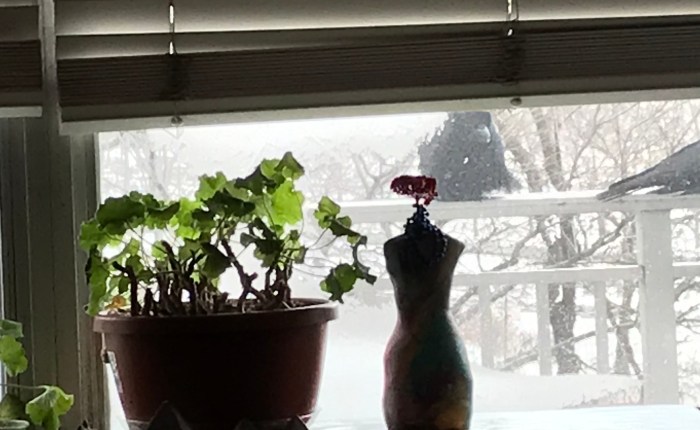
Day One: -23 °. I awoke to a thick film of silver ice covering all my windows. There were fractal peek-a-boos to the outside world near the balcony door handle and around my hardy geraniums on the indoor windowsills. The ice curtain shut me out of the humanity moving around behind the windows across the street, buses and cars on Lake Shore Drive and any fool pedestrian walking about in the feels-like-minus-40 degrees. The windows emitted a dazzling cold so I grabbed some goose down, hunkered down far away from the frozen glaze with Henry the dog and cuddled the TV remote.

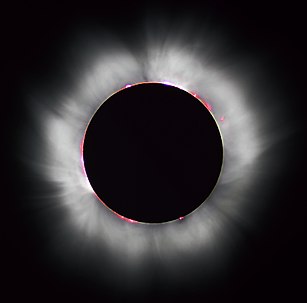
My binge-watching was interrupted by a thrashing whomp, whomp whomp, on my balcony. Then another. And another. Then two more. I rose to inch toward a clearing in the frosty glass. A murder of crows had come to visit. 

The American Black Crow measures 20 inches long with a 3-foot wide iridescent wing span. The crow and its cousin, the raven,  show up in every ancient mythology as bad omens of storms, disease or death. Native American tribes believed the crow had the power to talk and was a stealer of souls. Recent research suggests their cognitive abilities are as sophisticated as chimpanzees. If they look you in the eye, they will remember you, follow you down the street and caw to you when they’re hungry, like wild pets.

As the arctic blast began serrating its way from the North Pole down toward the Lower Forty-Eight, the goal of every bird in the Midwest was to gorge themselves, find a safe 51281615_10218858609480733_4258526774826106880_nplace and stay still to conserve the calories heating their bodies. The weather should have kept the crows out of sight.

Instead, it brought them to me.

Day Two: -21°. The ice wall on one of my windows melted enough for a small lookout. I prayed to the crows, “Come back. Please come back.” They first landed mid-morning. A mighty set of black wings fluttered a plumped-up body onto the balcony railing and the rest followed, plucking for leftovers. They flew off and came back. Again. And again. And again. I remained still throughout, trying to lock eyes with the leader. Was this a bad omen? Come to steal more memories?

In the late afternoon the temperature rose to minus-2 degrees. I strapped Henry into his dreaded boots, packed myself in layers of cold weather gear and set out. We clipped along the crackling tree-lined sidewalk.  A crow cawed overhead. Again. And again. And again.

The Fresh Coast

The Fresh Coast

When some people speak of the Midwest

They talk as if she’s the jilted cinderella 

Whose prince neglected, and I must defend her,

Not always cold, no oceans or mountains, sister,

But 600,000 sandhill cranes wade in her water.

The east coast comes to play sport, play act, pay 

To play, play around, play the innocent, put in play.

The west coast comes to run by, run. 

They say nothing eventful happens to her.

Then they blame her for Trump.


Eclipse of the Century at the Jersey Shore When My Mother Kicked the Coupling Cats

Eclipse of the Century at the Jersey Shore When My Mother Kicked the Coupling Cats

We stood in the street in front of my mother’s house five blocks from the Atlantic Ocean for what Walter Cronkite called the Eclipse of the Century. My 3-year old son Joe hippity hopped atop a bouncy ball clinging to the red rubber handle between his legs. Stacy, my 13-year old sister huddled on the frosty curb with her friend Billy. They had those cardboard gizmos with pinholes. I thought they got them at school but Stacy said Billy made them in his garage.

My mother never got chummy with her neighbors. A group of them came out from under the trees lining our sidewalks for an unobstructed view of the eastern sky. At one end of the house across the street, a construction tarp hung from the roof to the ground hiding a big hole. The mangled house was under repair after my mother pushed the wrong button on her 1959 Chrysler push-button transmission, slammed on the gas instead of the brakes, shot straight out of the driveway, jumped the curb and punched the house in its face. Unharmed, she passed out but not from the impact.

Billy reminded us earlier in the week that we needed a filter to look at the sun or we’d go blind.

“Don’t be ridiculous, you just have to look through the dappled sunlight under the trees,” my mother said. It was March. We didn’t tell her there were no dappling leaves.

The eclipse moved along the east coast from Florida to Maine. In her 1972 song You’re so Vain, Carly Simon memorialized the once-in-a-lifetime 1970 total eclipse of the sun. Cronkite and others reported that we wouldn’t see another eclipse like this until 2017, an absolutely unimaginable future time.

As the umbra started to move into position for the brief period it would black out all sunlight, my mother appeared on the darkening street carrying a can of Budweiser. Our long-haired white male cat, Mae West trailed along. He abruptly mounted a passing 308px-Solar_eclipse_1999_4_NR.jpgtomcat prompting my mother to kick the cats and scream, “You queers! Cut it out!”

Joe stopped bouncing and looked toward the shadowy sky. Stacy bolted toward him. “Cover your eyes!”

I gawked at my mother, already relishing the laughs I’d get acting out this scene to my friends. They loved her. One of the neighbors hurried over to my mother, “Stop kicking the cats!” The others, distracted by the commotion on our portion of the boulevard neglected to look up. The dark cloaked us but we missed gazing at the Eclipse of the Century.

Billy, unfazed by the street theater, peered at the solar system event through his homemade cardboard pinhole filter for the entire three minutes the moon passed in front of the sun, his Eclipse of the Century. He lived to tell the tale for another five years before a drunken driver took his life.

Anonymous Prayers

Father Long asks to meet on the wrap-around porch of the 19th century worn-out resort hotel in Spring Lake, NJ. I just left my husband and live at my mother’s house with my two-year-old boy. Assuming he wants to force feed me unwanted marriage counseling, I hang an emblematic roach clip on an anti-establishment leather string around my 22-year old neck to compound my defiant hippie ensemble. He talks about my marijuana use.

Give it up for your mother’s sake.

Are you talkin’ to her about givin’ up drinking for my sake?

He once had a job as the disciplinarian of an inner-city Catholic boys school. Realizing I’m no match for him, I make a fast exit scrambling out of the painted-wood rocking chair as I hear over my shoulder.

I’ll pray for you.

My mother’s cousin, Jesuit Arthur Long Jr. spends a few weeks every year near Sea Girt where I live during my spiritually-sick adolescence and young adulthood. This summer his vacation on the edge of the Atlantic Ocean is interrupted by my mother’s cry for help—help for me, her addict. Her lips never part for the word pray nor do her thoughts ever enter the prayer realm. How drunk must she have been to ask for help from her cousin, a soldier of God?

I wonder if Father gets dispatched to other wayward children sprung from his very wayward relatives. 

A few years later I make it to Alcoholics Anonymous and after six months sober I’m the speaker at a large meeting in Montclair, one of Manhattan’s bedroom communities. I talk about my inability to stop drinking, stop smoking pot, stop consuming illicit drugs, until I get to AA. I’m happy to be sober and tear up at gratitude for my father who brought me into the Fellowship. My father sobered up five years before me in Town’s Hospital Manhattan and started his sustained abstinence in meetings on the Upper East side during the time I was dying, way out there in some other dimension. We hadn’t seen each other for five years before he arrived at the public mental institution I overdosed into at 24 years old. He suggested I go to the AA meeting on the grounds.

After my six-months-sober talk at the Montclair meeting, a petite pearly lady stands back from a line of well-wishers before approaching me.

I pray for you everyday.

What? Do I know you?

I go to meetings in New York with your father. We helped him when he went to see you unknownin the hospital, told him what to say, to just share his story, what it was like, what happened and what it’s like now, and suggest you go to meetings—like we do with any


other alcoholic. A lot of us have been praying for you for a long time.

And here I am.

Unearned Chicago Whiteness

I want to be a woman who is not afraid of young Black men. I want to enter the subway platform like an alley cat flic-flac’ing her cold feet into lackadaisical safety. I’m an old woman who wants to love non-Anglo words bouncing off the curve of the tunnel—ping! pow! hitting the pulse of the collective-waiting-for-the-train with differing beats-per-minute.

Imagine if I accepted Black culture the way some accept Chinese culture. I’d stop trying to colonize Black names—it’s Na’Dia, not Nadia! I’d quit harping at the Walgreen’s cashier for her gold-plated elongated fingernails—how can you hit the keys with those? I’d accept rap and hip-hop, stop changing the words or the beat whitening it all up just to enfranchise my fragile birthright. 

I’d walk down Lawndale streets, how-you-doin’, and ‘wassupin’, a welcome visitor looking for friends and food and local art. Next day I’d take you with me sayin’, meet Taneesha from poetry class and oh there’s Damari from tutoring. Hi Fam. Here’s my friends. I’d hear new language poppin’ outta my own mouth. Like they were my own words. Like they have to do when they walk white and talk white on Michigan Avenue, or else. Or else, the judge says, I can’t understand you. Speak proper English. 

We’d gather all together and go to the movies, sit side-by-side transforming ourselves into subcutaneous doppelgängers. We’d be like, oh that’s funny or Girrrlll I feel ya’. All hands would open and close on popcorn from the same bucket. Afterwards we’d crowd the sidewalk two-steppin’ to No Diggity on our way to brunch. Everyone would get served and be safe.

My unearned whiteness is a blessing: I get to go out the door without rehearsing how to react when Macy’s security guards ask to see my receipt. And a curse: A white woman cried to the police there musta been 40 Black boys down there crowded in the red line and I’m helplessly guilt-ridden when the fact gets reported as 50 later that night. And 60 the next morning.

I’m an old white woman who wants to cuddle and cry with Black children maligned in that subway—not white women’s cries regurgitating Black boy history of false accusations and lynchings. No. No. God-the-Mother cries with tears that seep under my babies’ skin cleansing them of my control, my denial of their equality, my remarks about their hair.

I thought I was once a curious woman simply eavesdropping on human nature’s racial conversations. The constant banged-out message that my beloved Chicago is the most segregated city in the country woke me to know I’ve been a gagged participant all along.

My vow is to be the old white woman waiting in that subway, with you, emancipated from the fear of young Black men.

michael-sardin
CHICAGO (CBS)–An 18-year-old is among four people now charged in a mob attack on the CTA Red Line.

I Want To Be A Sports Fan But Doink!

I Want To Be A Sports Fan But Doink!

I want to be a woman who knows sports. I want to go to football games and know all the players, where they live, their salaries, their stats. I want to insert myself in men-talk, the world of facts and figures, history and strategy.

My hometown brags about her sports. We have the Cubs, the Bears, the White Sox, the Blackhawks and the Bulls. At Midwest Orthopedics in 2015, a year the Blackhawks won the Stanley Cup, the doctor said, “We do the Blackhawks, you know.” 

I returned in 2016, the year the Cubs won the World Series and someone said, “They do the Cubs, you know.” 

A friend who had her hip replaced said, “My doctor is the Bulls ortho.” 

Another who had shoulder replacement, “My doctor fixed the White Sox pitcher.”

When I was a young professional, my office mate, Patrick, told me I’d never get another man if I didn’t know sports. Every Monday morning he’d grill me. 

“Dodgers?”

“Los Angeles.”

“Packers?”

“Green Bay.” 

Patrick’s weekly quiz schooled me in teams, players, uniforms, stadiums and basic terminology. Osmosis had been my teacher until then. I played team sports as a kid and absorbed recurring words like touchdown, foul ball and goalie. My son, who learned to read looking at baseball scores in the back of the newspaper, played baseball, hockey and basketball. I wasn’t as fully engaged as other Little League mothers but I picked up tufts of jargon in the stands while rooting for his little body to get around the bases.

On a Sunday afternoon in early January 2019, I was on the #36 bus headed north to theth-1.jpeg movie theater to see “Vice” for the second time. Handsome, jovial cool cats at the Clark and Division bus stop grappled with grocery bags full of beer and pretzels. They were in mid conversation as they boarded: 

“…a company game between Bears and Packers, then a guy bought the Bears for $50.” 

“Cubs came after the fire. Always played Wrigley; Bears used to play Wrigley.”

After the fire? Was he referring to the 1871 Chicago fire?

One of the fans shouted out the words on the billboard as we passed the Weiner’s Circle: “It’s The End Of The World As You Know It. So Eat Hot Dogs!”

“Hope that’s not an omen!” shouted a passenger in the back and I realized the NFL wild-card round between the Bears and the underdog Eagles was about to kickoff.

After the movie I boarded the bus with a pack of  jostling men who kept shouting Doink! and fuck Cody! I looked in my iPhone. The Bears lost due to an errant field goal by Cody Parkey. Doink! The boozy herd bobbed and weaved, nearly falling on those of us sitting in the front seats. th

I fear I’ve forgotten most of what I learned from Patrick, since I’ve had no occasion to use the information. I want to be a woman who knows sports but life on the #36 bus confirms what I’ve always known—I don’t want a sports fan for a man.

Sex in the Art Institute

Sex in the Art Institute

On my first visit to “Painting the Floating World: Ukiyo-e Masterpieces,” I was so mesmerized by the dazzling patterns in the robes of the geishas that I did, indeed, float around the gallery.

R_UP_129R2_85-27_web“My god, a whole exhibit devoted to prostitution,” my companion whispered halfway around the showcased Japanese beauties.

I dragged back-to-back out-of-towners to The Art Institute of Chicago to see the paintings of Japan’s “metropolitan amusements to life,” as the curator describes it. The Weston Collection of concubines and geishas were painted between 1600-1850, the Edo Period, dubbed by the Japanese of the time as the “floating world”. 

My visitors were as entranced as I was with a particular part of the exhibit. Behind Japanese-style slatted-wood walls, long scrolls were rolled out flat in climate-controlled glass-topped tables. Moving sideways foot-by-foot in silent walking meditation, I peered down at the cases to study the painted images: depictions of men and women flirting and kissing, men and women embracing, then men and women in the most preposterous coital positions. Colorful garments wrap around their legs and arms, leaving the genital areas fully exposed. It had been a long time since I’d seen an erect penis. I had no idea there were so many ways to use it. The Manasquan High School gym teacher in New Jersey didn’t cover positions in 1960s sex education. Edo Period Japanese parents, however, bequeathed these scrolls to their newly-wed offspring for their sex education. How grateful I would have been had my mother given me the modern equivalent, The Joy of Sex.

My friend gasped. “I didn’t realize Japanese males were so well-endowed.”

I shrugged. “Well, don’t forget, all the artists were men.”

My cousin Therese came to town for Thanksgiving, and I couldn’t wait to get her to the Art Institute. I resisted briefing her as we ascended the stairs to the exhibit, stopping first to see American Gothic and Georgia O’Keefe. I left her at the Floating World entrance and pointed to the sign for the Member’s Lounge.

“I’ll meet you there. Take your time.”

The Member’s Lounge sets out catalogs for every exhibit. I grabbed a coffee, the Floating World book and settled into a chair at a corner table scrunched up against a wall crammed with dozens of other cafe tables and chairs. I was deep into searching for the scrolls of the erect-penis paintings when I felt the rustling of a neighboring body. A man with Asian features was squeezing himself into the adjacent table. I resumed my search. A jolting woman’s voice interrupted my task asking to sit at the Asian man’s table. I resumed my search.

“What do you think of acupuncture?” The woman asked the Asian man.

“I really don’t know anything about it,” he said.

“You’re kidding?” said the woman.

“I was in Chinatown yesterday for acupuncture,” she said her voice reaching the third octave.

What was going on? Was she so charged up after seeing the erect-penis paintings of Asian men she had to create stupid pick-up lines for this guy? The two of them carried on as if they were in a bar drinking sake. I abandoned my search for photos of the erect-penis scrolls and grabbed my notebook to record their conversation.

Just then Therese came through the door of the Members’ Lounge, caught my eye and burst out laughing.

“Wow. No wonder you left me by myself—so I could blush in secret!”

“Therese,” I mumbled, letting her in on the conversation at the next table, “there’s so much writing material here. I could sit in here every day during this exhibit and come up with a whole book, “The Overheards in the Members Lounge.”

“Overheards?”

“Yes, you know. Things you overhear. Write it all down.”

“Is that legal?” Therese asked.


The Gift: World’s Greatest Christmas Song

The Gift: World’s Greatest Christmas Song

Christina Rossetti’s “In the Bleak Midwinter” 

“In the Bleak Midwinter”, a poem by the English poet Christina Rossetti, was published under the title “A Christmas Carol” in the January 1872 issue of Scribner’s Monthly. The poem was set to music by composer Gustav Holst in 1906.

What can I give? 

Christina Rosetti gave us a personal tender poem pouring out her love for the transcendent God and later, in a rush, Gustav Holst vocalized her words with a snowy melody that perfectly acquaints us with her quiet passion. How pleased God must be with the gifts of these two artists whose 19th century lives were crippled by illness, financial despair, loneliness and depression. 

Their living legacy of lyrics and music are sprinkled delicately on the page waiting for me to sing them out from some curious reflexive viscera. As the organ introduces the tune, I nervously set my heart to sing with a childlike exuberance, “Me too! Me! Me! I want to give too.”  But what can I give? I have a terrible voice. Off-key. Tone-deaf. Dissonant. Breathless. Creaking. Croaking. Grating. I will make a mess of this magnificent carol. People will judge me. Shoot me dirty looks. Wish I’d shut it. Hope I choke. Hfullsizeoutput_48e5ate me!

He calls me to stillness. I respond in silence, close my eyes and allow Peace to rule my heart. In one second my transformed heart awakens and shakes off the grumbling in my head. I sing as loud as I can with my whole engaged core. I give God imperfect singing of this perfect song. I set my voice on an imaginary course of graceful, harmonious, angelic melody. This, I believe, is what He hears.

Oh my God, I love that my discordant heart can be stilled by Your Peace. I love that a perfect gift for You is my imperfect singing.

________________________________________

Dan Fogelberg sings In The Bleak Mid Winter HERE

Blest Be The Ties That Bind

I haven’t seen Rick Ridder in years but loved reading his 2016 book, Looking for Votes in All the Wrong Places. I bought it to add to his sales numbers, support him in my own 81JbkJ1jA8Lsmall way. We both survived the 1980s Gary Hart presidential campaigns. So when it comes to making room on the shelves for other sympathy books, the ties that bind keep Rick’s book in place.

My built-in bookshelf clings to the entire southern wall of my small living-dining room. It’s stuffed. Books, old Vanity Fairs, photos, souvenirs, dog sculptures, used conference binders, scrabble, dominoes, a small portable heater and my writing notebooks all collide on the faded white sagging shelves. 

When the time comes to rack the newer books, stockpiled on all the flat surfaces in my living space, I painstakingly pull the old prisoners from their slots on the shelves. They sit on the floor for hours, days, weeks, awaiting sentencing. I stare at the titles. Agonize over their fate. I wish then, more than at any other time in the hours before twilight, for a piece of someone to discuss the disposition of the hoard and share in my decision-making.

“What about this one? Remember this? Dimitir by William Peter Blatty. Mark suggested it when I told him Blatty named the girl in The Exorcist after me. Did I read it? Should I save it?” 

“Oh, then there’s: Age Doesn’t Matter Unless You’re a Cheese. Jeanette gave me that when I turned 70. Maybe there’s something in it I can use for my writing.”

“Oh yeah. Listen to this. Ram Dass: ‘I used to have a sign over my computer that read OLD DOGS CAN LEARN NEW TRICKS, but lately I ask myself how many more new tricks I want to learn—isn’t it better to be outdated.’”

“Outdated! Is that how I should think of these old darlings?”

Oh, I tried long ago to get help with this salvage operation. It broke down, however, when I plunged into the stories behind my keepsake books. No matter how good a friend I netted, my stories bored in the telling and the telling and the telling. I sit alone now on a stool wheeling around the wreckage from title to title. 

“These? Oh no, must save Ian Rankin, my favorite mystery author. Oh, c’mon, Regan. It’s not as if they’re going in the garbage. Put them on the bookshelves in the laundry room. Someone’s bound to enjoy them before they get carted off to the used book sale at the Newberry Library.”

“Ok, these can go—two books by David Ellis. Oh, well, maybe. He’s the lawyer-turned-mystery-writer who prosecuted Rod Blagojevich. A good lawyer. And a good writer.”

“Richard North Patterson’s, Exile, needs to go. It’s old and smells. Musty. But I’m so grateful that it helped me understand the Israel-Palestine mess. Maybe I’ll read it again.”

Loneliness has its price. Out of this last 24-book pile-up, only one goes to the graveyard: The Complete Book of Food Counts.

Wish I’d Saved Those Dead Bodies

I open the drawer to a pile of dead bodies—naked GI Joe and his headless pal, Ken, with his pants around his knees. Small plastic green soldiers had been flung willy-nilly into the drawer’s mass grave. Their weapons, swords and shields, were buried with them, $_3just like their human predecessors in the ancient world. I had not opened my low-slung coffee table drawers since my grandchildren stopped overnighting several years ago. I kept them in tact as a mini-shrine to time standing still.

How I yearn for those little boys to come flying through the door one more time, go straight to the coffee table, plop down on the floor and do battle on the table top with their action figures.

In another drawer I discover my granddaughter’s mini stuffed bear dressed like Betsy Ross, her hat half chewed up by one of my now-dead Scotties; a tiny red plastic car from Monopoly Junior; and, three red plastic cups in the shape of Shriners’ hats. I reach to the back of the drawer and feel around for the little monkey that goes with the cups. All three grandchildren loved this old-fashioned shell game. They set the three hats on the table top, hid the monkey under one and spirited the hats round and round, in and out. I would guess which hat hid the monkey. I always got it wrong. One of them would jump eff347a9d7e47ddeb8669a526ce39fbain to help me, their old grandmother with her limited sense of place. Another would whisper, “pick the left one” knowing the hat on the left was empty. They thought juking me was hilarious. I did too, but for different reasons—my delight was simpler: I loved hearing them laugh.

Perhaps the shell-game scammers on the L trains started with the Shriner monkeys when they were kids. Chicago visitors huddle with their suitcases on the O’Hare Blue Line, get sucked in, throw their dollars down, win once, then lose over and over. The scammer fools them like my grandchildren fooled me. And they all laugh too.

I clean out the drawers and throw all the bits and pieces of remembered joy down the garbage chute. I disinfect the coffee table as if it were a crime scene. This is what we do, after all. Clean things out. Throw them away. To have space for more stuff. I don’t need more space though. If I can’t hang it on the wall, wear it or stuff it into my bookcase, out it goes. So now I have two empty compartments in my small apartment I’ve no use for. Oh, I could store little Christmas ornaments there, but I already have a place for those. One drawer is a perfect place for the two TV remote controllers I all of a sudden need. But I’d never remember I put them there.

I really wish I’d saved that monkey shell game.

For now, these drawers of time past remain empty.