IRL (In Real Life)

IRL (In Real Life)

One of the first gifts I received from my grandson, CJ, was his framed eighth grade self-portrait. He filled the center of a twelve by sixteen inch paper canvas with his life-size face, neck and shoulders, probably as instructed by his teacher. The background is a collage of his own black & white photos, trees and fences, angled every which way. The drawing portrays what he looked like at thirteen years old. 

Except he painted himself cobalt blue. 

This painting hangs from a hook on the wall-to-wall bookcase in my living room. CJ is fair-skinned with reddish-blonde hair. I’ve never asked him why he painted himself cobalt blue. As far as I know, he wasn’t imitating Picasso’s blue period. No one knew about the blue people of Kentucky until the 2019 publication “The Book Woman of Troublesome Creek.” After hearing so many ads for Blue Man Group on TV, CJ expressed interest in seeing them live on stage. But it was an interest, not an obsession.


Cobalt blue, used for centuries by the Chinese for their blue and white pottery, is the epitome of coolness; dark, deep, and mysterious. It’s the color of the evening sky in winter, clear twilight boosted by the unseen sun from below the horizon. CJ’s not the only creative to fancy cobalt. J. M. W. Turner, Renoir, Claude Monet, and van Gogh all favored its compatibility with other colors. Remember Maxfield Parrish’s famous Daybreak? He used cobalt blue mixtures for the skyscape. 

Public opinion polls show blue as the favorite color of both men and women. And yet, a case of the blues refers to feelings of sadness. My parents used the term, the blues, to announce their alcoholic hangovers. 

Thanks to old African American traditions, the blues generally signify sadness without despair. Pastor Otis Moss III of Trinity United Church of Christ in Chicago preaches about a blue note faith, one that’s rooted in letting dark times exist side-by-side with hope. Moss teaches his congregation to let these dark moody blues move around them while they practice dancing in the dark. This practice keeps the blues from turning to hopelessness and death by despair.

For the past ten years CJ’s self-portrait has hung where I see it everyday. He’s melded into my unconscious seeing. He looks the same to me. But as I write this and inspect him further, I see the cobalt blue has faded to dark teal. Teal is a modern color, one not seen in art before the twentieth century. It has no meaning really, except a lot of European TV shows use teal interiors and costumes. It makes the actors look better. 

In real life, CJ’s hair has turned brown, but I still think of him as reddish blonde, just as his self-portrait will always be cobalt blue. We don’t see each other often in these isolating covid days. He’s in those perilous twenties where the blues start taking root.

I hope he’s dancing in the dark.

Saved By Eloise

Saved By Eloise

When friends announced their newborn’s name, Eloise, memories of New York’s Plaza Hotel stiffened my spine. I’d erased all memories of the palatial turn-of-the-century landmark after Donald Trump bought her in the late 1980’s. I even dumped my co-memories of Eloise, an early literary heroine who lived in the Plaza without her parents.

In the early 1950’s, my mother took my sisters and me to live for a while in her childhood home in North Jersey. One day, we took a train to Penn Station, then a cab ride to the Plaza at Fifth Avenue and Central Park South. We drank coca-colas, went to the powder room and backtracked home.

The book Eloise was published in 1955, a few years after that memorable first trip to the Plaza. The protagonist is a precocious six-year old, though the book was written for adults. After its publication, my mother gossiped about author Kay Thompson as if she were the next-door neighbor. On the phone with each of her sisters, she’d giggle at Eloise cartoon antics. They all grew up in the shadow of New York, mocking spoiled high society children similar to Thompson’s Eloise.

Kay Thompson lived at the Plaza and wrote the idiosyncrasies of other residents into Eloise stories. Plaza kibitzers tittered about a wealthy widow who had her hair done cheaper in the men’s barber shop rather than the women’s salon. Thompson had Eloise get her haircut in the barbershop too. Eloise picks ribbons from the garbage in the service elevator, mimicking a reclusive countess who was known to pilfer through hotel trash bins. 

Talk of the Plaza Hotel wafted through my childhood. I imagined myself living in the Plaza with my dog and turtle, like Eloise, getting into all sorts of fiendish exploits. My charlatan father often stayed there, or pretended he stayed there. I overheard him arranging to meet other business contacts in the Palm Court or the “coffee shop in the lobby,” as he satirically called it. When I was a teenager I lived with my father for a time in Manhattan. The Plaza was in the vicinity of my walk home and I’d often stop to use the powder room or meet friends in the coffee shop.

Once when I was around nineteen, I came out of an alcoholic blackout at 3:00 a.m. on the powder room floor in the Plaza. I had no purse, no money and was far from my New Jersey home. The bellman allowed me to use a phone in a small back office. I called Bernadette, a high school friend in the Bronx whom I hadn’t contacted in four years. She knew the bellman.

“Ask him for money and take a cab to my place.”

When I arrived, she made up a bed on her couch, gave me homemade chocolate chip cookies and milk. I tried to tell her what happened.

“No explanation necessary. It’s the home of Eloise after all. Anything can happen.”

The Veterans

The Veterans

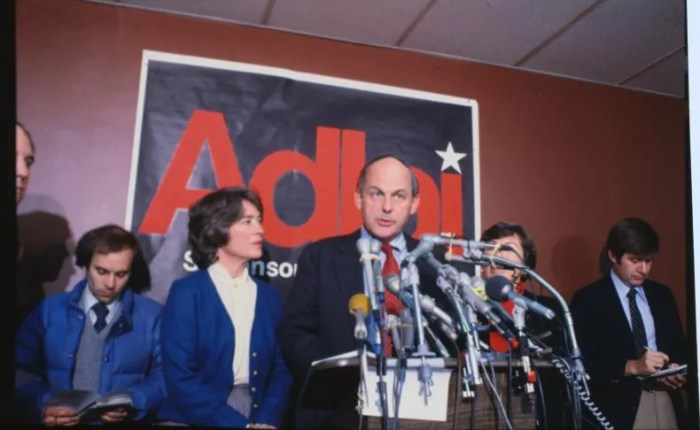
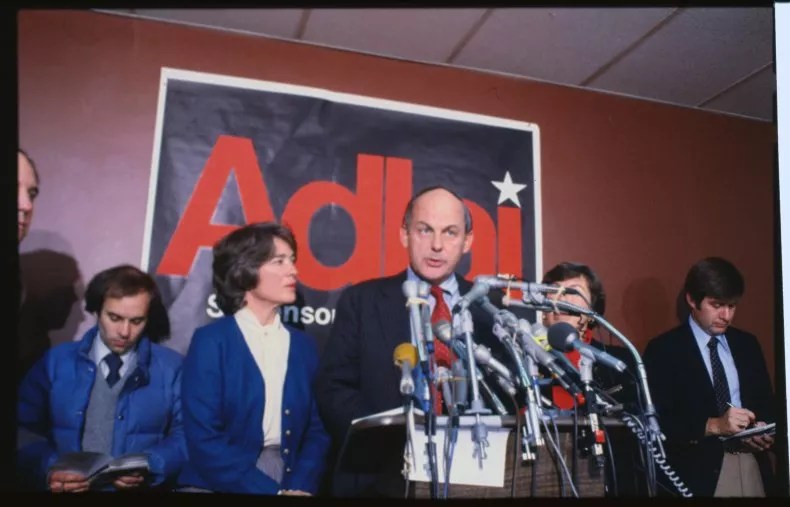
At a memorial service in downtown Chicago on Veterans Day eve, campaign veteran David Axelrod eulogized Adlai Stevenson III. In 1986 Adlai had reluctantly enlisted Axelrod as a consultant to steer the ship of his campaign for Illinois governor. Adlai had nothing against Axelrod. He just didn’t understand why he needed a consultant to do what he thought the campaign staff should do. Axelrod recounted how Adlai fought, like the Marine he had once been, for higher principles—“utterly immune to pressures of organized money, politicians and public opinion”.

He reminded us of how the press derided Adlai as “professorial” and out of touch with voters. But Nancy Stevenson could light any room with grace and warmth, insulating her husband from criticisms of being cold and aloof. They both always appreciated the sacrifices of campaign staffers. On that night, at a party to mark her husband’s death, she offered us one final salute from her and her “Ad”. 

Nancy was the last to speak. With a cavalcade of children and grandchildren surrounding her, she chronicled each of the Stevenson campaigns. Treasurer. Senator. Governor. I looked around the room full of campaign veterans and wondered how she deployed so many of us so fast. 

Small units clustered together after the formalities, telling favorite Adlai yarns, as if he was the childhood uncle. There’s a familial coziness in campaign storytelling. I gravitated toward the governor-campaign crew, some of the funniest people I’ve ever known.There’s no doubt we all respected him for the valor conveyed by Axelrod. But as a candidate, Adlai gave us a lot of stand-up comedy material.

In 1985 the Chicago Bears won the Super Bowl. At a campaign event, an enthusiastic  supporter yelled out, “Hey Adlai, you’re the Mike Ditka of politics!”

“Who’s Mike Ditka?” Adlai asked a campaign staffer in the car afterwards. The staffer explained that the ’85 Chicago Bears was being touted as the greatest NFL team of all time. Adlai said, “Oh, I thought NFL stood for some new terrorist group.”

In the early days of the 1986 campaign, I was the driver waiting for Adlai and the press secretary outside the Chicago Tribune. When the two got in the car, we headed down the Dan Ryan to a campaign event on the far south side. The press secretary and I were looking forward to the drive time to review the long-term schedule with Adlai. But Adlai, always prepared,  hopped in the front seat, tuned in WFMT and pulled sheet music out of his briefcase. We were mum as he followed along to the tinny car radio ringing out Bach’s Mass in B Minor all the way to Calumet City. 

Adlai once accused his opponent, incumbent Governor Jim Thompson, of implying he was “some kind of wimp.″ Thompson sounded off, “I never called Adlai a wimp”. The label stuck and at the conclusion of every one of Nancy Stevenson’s speeches after that, she smiled, winked, and affirmed, “Ad…is no wimp.”

RIP. Adlai Stevenson III. October 10, 1930 – September 6, 2021

Scammers and Fear Mongers

Scammers and Fear Mongers

Comcast/Xfinity notified me this week of a $100 charge for in-home service. Combing their website I found the “contact-us” link at the hairline of the fine print. I cleared my schedule, settled in for an extended tussle and sent an inquiry: “Isn’t in-home service free as part of your recent upgrade to my high-rise?”

Within five minutes the reply came: “$100 will be credited to your account.” The response crimped my escalating ire. Restitution was enough. I didn’t look for, nor did I need an apology.

When I recounted this good fortune to a friend, she said, “They were hoping you wouldn’t notice and just pay it.” Really? I suggested she was a bit more cynical than me, that I prefer to think of it as a mistake.

My initial reaction is that a human error occurred, like a beautician accidentally snipping off too much. On second thought, conditioned by my friend, I later suspected that a programmer set a computer to scam thousands of customers, expecting a certain percentage would pay without question. Teased by a subconscious groupthink, I reckoned Comcast/Xfinity, Big Pharma, Medicare, IRS, Social Security, banks, mortgage servicers, insurance companies, condo associations and Amazon not only make mistakes but misbehave. Experience has shown me that correcting mis-charges in all these organizations requires pull-my-hair-out patience. To make matters worse, AARP informs me every week to be over-vigilant to incoming email, text messages, phone calls, and snail mail. Apparently, thousands of scammers are out to shear my bank account.

Accepting the idea of a corporate crime wave is easier when in the thick of a crisis. A few years ago I sat with a tattooed, mohawked alcoholic who was detoxing in the hallway of an emergency room. A nearby social worker overheard me phoning his family with the news that their insurance denied coverage for inpatient treatment. She pulled me aside and offered: “They always reject you on the first try. Their business model counts on you giving up. Tell them you know it’s against the law to deny him.”

The father of the patient wigged out at the shamelessness of the blameless insurance counselor. I say blameless, because what kind of mullethead would take a job where the requirements would be to lie to the customers? Insurance eventually accepted the sufferer’s claim. He lasted two weeks in rehab before cutting out, but that’s another story.

86922a4b282276bf1fe4cf8fc1f67411When the devils throw blow-out parties, they wave around essential-fatty-acid credentials weaving stories that depict the decolorization of human goodness. They bob around spewing certainties on the demise of the Democratic Party and the catastrophe of melting polar ice caps. Then they buzz cut what’s left of our serenity pronouncing Trump will be the next president. 

How do I foil hair-on-fire incoming?  By upsweeping the good. I stick every 100 dollar refund on the beehive and wait for the honey.

Ageism and Activism

Ageism and Activism

From the Board of Directors of Skyline Village Chicago reprinted from the November-December 2021 Newsletter
 
Age-related shaming can occur anywhere—the shove in the street, the cold shoulder at the cosmetics counter, the deaf ear at community meetings, and the big one—the obtuseness of the health care system.
 
Activism-Against-Ageism-2Ageism and age discrimination are different. Age discrimination raises its ugly head in institutions, corporations and housing. Experts often refer to ageism as complex and subtle. It is subtle, but not that complex. When someone addresses us as “young lady”, the implication is that young is good, old is bad. If we act flattered, we’re perpetuating the stigma. The expression “senior moment” aims to joke about aging memory loss as if it is an embarrassment rather than a normal part of getting old. One of our neighbors is often called “young at heart”. She’s an eighty year old woke grandmother who likes Chance the Rapper and marches in anti-racism demonstrations. “Young at heart” diminishes the lifelong experiences that have brought her to her own reckonings. Yes, ageism is subtle, but really, it’s not so complicated.
 
People in power have implicit or unconscious biases, baked-in at birth, passed down from generations like old recipes. Their unrealized thoughts are that people much older can be ignored because they are close to death, or they have had “full lives,” or they no longer care to survive. These never-expressed sentiments influence and often determine public policy.
 
Acquiring awareness of our own ageism warrants self-education and introspection. When we experience ageism from without, we tend to think “this is my problem,” rather than, “this is OUR problem.” Dismantling ageist thinking and behavior requires collective action, just like movements against racism, sexism and ableism. 
 
Anti-ageism activism is turning intimate suffering into public grievance. “In our society, there is this endless drumbeat of youth. We need to challenge the underlying message that age decreases your value,” says Ashton Applewhite, author of This Chair Rocks: A Manifesto Against Ageism and a blog called Yo, Is This Ageist?
 
Recently two members of Skyline Village challenged ageism by writing letters to the editor. Nancie Thompson and Regan Burke assure us they have been lifelong submitters of letters to editors. They had no expectations their letters would be published and yet, there they were—in the same week! 
 
Let’s keep it up. Write your own letters to the editor the next time you hear, see or read ageism. 
 
The links below will take you to contacts for your own submittals of letters to the editor.
 
 
While you’re at it, email us examples of ageism you’ve experienced: info@skylinevillagechicago.org. We’re compiling a list for Skyline’s advocacy work. Don’t worry! If we use your example it will be anonymous unless you tell us otherwise.
 
Thank you for your contribution to this important effort.
 
Skyline Village Chicago Board of Directors
Phyllis Mitzen, Sandra Herman, Evelyn Shaevel, D Clancy and Regan Burke
 

Ageism and Activism

Ageism and Activism

From the Board of Directors of Skyline Village Chicago reprinted from the November-December 2021 Newsletter
 
Age-related shaming can occur anywhere—the shove in the street, the cold shoulder at the cosmetics counter, the deaf ear at community meetings, and the big one—the obtuseness of the health care system.
 
Activism-Against-Ageism-2Ageism and age discrimination are different. Age discrimination raises its ugly head in institutions, corporations and housing. Experts often refer to ageism as complex and subtle. It is subtle, but not that complex. When someone addresses us as “young lady”, the implication is that young is good, old is bad. If we act flattered, we’re perpetuating the stigma. The expression “senior moment” aims to joke about aging memory loss as if it is an embarrassment rather than a normal part of getting old. One of our neighbors is often called “young at heart”. She’s an eighty year old woke grandmother who likes Chance the Rapper and marches in anti-racism demonstrations. “Young at heart” diminishes the lifelong experiences that have brought her to her own reckonings. Yes, ageism is subtle, but really, it’s not so complicated.
 
People in power have implicit or unconscious biases, baked-in at birth, passed down from generations like old recipes. Their unrealized thoughts are that people much older can be ignored because they are close to death, or they have had “full lives,” or they no longer care to survive. These never-expressed sentiments influence and often determine public policy.
 
Acquiring awareness of our own ageism warrants self-education and introspection. When we experience ageism from without, we tend to think “this is my problem,” rather than, “this is OUR problem.” Dismantling ageist thinking and behavior requires collective action, just like movements against racism, sexism and ableism. 
 
Anti-ageism activism is turning intimate suffering into public grievance. “In our society, there is this endless drumbeat of youth. We need to challenge the underlying message that age decreases your value,” says Ashton Applewhite, author of This Chair Rocks: A Manifesto Against Ageism and a blog called Yo, Is This Ageist?
 
Recently two members of Skyline Village challenged ageism by writing letters to the editor. Nancie Thompson and Regan Burke assure us they have been lifelong submitters of letters to editors. They had no expectations their letters would be published and yet, there they were—in the same week! 
 
Let’s keep it up. Write your own letters to the editor the next time you hear, see or read ageism. 
 
The links below will take you to contacts for your own submittals of letters to the editor.
 
 
While you’re at it, email us examples of ageism you’ve experienced: info@skylinevillagechicago.org. We’re compiling a list for Skyline’s advocacy work. Don’t worry! If we use your example it will be anonymous unless you tell us otherwise.
 
Thank you for your contribution to this important effort.
 
Skyline Village Chicago Board of Directors
Phyllis Mitzen, Sandra Herman, Evelyn Shaevel, D Clancy and Regan Burke
 

Eight Things I Learned in the E.R.

<strong>Eight Things I Learned in the E.R.</strong>

A doctor I’d never seen peeked around the curtain of my Emergency Room cubby hole and softly announced I have clots in my lungs.

My entire joyless face broke into an involuntary smile.

“That’s great news,” I said.

The doctor pulled his head back, turtle-like, as if he’d delivered the news to the wrong patient.

“There’s a simple solution, right? No surgery? Just pills?”

“That’s right,” he said.

In the thirty-six hours I’d been in the E.R. I’d learned a few things.

First of all, most hospital employees say “E.D.”, as in emergency department, rather then E.R. I was in the E.R. because I couldn’t catch my breath. A few hours of oxygen fixed that. Nurses and doctors kept saying, “it’s good you came to the “E.D.” Everytime I heard it, I thought of those commercials for little blue pills. On the other hand, when I hear E.R., I think of George Clooney.

Second, a nurse asked me if I wanted to be admitted. Was that my decision? My friend Kristina, who came to rescue me from fear and confusion reminded me that we have to say “I want to be admitted”, to satisfy Medicare. If you hesitate in making that declaration, you’ll be farther down on the waitlist for a bed upstairs. And let’s face it, if you’re seventy-five years old and find yourself in the E.R. with tubes in your nose, you’re going to end up admitted upstairs.

Three: There are no beds, no blankets and no extra pillows. The board you lie on is a padded gurney. The E.R. is a whistle-stop on the way either back home or upstairs. No need for frills.

Four: The E.R .does not have food service. You may find out about the secret stash of turkey sandwiches, graham crackers and apple juice. But no one’s in a hurry to get you food. If you toss it, well, there’s the clean-up. 

Five: The call button for the nurse is like an emotional support dog. It’s a comfort lying next to you, but won’t answer your call for help if you need to drag your tubes and drips to the bathroom down the hall. 

Six: The E.R. has all the equipment for all the tests. It’s designed to get results fast. When someone says, “you can have a CAT scan here or you can have it upstairs”, get it done in the E.R. The upstairs equipment is for the entire hospital and there is a long wait, even for someone with clots in the lungs.

Seven: Watch for clues. When a doctor says we want you to take Eliquis but it’s expensive, that’s your clue to call your friend and find out what online Canadian pharmacy she uses. And yes, buying drugs from Canada is legal.

Eight: There are a lot of doctors, nurses and technicians coming and going using words you’ve rarely heard. Call in a savvy friend like Kristina, to rehash the diagnosis and the prognosis. 

Most important of all: take a breath and let them take care of you.

Are People Living on the Red Line?

Are People Living on the Red Line?

In the past few years, whenever Ian would visit Chicago, he’d hole up in his hotel for hours working on some project for his job. I’d see him only at our favorite restaurants at mealtime. But this past Labor Day weekend, Ian came to Chicago freed from an old job, celebrating a new.

Our first night at a cherished outdoor restaurant was full of laughs about the ins and outs of “onboarding” the new job and the logistics of moving to Washington, where he hadn’t lived for twenty years. On Saturday afternoon I caught up with him in the lobby of his hotel. We walked a few blocks to the Art Institute for the last of the Bisa Butler exhibit next to the popular Impressionists gallery. 

Early Saturday morning Ian had run a 5k in Chicago’s Beverly neighborhood. To get to the southwest side he’d taken the CTA train to 95th Street, then hopped a bus. Throughout our walk to and within the Art Institute, he reported his experiences on the Red Line.

“Are people living on the Red Line?” he asked while studying Georges Seurat’s Sunday in the Park. He’d entered the train under Grand Avenue at 6:00 a.m. and had trouble finding a seat for all the passengers and their belongings. A woman in a work uniform demanded a scofflaw in the corner stop smoking. An argument broke out among all the passengers at that end. “Leave him alone! He deserves to have a smoke whenever he wants,” a burly agitator shouted.

“You have libertarians in Chicago?” Ian asked.

Visiting Paul Gauguin. Art Institute Chicago. Labor Day 2021.

In the Paul Gaughin gallery, Ian elaborated on how, at every stop beginning at Roosevelt Road, a young hustler stood in the doorway with his arms stretched out to keep the doors from closing.

“Gimme money! I’m not letting the doors go til y’all gimme some money,” he yelled to no one in particular until an exasperated hostage would give in. After a few stops Ian fled that car and ran onto another. When he finally disembarked at 95th, a policeman asked him why he was on the Red Line. Like he should know better.

Ambling among Claude Monet’s Water Lilies, I heard why he’d moved from his Michigan Avenue hotel after his return from the morning 5K in Beverly. The hotel was trashy—meaning real trash. There were food containers and empty Starbucks cups all over the lobby. The trash bins were overflowing. No sign of the maintenance crew. Boisterous tourists and children occupied every available lobby seat.

By the time we reached Georgia O’Keefe’s Sky Above Clouds IV,  I looked back at the packed galleries. I hadn’t been in a crowded indoor space since before the pandemic. Suddenly my throat closed and my legs wobbled.

“I gotta get outta here,” I half-whispered to Ian. We darted through the less-crowded Modern Wing, out to late-summer Monroe Street and tender-loving Lake Michigan.

And Still, He Persisted: Remembering Adlai (1930-2021)

<strong>And Still, He Persisted: Remembering Adlai (1930-2021)</strong>

Excerpted from “In That Number”. Regan Burke. Tortoise Books. 2020

Fellow campaign staffers and I met Adlai Stevenson III at Chicago’s historic downtown restaurant, The Berghoff. It was 1986, Adlai’s second run for Illinois governor. We met to brief him on his speech that night before the Illinois AFL-CIO convention. He was already seated with a martini.

The AFL-CIO endorsed Adlai four years earlier during his losing campaign against Jim Thompson. As governor, Thompson legalized collective bargaining for the state employee union, a major victory for the union and state workers. By the time Thompson’s reelection rolled around, unions had broken their traditional bond with Democrats and endorsed the Republican governor.

Adlai formed the Solidarity Party that spring because right-wing followers of Lyndon LaRouche won two spots on the Democratic ballot in the March primary. Adlai, repulsed by the LaRouchies’ conspiracy-ridden statements, refused to be on the Democratic ticket with “those neo-Nazis”. The campaign desperately needed labor union members to fan out around the state and educate confused Democratic voters on how to vote for the Solidarity Party.

On this September evening Adlai would present his labor union bona fides and make the unusual plea to the rank-and-file audience to vote for him even though their leaders had endorsed his opponent.

Adlai kept his busy daily law practice while campaigning for governor; we were accustomed to briefing him either in his office at lunchtime, at the end of the workday, or in the car on the way to his evening campaign events. Once in a while we’d meet up with him at Berghoff’s, his favorite Loop restaurant.

thAdlai ordered another martini, a steak, baked potato and a salad. We ordered nothing. We had a lot of ground to cover, and food and drink would be in the way. When the second martini arrived, Adlai asked for beer with dinner.

The campaign’s fast-talking policy director, David Oskandy, laid out elements of the speech he’d written, emphasizing important transitions, including the obligatory laugh lines (which didn’t seem so funny to me). The press secretary, Bob Benjamin, presented the anticipated media questions Adlai might be facing after the speech—especially those having to do with Adlai’s recent off-the-cuff remarks where he’d mused about replacing union highway workers with unpaid prison inmates. My part, as the campaign scheduler, was to familiarize Adlai with last minute changes to the schedule, review the personalities and politicians who’d be at the event, and give him an estimate of how many  Stevenson supporters (holding “Labor for Adlai” signs) would be in the audience.

Adlai listened as he ate his dinner. He ordered another beer. The three of us interrupted and contradicted each other, talked frantically fast, repeated ourselves, and got louder and louder—we acted like we were racing against the clock, although there was plenty of time before the evening’s event.

After dinner Adlai ordered a brandy, sat back in his seat, as if he’d pulled the car over to quiet squabbling children. He asked questions of each of us. And as informed as we all were in our roles, we had no answers to his questions. He proved to us, as he always did, that he had an unmatched deep intelligence, housed in a mind that absorbed information, clicked through and organized it, then rolled out high-caliber ideas sprinkled with vocabulary few understood.

He savored Irish coffee as he held forth on the history of labor unions in Illinois, and the Stevenson family’s complicated legacy with them.

The press secretary gave the signal that it was time to hit the road. Adlai stumbled to his feet and muddled through thank-yous and goodbyes. David and I locked eyes in terror.

We slumped on the table. Finally, David ordered his own martini and said, “Oh well. No one ever understands what he’s saying anyway.”

Love Transcends Rules

<strong>Love Transcends Rules</strong>

Point Pleasant Nursing Home was a popular employer for minimum wage teenage workers.

The Jersey Shore’s borough of Point Pleasant straddles an expanded spit of land on the Atlantic Ocean between the Manasquan and Metedeconk Rivers. The 25,000 year-round residents reluctantly provide an oceanfront haven for summer visitors. Evelyn Adams, two-time winner of the New Jersey Lottery, is Point Pleasant’s most famous citizen.

An old colonial institution, Point Pleasant Nursing Home sat on the highway a mile away from the mainstreet town of shops and restaurants. Shoppers at the Brave New World Surf Shop across the road supplied a low level hum of traffic.

At my interview for the job, a clear dress code was laid out: wear a uniform, no flip flops, no make-up and no jewelry. My waitress uniforms from two previous jobs at the Asbury Park boardwalk and the Olde Mill Inn were acceptable. 

New employees trained on the night shift. On my first night I clocked in at 11:00 pm. A seasoned attendant showed me the ropes. Direct patient care, other than help feeding those who needed it, was the responsibility of the nurses. We were helpers. 

Some residents were roaming the halls though it was way past lights out. We left them alone so they wouldn’t get too agitated and scream at us, which would have cascaded into waking others. Eventually they would go to their rooms, but we had to keep an eye on them lest they fall asleep in the hallway and keel over. There’s a certain knack, instinct maybe, to knowing just the right point to steer people into bed. It might be droopy eyelids, slower walking, leaning against the walls; every patient’s body gave off a different signal. My trainer told me not to worry, that I’d pick it up fast.

When all were safely tucked into bed, we began straightening up the day room while listening for disturbances from the sleeping patients. My job was to put games like Monopoly, bingo and chess in their respective boxes and wiggle them into overstuffed cabinets. I wrote down pieces of each game that were missing so the next shift could look for them in patients’ hiding spots—pockets, drawers, purses.

A completed jigsaw puzzle of an Impressionist painting lay on its box cover under a window. I put the pieces back in the box and stuffed it into the cabinet along with art supplies, books and magazines. The maintenance crew cleaned and swept.

I was instructed to offer a simple greeting to each awakening patient before my shift ended at 7:00. One woman wandered toward the day room. I followed her. She stopped at the space where the completed jigsaw had been and looked at me panic-stricken. In a flash she grabbed my hair, shrieked I stole her art, and smacked me in the face. By the time the nurse reached us we were both screaming.

And that was the end of that job.

Twenty-five years later my mother was moved to Point Pleasant Nursing Home after assisted living facilities could no longer care for her. By that time all the people with Alzheimer’s disease and other dementias lived in dormitory settings on the first floor. My mother spent her time taking clothes and jewelry from others and hiding them in her closet. The nurses kept a watchful eye but said nothing. They were as relaxed with her as they were years prior when people roamed the halls until they tired out. 

Until the last, my mother did what she always loved: broke the rules.