Burning Love

Burning Love

One fall afternoon in 1955, all the kids on the block raked their piles of fallen leaves off the lawns and sidewalks and into the street. Heaps of crinkled oak and maple mounded the curbside. The confluence of those sweet smelling deadfalls and autumn breath propelled us to kick up our feet and whoosh our sneakers through the piles. We’d shape more piles with armfuls of fly-aways, throwing half  in the air and half on the mounds.

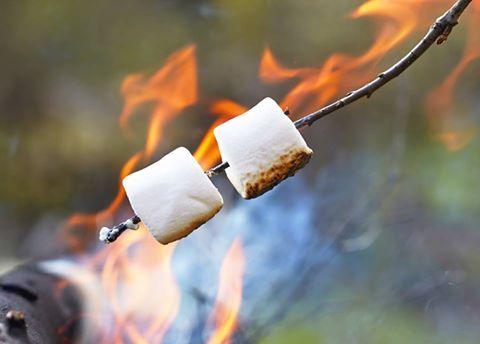
In the evening, the whole block came out. Designated parents set fire to the five foot stacks of leaves, one by one. The kids wiggled hot dogs and marshmallows onto twigs and held them over the flames. We ran back inside to our kitchen, stuffed our charred dogs into buns, plopped mustard on them and ran back to stand around the fire and eat with our neighbors.

I went to sleep late that night comforted by communal joy. Early the next morning I woke up with a hacking cough and sneezing fits. By the afternoon I could hardly breathe. My eyes were so watery I lost focus.

My mother, who had two other children and was pregnant, wasn’t a reliable nurse. Two aspirin and bedrest was her usual answer to any ailment. We rarely saw a doctor.

Once, while sitting on the back steps, she witnessed me fall off my bike and scrape my knee in the driveway. She gulped down a bottle of Budweiser and said, “Don’t expect me to feel sorry for you!”

The morning I woke up hacking and sneezing, she moved my limp nine-year-old body into a second-floor room of my own at the front of the house, closed the curtains and set up a humidifier. No one was allowed in, except her. And the doctor. The verdict? I had an allergic reaction to burning leaves that kicked off a bout of bronchitis.

During the next three weeks my mother brought me Campbell’s soup and apple juice on a tray. She took my temperature twice a day and rubbed Vicks Vapo Rub on my chest and back. She never complained about my unrelenting loud cough. I cried myself to sleep in her arms and called for her in the night. She always came. 

My parents had too much to hide to ever become friends with any of our neighbors, wherever we lived. But one day, from my sick room, I heard her ask a neighbor not to burn any more leaves because I was sick.

I’m still allergic to burning leaves. In fact, I’m allergic to leafing out in the spring and falling leaves in autumn. The sheltered memories of kicking up leaves and smelling them burn evokes both sadness and delight of a community that smelt and felt the rush of the season at the same time in the same way.

But my mother ministering to my sickness is more than a memory. That one brief period taught me all I needed to know about healing love.
Boiled in anger

Boiled in anger

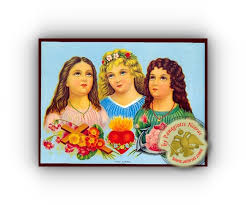
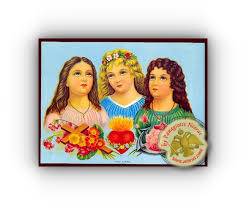
Saints Faith, Hope and Charity Catholic parish in Winnetka, Illinois, is named for three virgins martyred in second century Rome during the reign of Hadrian. The girls, ages twelve, ten and nine were boiled in tar and beheaded for their refusal to denounce Jesus.

My two sisters and I attended Saints Faith, Hope & Charity school in the late fifties at about the same ages as the boiled virgins. I entered the fifth grade after the school year started, having attended the Cathedral School in downtown Chicago for a few weeks while my parents finagled a new home in the northern suburbs. We’d just been run out of St. Louis for failure to pay our bills.

Outwardly I was accustomed to masking the shame and embarrassment of our alcoholic family life. I donned my most congenial personality for the girls at “Faith Hope”. I needn’t have. The girls greeted me like a new puppy. Everyone wanted to call me their friend and invite me to their homes after school. At Kathy White’s house, we all gathered in the basement and played very competitive dodgeball. But the girls themselves weren’t competitive. These girls all seemed like best friends.

The Faith Hope Dominican Sisters, were the kindest of any nuns I’d encountered at the ten or twelve Catholic schools I’d previously attended. Whenever one of the Faith Hope sisters discovered I’d forgotten my lunch, I was treated to a sandwich in the convent dining room. I overheard rumblings at home that the mother superior may have called my parents about the missing lunches but I never heard about it at school.

Faith Hope’s lively playground burst into jump rope, hopscotch, steal-the-bacon and ball games. In the winter girls and boys alike played king of the hill on huge snow piles. 

One day on the playground, Helen Smith gathered some girls to sneak off to the church. She wanted to show us a secret booklet her older brother told her about. We edged into the vestibule as she reached up to a high shelf and pulled down, “Secrets of Marriage”. Helen read aloud descriptions of a man’s penis planting a seed into a woman’s vagina to form a baby.

“Ewww!” we screeched.

“That’s disgusting.”

Some of us ran out, hid in the folds of a giant spruce and giggled ourselves into oblivion. Others stayed inside and learned more details.

Faith Hope’s pastor, Monsignor Thomas Burke, a charming powerhouse of a priest, didn’t evoke fear or condemnation like other priests I’d known. He connected. We weren’t related, but Monsignor Burke, who told me Regan means “queen” in Gaelic,  joked that all the Burkes in the Midwest were cousins.

During my seventh grade year, our evicted family moved away. I felt like one of those martyred sisters from the first century, boiled in anger. I was certain I’d never find as happy a time as I’d had at Faith Hope.

A Faith Hope friend I hadn’t seen in sixty years sent me a note after she’d read my book, In That Number. It simply said, “You belonged to us.”

And the saints came marching in.

Race Restrictions: The Chicago Covenants Project

Race Restrictions: The Chicago Covenants Project

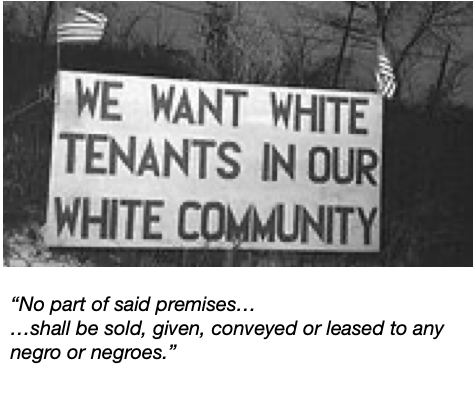
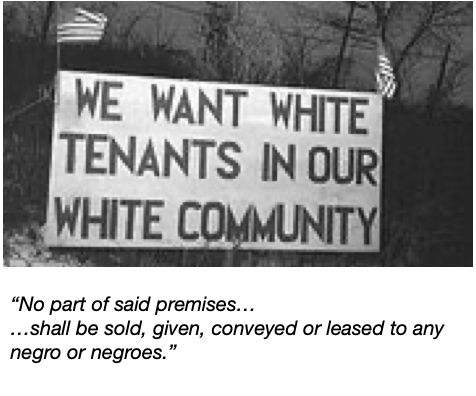
Restrictive covenants, redlining and contract buying were some of the discriminatory housing practices used to segregate Chicago in the first half of the Twentieth Century. Restrictive covenants prevented Black Americans, and sometimes Jewish Americans from buying, renting, or living in houses in white neighborhoods. 

The Chicago Covenants Project, begun in Spring 2021, uncovers deed restrictions officially recorded in Cook County. A team of their researchers and volunteers gather in the Tracts Division in the basement of city hall a few times a month to search land records for racial covenants. 

Finding the Tracts Division of the County Clerk’s Office is the first test of a volunteer’s sleuthing skills. The entrance to the first floor staircase is often obscured by a large easel with a sign listing the prices of birth certificates and marriage licenses—no arrow pointing to “Tracts”. I once worked in the Clerk’s office but I still feel subversive slipping past the sign and the security guard to head downstairs.

The Tracts Division is a football-field sized room organized by rows of old shelves filled with real estate index books. Each book is 2 feet by 4 feet. A Project researcher assigns the books by number. My first assignment was book number 420. I lifted it onto the top of the elbow-high bookshelf and leafed through page by page. Thank God I thought to swallow an allergy pill before I left home.

Every deed recorded in Cook County until 1980 is hand written in an index book. After 1980, the records are digitized. Each page could have deeds recorded from 1910 to 1980. I looked only at deeds recorded up to 1950 since restrictions waned after a 1948 Supreme Court decision declaring racial covenants unconstitutional.

The volunteers in Tracts spread out around the room with their assigned books. Looking for covenants line by line is tedious. There’s a small explosion of joy, “I found one!” when one of us spots a handwritten “rac-restr” notation.

Property ownership has long been the avenue to accumulating family wealth. Restrictive covenants helped deny this possibility to Black Chicago for decades, while walling off the city’s segregated communities and perpetuating generations of racial inequity.

The Chicago Covenants Project has uncovered deed restrictions all over Chicago and the suburbs. Organized neighborhood groups supported by realtor associations once signed up homeowners block by block. Between 1933 and 1937, a mailer was distributed door to door to stoke fears about Blacks moving to Chicago’s North Side, where I’ve always lived. It minced no words: “The Near North Side Property Owners Association proposes to ask every property owner in the district to agree to sell and rent to white people only.” 

Even the renowned Newberry Library has a racial covenant. 

You may be asking, “what’s your point?” 

Well. These buried files prove that racial inequity in Chicago was intentionally created by white people—house by house, block by block, neighborhood by neighborhood. 

A fact that cannot be erased.