An Inauspicious Birth

An Inauspicious Birth

Until late 1944, my father had been a Navy pilot headquartered in Key West where he patrolled the Florida Straits for German submarines. After the war, as a new law school graduate, he reported for duty to the military court at the Naval Academy in Annapolis, as ordered.

Two of my sisters and I were born in the Naval Academy Hospital. On the day I was born, my father was in the middle of a complicated trial. All my life I’d heard that my father asked for a pause in the trial to visit my mother and me in the hospital. My birth was announced in the newspaper as part of the daily coverage of the court proceedings. When I was old enough to ask, I heard from my mother and him that he defended Navy personnel for stealing food from the Officers’ Mess. It sounded admirable. I fabricated stories about men he defended—petty officers sending necessities home to their poor families— and bragged about him to my friends.

In my fifties I went to Annapolis to search the archives for the article announcing my birth. Before I started rolling through microfiche, I called my father and asked for some common names and dates to look for besides my birth date.

“I can’t remember,” he said. “Call me when you get home.”

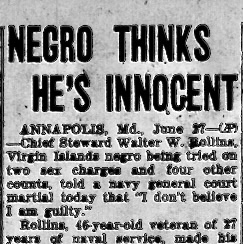
Newspaper articles from 1946 report details of my father’s part in the trial. In the Judge Advocate General’s Corps (JAG), he worked not as a defender of the disadvantaged but as a prosecutor.

The day my arrival interrupted the trial, June 13, 1946, my father was about to call an important witness to testify against former Chief Steward Walter W. Rollins. Rollins, “a Negro”, was accused of throwing an all-night party in his basement quarters of the Officers’ Mess with five white people. The day after my birth, the witness would testify they played penny-ante poker from 1:30 am until 9:30 am, but no money changed hands. The charges against Rollins included adultery with a white woman, a morals offense, gambling, embezzlement, misconduct and theft. He apparently took a jug of whiskey from the Officers’ Mess. Rollins was sentenced to two years in federal prison. After twenty-seven years of service to the Navy, he was demoted to First Mate and received a bad conduct discharge.

No wonder my father evaded his history at Annapolis. He had just been commissioned a Lieutenant Commander, had flown the prestigious Grumman Avenger torpedo bombers in the elite Air Corps. He’d been a scholarship student at Georgetown University and Law School. And yet, for years, he secretly funded all extracurriculars with money he earned at all-night high-stakes bridge games. He’d been arrested for drunken brawls and flown illegal rum and cigars home from Cuba. A much worse law-breaker than Rollins, my father tried to blot out his part in the Rollins’ trial.

He never served as a trial lawyer again.

And I never told him what I knew.

Seeing Jesus

In 1949 the Soviet Union started the Cold War by detonating its first atomic bomb, blockading Berlin, and pushing its way into Poland and Eastern Europe. The voices I heard swirling above my head at cocktail hour in our Washington home implied the Russians were coming for us. Everyone acted like this was the worst thing that could ever happen. 

Air raid drills were concocted by the federal government through the National Civil Defense Administration to protect people from incoming A-bombs. Common folk-wisdom said only cockroaches would survive a nuclear attack. Nevertheless teachers were required to conduct impromptu air raid drills. They shouted, Drop!—a signal for us to jump out of our seats, crawl under our desks, fall over our knees and cover our heads. The nuns added the instruction to recite Hail Marys aloud while on the floor. 

Holy Mary, Mother of God, pray for us sinners, now and at the hour of our death. Amen.

At seven, I didn’t understand the difference between a drill and the real event. I went to my death every time I huddled under that desk. I feared the A-Bomb was the worst thing that could ever happen. But, I was not. afraid. to die. 

This is it, I’d pray. This is the day I’m going to see Jesus.

I believed Mother Mary would grab me in her arms like she did baby Jesus and take me to heaven. Why did we practice to avoid such ecstasy? 

By the time third grade rolled around, I got used to not dying under the desk. Images of children who lived after their exposure to the atomic bombs in Hiroshima and Nagasaki appeared on our small black and white television. I saw that there were worse things than death. 

Our Catholic school teachers taught that Communists who ruled Mother Russia prohibited the celebration of  the Mass. The clergy declared this was the worst thing that could ever happen. We prayed for Catholic Russia.

At home, my two sisters and I made our own breakfasts and school lunches because my mother’s alcohol intake rendered her unconscious in the mornings. We often gathered around her bed trying to figure out if she was alive. Holy Mary, Mother of God. One of us would place a finger under her nostrils to feel her breath until, with one exhale, she’d confirm that the worst that could’ve happen, hadn’t—and we’d be off to knock on neighbors’ doors scrounging rides to school. 

Those early almost-worst-that-could-happen memories have inoculated me against the mau-mauing of present-day alarmists, naysayers and fear-mongers who sermonize about the death of our democracy. Yeah-but’ers and tsk-tsk’ers want us to heed their cynical creed that our country is hopelessly overrun with insurrectionists, sexual predators, corrupt politicians and gun-toting scofflaws.

And what if these are apocalyptic times? So what? So were the 1950’s. I’ve been here before. 

Mother Mary may be out of commission these days, but I still dream of seeing Jesus.

IRL (In Real Life)

IRL (In Real Life)

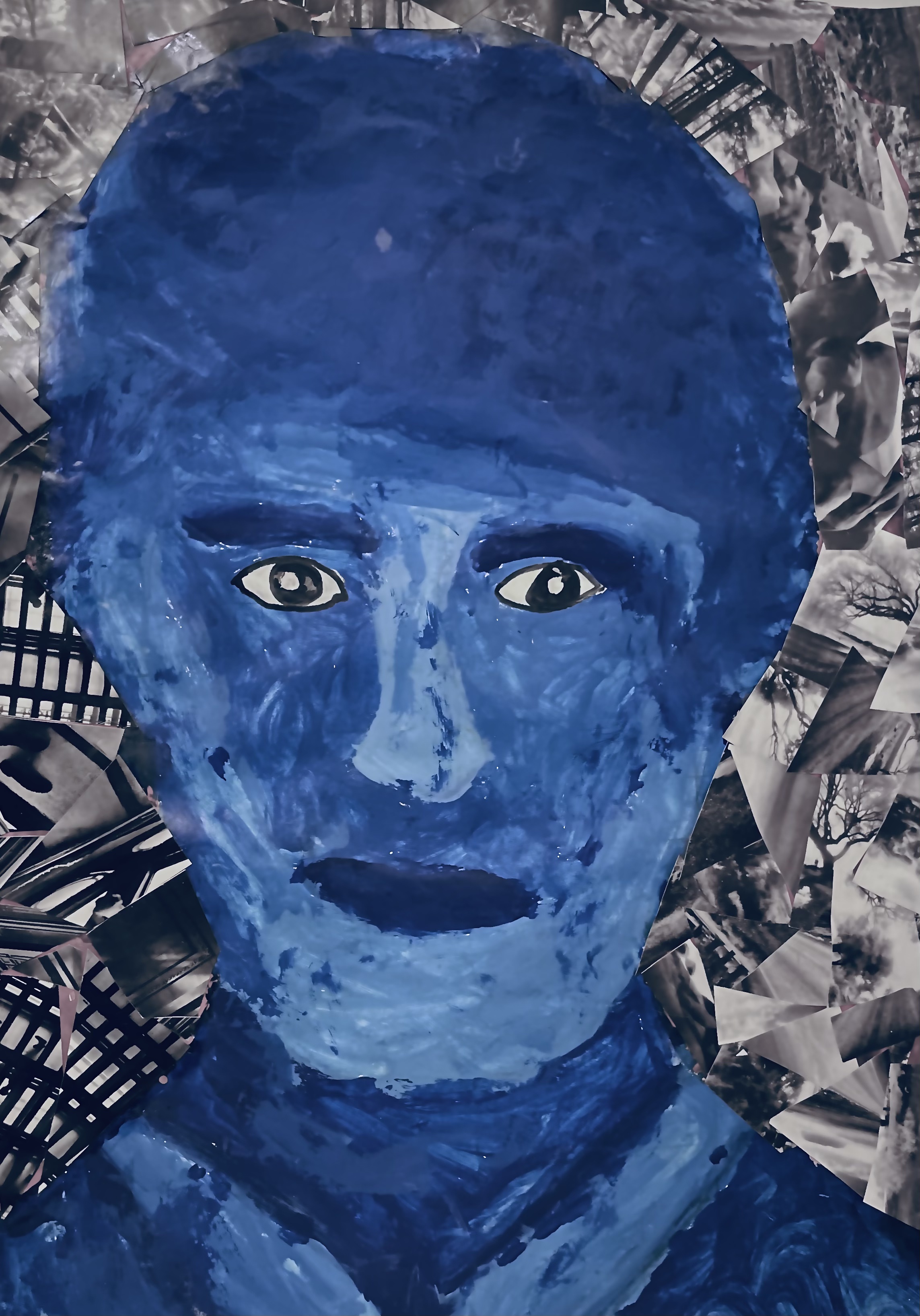
One of the first gifts I received from my grandson, CJ, was his framed eighth grade self-portrait. He filled the center of a twelve by sixteen inch paper canvas with his life-size face, neck and shoulders, probably as instructed by his teacher. The background is a collage of his own black & white photos, trees and fences, angled every which way. The drawing portrays what he looked like at thirteen years old. 

Except he painted himself cobalt blue. 

This painting hangs from a hook on the wall-to-wall bookcase in my living room. CJ is fair-skinned with reddish-blonde hair. I’ve never asked him why he painted himself cobalt blue. As far as I know, he wasn’t imitating Picasso’s blue period. No one knew about the blue people of Kentucky until the 2019 publication “The Book Woman of Troublesome Creek.” After hearing so many ads for Blue Man Group on TV, CJ expressed interest in seeing them live on stage. But it was an interest, not an obsession.


Cobalt blue, used for centuries by the Chinese for their blue and white pottery, is the epitome of coolness; dark, deep, and mysterious. It’s the color of the evening sky in winter, clear twilight boosted by the unseen sun from below the horizon. CJ’s not the only creative to fancy cobalt. J. M. W. Turner, Renoir, Claude Monet, and van Gogh all favored its compatibility with other colors. Remember Maxfield Parrish’s famous Daybreak? He used cobalt blue mixtures for the skyscape. 

Public opinion polls show blue as the favorite color of both men and women. And yet, a case of the blues refers to feelings of sadness. My parents used the term, the blues, to announce their alcoholic hangovers. 

Thanks to old African American traditions, the blues generally signify sadness without despair. Pastor Otis Moss III of Trinity United Church of Christ in Chicago preaches about a blue note faith, one that’s rooted in letting dark times exist side-by-side with hope. Moss teaches his congregation to let these dark moody blues move around them while they practice dancing in the dark. This practice keeps the blues from turning to hopelessness and death by despair.

For the past ten years CJ’s self-portrait has hung where I see it everyday. He’s melded into my unconscious seeing. He looks the same to me. But as I write this and inspect him further, I see the cobalt blue has faded to dark teal. Teal is a modern color, one not seen in art before the twentieth century. It has no meaning really, except a lot of European TV shows use teal interiors and costumes. It makes the actors look better. 

In real life, CJ’s hair has turned brown, but I still think of him as reddish blonde, just as his self-portrait will always be cobalt blue. We don’t see each other often in these isolating covid days. He’s in those perilous twenties where the blues start taking root.

I hope he’s dancing in the dark.

Saved By Eloise

Saved By Eloise

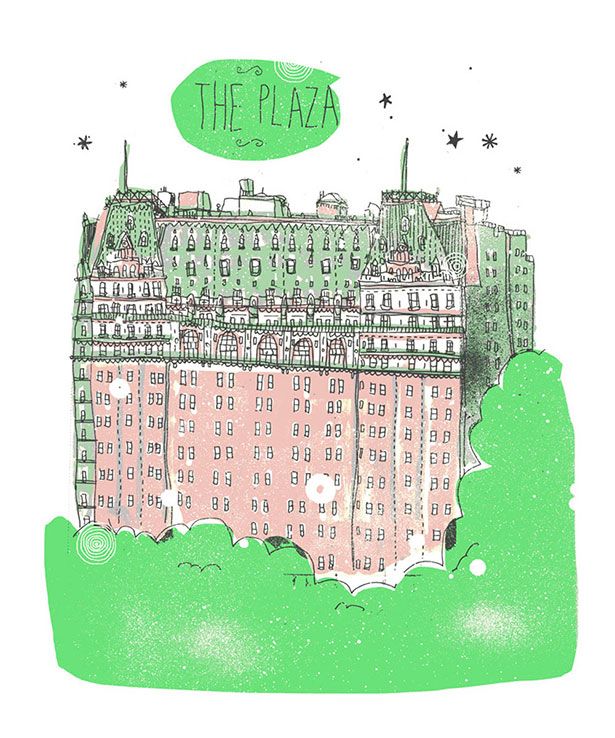
When friends announced their newborn’s name, Eloise, memories of New York’s Plaza Hotel stiffened my spine. I’d erased all memories of the palatial turn-of-the-century landmark after Donald Trump bought her in the late 1980’s. I even dumped my co-memories of Eloise, an early literary heroine who lived in the Plaza without her parents.

In the early 1950’s, my mother took my sisters and me to live for a while in her childhood home in North Jersey. One day, we took a train to Penn Station, then a cab ride to the Plaza at Fifth Avenue and Central Park South. We drank coca-colas, went to the powder room and backtracked home.

The book Eloise was published in 1955, a few years after that memorable first trip to the Plaza. The protagonist is a precocious six-year old, though the book was written for adults. After its publication, my mother gossiped about author Kay Thompson as if she were the next-door neighbor. On the phone with each of her sisters, she’d giggle at Eloise cartoon antics. They all grew up in the shadow of New York, mocking spoiled high society children similar to Thompson’s Eloise.

Kay Thompson lived at the Plaza and wrote the idiosyncrasies of other residents into Eloise stories. Plaza kibitzers tittered about a wealthy widow who had her hair done cheaper in the men’s barber shop rather than the women’s salon. Thompson had Eloise get her haircut in the barbershop too. Eloise picks ribbons from the garbage in the service elevator, mimicking a reclusive countess who was known to pilfer through hotel trash bins. 

Talk of the Plaza Hotel wafted through my childhood. I imagined myself living in the Plaza with my dog and turtle, like Eloise, getting into all sorts of fiendish exploits. My charlatan father often stayed there, or pretended he stayed there. I overheard him arranging to meet other business contacts in the Palm Court or the “coffee shop in the lobby,” as he satirically called it. When I was a teenager I lived with my father for a time in Manhattan. The Plaza was in the vicinity of my walk home and I’d often stop to use the powder room or meet friends in the coffee shop.

Once when I was around nineteen, I came out of an alcoholic blackout at 3:00 a.m. on the powder room floor in the Plaza. I had no purse, no money and was far from my New Jersey home. The bellman allowed me to use a phone in a small back office. I called Bernadette, a high school friend in the Bronx whom I hadn’t contacted in four years. She knew the bellman.

“Ask him for money and take a cab to my place.”

When I arrived, she made up a bed on her couch, gave me homemade chocolate chip cookies and milk. I tried to tell her what happened.

“No explanation necessary. It’s the home of Eloise after all. Anything can happen.”