LikeNotLikeMyFather

Every day I look more like my father with one major exception. He was obsessed with his looks, particularly his weight. 

His man at Gucci dressed him in snazzy Italian tweed, buckled loafers and the branded red, green and tan striped garters to hold his cashmere socks in place.

Every time he lost weight he’d preen before the store mirror as the tailor tucked a little in here, a little in there. He delighted in the Gucci salesmen fussing over him like clucking hens admiring their brood. When I accompanied him on these shopping trips, I wished for a fashion shield to surround my rainbow-colored, unstructured and untailored wardrobe. Funds from my part-time receptionist job required me to shop in Marshall Field’s “Last Chance” room.

An avid devotee of the Dr. Atkins’ low-carbohydrate diet, he packed his fifty-seventh-floor fridge with white protein—cottage cheese, plain yogurt, eggs, chicken, tuna salad—plus sugar-free Vernor’s ginger ale. He disdained calorie counting and instead tracked protein grams and carbohydrates.

His favorite topic of conversation was his diet. When I didn’t change the subject fast enough, my food intake brought on unwanted rhetorical questions. “What’s in that bowl?” He’d ask already knowing it was carb-forbidden spaghetti or ice cream.

The Atkins diet was all the rage in Alcoholics Anonymous. My father cornered newcomers and hammered a Dr. Atkins wedge into their soggy brains before jotting down his phone number and saying, “Call me anytime.” Whenever he saw someone at an AA meeting holding a donut, he’d explain that a no-sugar low-carb diet keeps the blood sugar regulated and, in turn, reduces the craving for alcohol. Beginners were known to eat all-protein tuna fish right out of the can, in accordance with his dictates. 

The grocery store on the second floor of his building had a deli counter with a superior version of my favorite food, cole slaw. I once purchased a pint. He caught me at his kitchen counter about to take a forkful.

“You’re not going to eat those carbs here, are you?” 

His kitchen counter was strewn with the maniacal makings of a high protein drink. Next to the bartender-grade electric mixer stood pricey containers from Sherwyn’s Health Foods: powdered desiccated liver, brewer’s yeast, magnesium, Vitamin C, flax seed, liquid amino acids, sunflower oil, and liquid lecithin, a brown goo that could lubricate a car. My kitchen had potato chips hidden in cabinets and Hershey bars squirreled away in the freezer. 

For a few years in the 1980s I spent weekends at the three-acre garden on the third floor of his building, Lake Point Tower. I’d spend time peering through binoculars spotting gulls, hawks and bufflehead ducks at the confluence of the Chicago River and Lake Michigan. My father, clad only in Gucci swimming trunks, would strike a favorite yoga pose—standing on his head—within sight of all the bathers and sun worshipers around the nearby pool. 

As much as he tried, he couldn’t escape hangdog jowls and double chins as he aged. 

Nor can I.
Reparation Ghosts

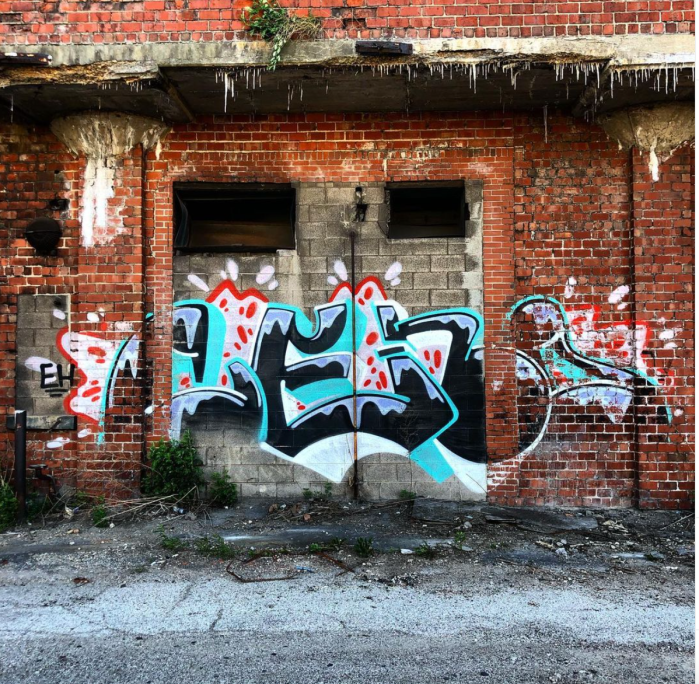
America’s greatest living poet, Kevin Coval, posted a photo on Instagram of spray-painted artwork on an abandoned building. His caption read: “there’s some ghosts in this house”.

Yes, indeed there are ghosts. And they’re whispering at my door.

For the past fifteen months I’ve shut the door on quite a few ghosts. I hear dead friends whisper “it’s ok to let me in now. to miss me. to mourn me”. There are the terrifying ghosts I’d boxed up and shoved into the southwest corner of my noggin. They’ve gotten loose. They’ve inched their way from the outer part of my field of vision to standing right in front of me. 

“Go out,” they command. “Talk to people. Meet friends. Make mistakes. Fail. Be brave.”

Then there are the ghosts of abandoned homes in Chicago. As the shutdown got rolling, anti-racist Zooms flew out of virtual networks and landed on my computer screen. I heard the voices and faces of Black families who were systematically denied family wealth in mid-century Chicago. Black and white activists explained contract-buying and redlining. Poets spoke of the mental wreckage caused by whites colonizing their neighborhoods.

I’m haunted by the stories in Beryl Satter’s 2009 book, “Family Properties: How the Struggle Over Race and Real Estate Transformed Chicago and Urban America.” Unscrupulous brokers sold homes by contract and convinced Blacks they were making monthly mortgage payments. But there weren’t mortgages. They didn’t own their homes, didn’t build equity, couldn’t sell, and couldn’t pass the deeds on to their offspring. The massive housing scheme drained as much as $500 million from the Black community.

In 2014, Ta-Nehisi Coates wrote about North Lawndale’s contract buyers in The Atlantic article The Case for Reparations.  He made the case. Denying Black families access to generational wealth through home ownership and other racist practices has caused the poverty, social ills and violence in the Black neighborhoods of the nation’s cities.

Coates had a solution. Reparations.  A word that makes a lot of people shiver came out of the Congressional closet where it had been languishing in a bill first introduced in 1989. About 12.5 million slaves were abducted from Africa. Reparations for their 35 million African-American descendants today would be approximately $1.5 to $2 trillion. 

White powerhouse hustlers say, ”The people to whom reparations are owed are long dead.” 

Oh those ghosts. They’re falling from the sky like rain and irrigating seeds of change. Evanston Illinois is the first place in the country to make housing reparations for Black families victimized by redlining, a practice that defined clear racial boundaries. The Evanston program is funded by (get this), marijuana sales. Illinois is expected to receive $1 billion in marijuana revenue in 2021. Uh. Oh. Someone may get the idea to use half of that for housing reparations for descendants of the swindled families in Chicago’s North Lawndale. 

That might satisfy the Chicago ghosts. Might not. I have a feeling it won’t satisfy the poets.